Monticello
American WomanMonticello is more than a stop on Jenny’s route away from the farmhouse: it is a practical refuge for supplies, a place where the fugitives move uneasily among ordinary residents, and the town attached to a crime that will remain unresolved in court. Its modest shops and quiet residential streets make a stark setting for the shift from hiding in the countryside to planning a robbery and, later, confronting the consequences of the group’s life on the run.
Setting and Approach
Driving west from the farmhouse, Jenny passes through forested hills and agricultural valleys before reaching Ferndale, a small settlement she does not dare stop in. Roughly twenty minutes beyond Ferndale, she comes to a junction with a four-lane state highway. Newspaper boxes at the curb mark a change from the rural route: she buys the Times and the Monticello Examiner and sets out to explore the town. The approach places Monticello at the edge of a larger but still unfamiliar landscape, a place Jenny reaches by following roads rather than by any clear sense of where she is going.
She sees Monticello as a largish small town, worn down and economically uneven. It has three grocery stores, and Jenny examines all of them before choosing the one whose parking lot contains rusting cars and no new ones. She reads the scene as a reason to shop there, then hurries through the store, buying canned soup, chili, spaghetti, beans, corn, tuna, and even bread in a can. The quantity and durability of the food make the errand legible as provisioning for an uncertain stay, rather than an ordinary household shop.
Shopping and Encounters
The grocery store brings Jenny into brief contact with people whose questions and gestures make concealment feel precarious. A cashier comments on the size of her purchase and calls across the store for help. Jenny reacts with sudden physical tension, but the call is only for a lanky boy to carry the groceries outside. He loads the cans into boxes and a cart, then pauses to adjust his hair with a comb. Crossing the parking lot, he asks Jenny whether she is from Vietnam. The encounter joins the practical business of shopping to the scrutiny of strangers: even an everyday question can feel consequential to someone trying not to attract notice.
The boy is later identified as Thomas, who works at a store in town. When Juan proposes a robbery, he takes care to distinguish Thomas from the intended target: Thomas is not to be involved, and the plan is directed instead at his boss. This connection gives the earlier grocery errand a second significance. The town’s small commercial world is not just a backdrop; its workers and routines become familiar enough to the fugitives to inform their plans, even as they insist that one young employee should remain untouched by them.
Main Street and the Residential Streets
On a later visit, Jenny uses a telephone booth at the end of Main Street to call Frazer. She tells him to come early, possibly that night, and ends the call quickly. When she looks back toward the car, sunlight reflecting from the windshield prevents her from seeing Juan. She is unsure whether he is waiting there, and tells Frazer that there is no time. His offer to buy milk and return within minutes does not change her urgency.
Juan soon comes back toward the car with a pleased expression. The few Main Street businesses still operating are nearing their evening closing time: there is a fishing-supply store, a Singer sewing-materials shop, a Maytag repair outlet, and a five-and-dime whose Fourth of July display is still in the window. Jenny realizes that she and the others have missed the holiday by seven or eight weeks. The detail makes time visible in the town’s neglected storefronts and in the fugitives’ own dislocated calendar. Juan wants to look around and persuades Jenny to walk with him, although she asks what he has bought and whether he has spent all their money; the purchase itself is not specified.
Away from Main Street, Monticello changes into a quieter residential place. Tree roots have cracked and lifted the sidewalks, and old houses stand at the backs of deep lawns, dignified but in disrepair. Children’s voices come from backyards. Farther from the commercial center, the houses become smaller and less maintained, while the yards grow lusher. The pair move slowly along one block and then another, briefly inhabiting streets that have no apparent connection to their pursuit. In another encounter, Juan turns toward Thomas in the back seat and speaks to him congenially, asking where he lives and what he plans to do. Thomas says he lives nearby, where Juan picked him up. The easy manner of the exchange sits beside Jenny’s concern that Juan might want to be recognized, exposing the tension between his social confidence and their need for caution.
From Local Knowledge to a Robbery Plan
Monticello’s commercial geography becomes operationally important when Juan explains the group’s plan to Jenny. After a council and vote, he says they intend to rob a bank on Main Street on Sunday. The target is the deposit made by the boss of Thomas’s store: the boss carries it alone to the bank’s drop safe, and Juan and Yvonne have checked him out. Juan describes him as a small man and expects him to hand over the money. He stresses that Thomas will not take part and will not be affected. Jenny immediately objects, but Juan asks her to hear the plan before rejecting it.
The proposal depends on the kind of local knowledge that the earlier scenes establish. The fugitives have learned which stores are open, where Main Street lies, and how one business’s daily routine leads to a bank deposit. Monticello is therefore both a place of temporary ordinary activity and a place they have begun to map for escape. The contrast is sharp: Jenny’s shopping is hurried and defensive, while Juan’s plan turns the town’s familiar routines into a target. The evidence establishes the proposed robbery, not its completion in Monticello; its later legal consequences should not be mistaken for proof that this particular plan succeeded.
The Murder and the Town’s Legal Afterlife
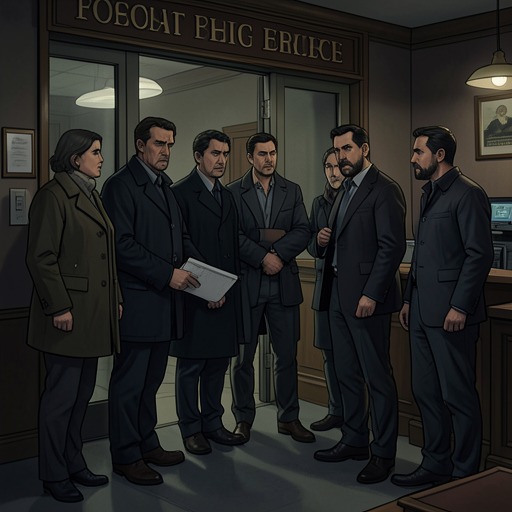
Monticello returns in the account of Jenny’s imprisonment as the location of a grocery-store owner’s murder. George Elson tells Jenny that Pauline has named her as an accessory to the murder of a grocery-store owner in Monticello, New York. He places the day’s newspaper on her cot, where it identifies Juan and Yvonne as well as the make of the gun. Elson cautions that charges may not follow soon, because the authorities have no evidence beyond Pauline’s statement and he considers her credibility insufficient. Monticello has thus shifted from the fugitives’ supply stop and intended robbery site to a place named in a public accusation, with the newspaper making the town’s violence part of Jenny’s immediate prison life.
Jenny struggles to believe that Pauline has betrayed her, even as reports attribute further information about their associates to Pauline. Juan and Yvonne deny being in upstate New York at the time of the murder and deny knowing Jenny. Jenny’s own theory—that Pauline was cornered and had no choice—has nothing to support it, and the letter she sends receives no reply. The town remains attached to an accusation whose personal meaning is clearer to Jenny than its legal resolution.
In the later accounting of the women’s sentences, no one is charged with Mr. Morton’s murder. Jenny and Pauline are tried and convicted only for acts committed before they met, leaving their time together unrecorded in the criminal proceedings. Monticello consequently marks a gap between lived events and legal narrative: the murder is named, its alleged participants are exposed in the newspaper, yet it produces no charge. The town’s significance rests in that unresolved separation between what happened during the fugitives’ shared life and what the courts ultimately chose to prosecute.