No one is ever out of character
American WomanNo one is ever out of character is Frazer’s compact statement of faith in human predictability. While searching for Jenny around Red Hook, he turns the idea into a practical method: her habits, he believes, can narrow the places she would choose to live. The maxim also exposes the confidence—and the possible blind spot—behind his attempt to read her through routine.
The Principle
Frazer’s formulation, No one is ever “out of character,” follows his broader belief in the inflexibility and knowability of people. In his view, conduct that looks startling under close examination is not a break with a person’s nature but a louder version of a habitual gesture. The saying therefore turns apparent contradiction into continuity: surprise may be dramatic, but it does not make a person unknowable.
The line is more than an abstract observation because Frazer immediately uses it to reason about Jenny. He believes she makes recurring compromises, and that familiarity with those compromises gives him a way to anticipate her choices. The maxim converts knowledge of a person into a kind of map—not an exact address, but a limited field of likely behavior.
Applied to Jenny’s Search
Frazer’s search begins in Red Hook, where he repeatedly drives the sparse roads, circling back past the farm store, church, diner, and post office. After checking Jenny’s post-office box from outside, he recognizes that he may be looking in the wrong place. She would not want to live too close to the post office, he reasons, but she would not want to travel too far to collect her mail either. Her likely choice is the compromise he thinks he knows her for making.
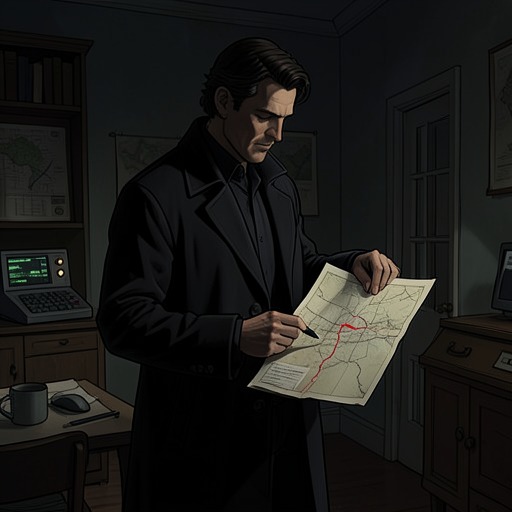
He applies the same reasoning to the Hudson River. Although one bridge lies west of Red Hook, he bets that Jenny would not cross it to get her mail: traffic would concentrate there, and the bridge offers no good exit. He marks Red Hook with an X on his map and draws a circle around it based on a half hour’s driving distance. The circle is partly an amusement, but it also gives visible form to his conviction that people stay within familiar realms of being.
Confidence and Limits
The search makes the maxim both a method and a measure of Frazer’s confidence in his own judgment. He can see that he has been concentrating too hard on the wrong thing, and considers stopping for the day and beginning again in the morning. Yet even as he corrects his approach, he continues to rely on the premise that Jenny’s familiar habits will constrain her choices. The saying steadies his search by making her behavior legible, while the map’s circle records how much of that legibility remains an estimate.
Frazer laughs at the idea that anyone can be out of character. In context, the laughter gives the maxim a light, self-assured finish, but the scene also shows what the principle asks him to assume: that knowledge of a person’s repeated gestures can account for the choices that matter. It is a useful working theory in his search for Jenny, not proof that he can know exactly where she is.