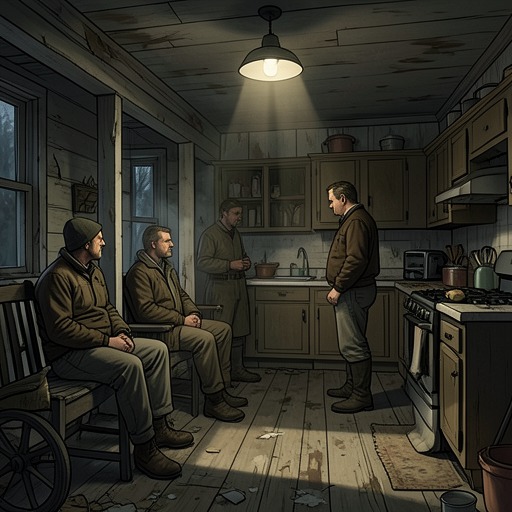
Pauline
American WomanPauline is the nineteen-year-old heiress whose kidnapping brings The cadre into national view and whose choices unsettle the distinction between victim and political actor. First presented to the public through demands and recorded statements made during her captivity, she later joins the group, takes part in its bank robbery, and flees with Jenny. Her story does not resolve into a simple account of conversion or coercion: she claims her commitment as her own, yet the conditions under which she acquired it remain part of the novel’s argument about power, gender, and class.
Identity and Public Image
Pauline comes from one of San Francisco’s most prominent families. Before her disappearance, her wealth and family history make her a familiar subject for newspapers and magazines, which circulate portraits of her as a privileged young woman. The public image survives her kidnapping: readers and viewers encounter a heiress whose appearance and status seem to stand for the very class order that The cadre says it opposes. But the story repeatedly sets that image against Pauline’s actual circumstances and later choices. Her family’s money does not make her experience of captivity unreal, nor does her participation in the group erase the advantages her background may continue to confer.
The kidnapping demand turns Pauline into a symbol before she can speak freely in public. Her recorded voice is used to call for a week’s supply of healthy food for every California resident below the poverty line or facing other forms of social marginalization. The distribution is to last at least a month, require no strings or bureaucratic screening, and take place in ordinary supermarkets rather than government record-keeping centers. The food is presented not as the ransom itself but as a preliminary gesture before negotiations. Pauline reads the demand aloud, with pauses as she turns pages; her voice is described as girlish but flat. In this first public role, she is at once the captive whose release is being negotiated and the apparent spokesperson for The cadre’s politics.
From Captive to Comrade
Pauline’s change from captive to member is gradual rather than instantaneous. Before she is admitted, The cadre slowly allows her more movement and knowledge: first access to the members’ faces, then privacy for ordinary bodily needs, freedom to move about, and eventually a place in meetings where she can offer advice. The ransom negotiations with her parents are faltering, and the group debates whether to trust her with full membership. At that point it has eleven members, including its leader, and likes the idea of becoming twelve, a number that could be divided into four units of three. Nine members vote yes; Juan and Yvonne vote no. Their opposition reflects both their distrust of Pauline and their close, often disruptive allegiance to one another within the group. They are overruled, and Pauline is admitted.
The decision is presented as a considerable risk for a group that has already found it difficult to trust her even with limited freedoms. Pauline’s later actions make clear that she does not regard membership as a merely imposed label. On April 3, 1974, she announces by tape that she has chosen to remain with her comrades rather than rejoin her family, and identifies the group as her new family. Two weeks later, she is visible on security footage during The cadre’s bank robbery, which brings in fifteen thousand dollars to fund The People’s Liberation. The bank belongs to a prominent business partner of her father. The attorney general then declares Pauline a criminal rather than a crime victim and issues a Wanted poster bearing her face. The shift is stark: the public voice introduced through a ransom recording now appears as a participant in the group’s action.
Her commitment is also tested by the deaths of comrades and the group’s collapse. At a memorial recording, Pauline speaks about individual members, recalling their habits, efforts, and relationships, including one comrade she describes as a brother she had never had. Hearing the tape later, she cannot continue listening and leaves the room in tears. The memorial exposes the personal attachments inside the political collective, but also the cost of turning private grief into a public statement. For Pauline, the group is not only an ideology or an adopted family name; it is made up of particular people whose loss remains painful even as the struggle continues.
Jenny, Trust, and Political Learning
Pauline’s relationship with Jenny becomes one of the novel’s central tests of what her declared commitment means. At one point Pauline insists that she could leave whenever she wished and that her commitment exceeds Jenny’s. The assertion answers the idea that she is simply a helpless prisoner, while also sharpening the tensions among the survivors. Juan warns her not to speak to Jenny that way; Yvonne complains that Pauline is treated as if she can do no wrong. Pauline’s confidence and the resentment it provokes coexist with the damage and dependence left by their shared circumstances.
Pauline later receives the task of persuading Jenny to stay with the group and recruit her. She tells Jenny that an earlier act meant to remove the temptation of returning to her former life had not shown that she could move forward or prove herself as a full member. Recruitment is her first independent assignment, and she knows the others expect her not to fail. Her appeal therefore joins political purpose to personal proof: she wants Jenny to remain, but she also wants to demonstrate that she can carry responsibility without assistance.
Their relationship changes as they travel together. Once Jenny’s money is gone, the two spend stolen bills sparingly as they move west, taking an indirect route and considering where it would be safest to settle. In Winnemucca, Pauline tells Jenny that she would not reveal Jenny if captured, while acknowledging that Jenny did not have to stay with her. Jenny promises not to betray her. Their exchange rests on an understanding of one another built through shared danger, rather than on a general agreement about politics. When they reach the blue expanse of San Pablo Bay, both recognize that their destination is home.
Afterward, Pauline helps create a women’s firearms study group with Jenny, Sandy, Joanne, and Lena. They begin not with shooting but with the parts of a gun, ballistics, weapon types, and their uses; together they take apart and clean a 12-gauge shotgun. The work gives them a shared pleasure in learning without pretending to know in advance. Their discussions identify a gendered habit of presenting themselves as more knowledgeable than they are, while men are often granted the presumption of already knowing. For Pauline, this political education is not simply a continuation of the cadre’s armed methods. She wants women to understand weapons without intending to use that knowledge to hurt or kill, and the group’s study becomes a way to question both male authority and women’s learned deference.
Pauline and Jenny also disagree over how gender shapes revolutionary action. Pauline argues that men, including men pursuing political change, may reproduce masculine forms of violence; she applies that critique to her own abduction and to William’s methods. Jenny resists treating those methods as inevitable consequences of being male, comparing that logic to the claim that women do housework by nature. Their argument grows from a shared recognition that women have often followed rather than led in political movements, and from Pauline’s written resolution that women must assume leadership. The dispute does not cancel their closeness; it shows them trying to make a new politics together without agreeing on every explanation of the past.
Arrest, Testimony, and Unequal Consequences
Jenny and Pauline are arrested separately. Pauline is taken to the Federal Building in downtown San Francisco, followed by news vans and reporters, while Jenny is driven alone through Oakland. Their separation is described through Jenny’s imagined possibilities for staying connected, but the immediate fact is that the public and legal process divides them. Pauline’s family members have visited her, yet her lawyer tells Jenny that those encounters have barely connected: the family brings tears and unspoken expectations, while Pauline responds with near silence.
The rupture deepens when George Elson informs Jenny that Pauline has named her as an accessory to the killing of a grocery-store owner in Monticello. Jenny rejects the accusation. The novel does not present the disclosure as uncomplicated access to Pauline’s motives: later, Jenny imagines Pauline naming a wider circle of associates, but understands that scenario through her own uncertainty and through the false roles the two women had adopted to survive. Jenny had claimed to be Pauline’s captor and cruel keeper; she can therefore imagine Pauline’s statements as an answer shaped by that fiction, while still experiencing the disclosure as betrayal. No one is ultimately charged with Mr. Morton’s murder, and the women are tried and sentenced only for acts committed before they met. Their shared time, which has become central to their lives, is consequently left out of the legal record.
Their punishments also reveal how differently class and race shape the aftermath. Pauline is convicted of bank robbery and serves less than two years before her sentence is commuted. Although the press presents her as receiving a severe penalty, she emerges with her former class privilege intact: her adventure can make her seem more interesting, and prison does not leave a lasting stigma. Jenny, by contrast, receives the minimum sentence for her participation in the selective service recruitment center bombings and is moved to work release after a year for good behavior. The apparent leniency makes her feel newly obliged to be grateful and accommodating. She understands the praise for her conduct as the treatment of a model minority, someone granted privileges as an example to others of her racial group. Their legal outcomes therefore do not simply measure their crimes: Pauline is treated as a victim even after conviction, while Jenny experiences conditional approval as another form of social discipline.
Significance
Pauline’s trajectory holds together several identities that the novel refuses to collapse into one another: heiress, captive, political convert, comrade, fugitive, intimate partner, and convicted bank robber. Her recorded declarations establish an account of chosen allegiance, while the circumstances of captivity and the group’s internal power relations prevent that account from becoming a simple proof that her choice was wholly free of pressure. Her political development continues beyond The cadre, especially in the women’s study group, where armed knowledge becomes a subject for collective inquiry rather than an uncomplicated call to violence.
Her eventual treatment also exposes the durability of class privilege. Pauline can be prosecuted and still be regarded as fundamentally a victim, as though hardship has added distinction without permanently changing her social standing. The difference between her outcome and Jenny’s makes their separation more than personal: their friendship crosses class lines, but the justice system and public opinion do not erase those lines. Pauline’s survival is real, but it does not mean that she and Jenny pay the same price, or that the story can assign a clean moral label to either woman.