Pauline’s imprisonment after being held captive
American WomanPauline’s imprisonment after being held captive is a shifting condition, not a single uninterrupted experience: she moves from confinement by the revolutionary group to commitment within it, and later to incarceration by the state. The novel makes each transition contested. Pauline describes a political awakening that gives meaning to her captivity, while Jenny and Juan challenge how that story is told; after Pauline’s arrest, lawyers, doctors, and public commentators recast her as a victim. Her eventual conviction, short time in prison, and commutation reveal that confinement’s consequences extend beyond a sentence—and fall differently on Pauline and Jenny.
Captivity and the account of conversion
Pauline’s account begins with an illness during her captivity. She says that a comrade cared for her and read aloud from Karl Marx’s Capital, Eldridge Cleaver’s Soul on Ice, and George Jackson’s Blood in My Eye. Previously familiar with the books but not persuaded of their importance, she describes hearing them while ill as the beginning of a new understanding of her life and of her future comrades’ beliefs. She wanted to see the reader, but says he answered that the words mattered more than his appearance. In this telling, confinement is also the setting for a political conversion: care and reading become the means through which Pauline interprets her past and chooses a new affiliation.
That explanation does not settle what her captivity was like. While Pauline reads her account aloud, Juan interrupts to correct its detail about a blindfold: he says there was no blindfold at the time being described and insists that it had already been removed. Later, he explains that Pauline was blindfolded at the beginning so she could not identify the captors, presenting the measure as standard and intended for her protection. His objections distinguish between what may have happened at different stages and what the group’s book should say about it.
The dispute is also over what details can establish. Juan tells Pauline that a fact may fail to support the point of a story when removed from context, and presses her to find another way to convey the importance of seeing her reader. Pauline says the moment mattered more because she had not been able to see him before finally doing so. The episode shows her trying to preserve the emotional and political meaning of her experience, while Juan treats its representation as a collective account subject to revision. Jenny overhears their argument and wakes abruptly at the crash when Juan kicks the recorder or typewriter from the coffee table. The interruption makes the struggle over narration part of the conditions surrounding Pauline’s confinement: others are not merely describing it but deciding which version will be recorded.
Agency, loyalty, and Jenny’s doubts
The revolutionary group had publicly represented Pauline as well treated: its communiques said she could exercise, read newspapers, and eat with the members, and claimed that punishment would never win her over. Juan confirms those arrangements but also explains the initial blindfold. Jenny’s question about the closet adds another unresolved point; the evidence does not give a definitive answer to it. The account therefore holds together claims of comparatively humane treatment and facts that complicate an uncomplicated picture of freedom.
Pauline rejects Jenny’s view of her as simply a helpless prisoner. She says she could get into the car and drive away whenever she wanted, and claims greater commitment than Jenny. Her words assert a present choice, but they do not erase the conditions under which her captivity began. Nor do they resolve Jenny’s uncertainty about whether Pauline had chosen to remain with the group. Jenny recalls having asked Frazer, before she had met the members, whether Pauline was staying with them voluntarily. Pauline refuses to explain the context and tells Jenny that she does not really know her. Their exchange leaves the question of consent unsettled at the level of personal understanding even as Pauline speaks forcefully for her own allegiance.
The closeness between the women does not prevent a widening rift. Pauline recalls that she had wanted to apologize when Jenny was ill with a fever, and says the group had been frightened for her. Jenny, however, sees Pauline as hard-eyed and silent when challenged. Elsewhere, the novel describes the two women’s later imprisonment and punishment as diverging sharply, despite their shared history. Pauline will be treated publicly as a victim of her captors and, in the end, of her lawyers; Jenny will experience her comparatively light sentence as a different kind of injury. Their relationship is thus caught between intimate knowledge and unequal social interpretations of what each woman endured.
Arrest, public narrative, and legal confinement
After Pauline is arrested, the public account of her condition becomes another arena in which her agency is disputed. Newspapers carry statements from her lawyers, doctors, brainwashing experts, and family spokespeople. They describe severe malnourishment, hallucinations resembling flashbacks from drugs, flat speech, and an initial failure to recognize family members. Her lawyers present her condition in seeking bail; the brainwashing experts argue that deprivation and violence had made her incapable of willing participation in criminal acts.
Those claims meet an image that resists a simple portrait of helplessness: at her first public appearance, Pauline is tanned and shouts Venceremos at television cameras. The judge nevertheless denies her bail. Two days later, her lawyers file another bail motion containing testimony from an unnamed person described as especially qualified to speak about Pauline’s life during the lost year. That witness supports the account of malnourishment, drugging, brainwashing, and unwilling captivity. The competing accounts do not disappear with Pauline’s arrest. Instead, the language of captivity follows her into court, where the central question becomes whether she acted freely before she was taken into legal custody.
Sentence, release, and unequal consequences
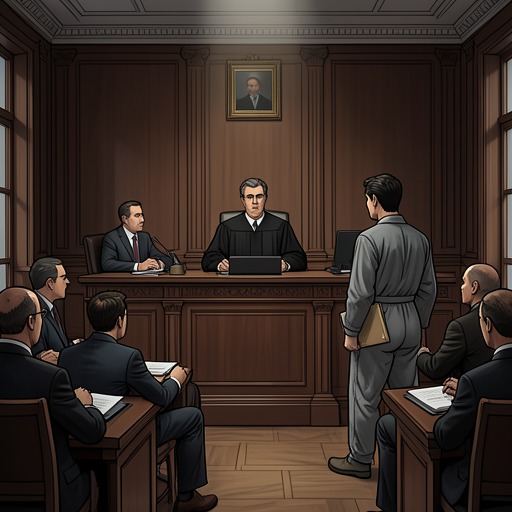
Pauline is convicted of bank robbery, but her prison term does not match the image of a lasting fall from privilege. She serves less than two years before her sentence is commuted, and the stigma of prison does not remain attached to her. Her experience is publicly cast as an ordeal that has made her more interesting, while her conviction can be interpreted as the result of her attorneys’ poor work rather than as proof of enduring criminal identity. The apparent severity of the case therefore coexists with her eventual restoration to social standing.
Jenny’s punishment provides the contrast that clarifies the novel’s account. Convicted for her participation in selective service recruitment center bombings, Jenny receives the minimum sentence and, after a year, transfer to a work-release program for good behavior. Yet she experiences the praise and privileges attached to her prison conduct as evidence that she is being treated as an exception to a disparaged category. Pauline can be punished and still emerge, in public perception, without being degraded; Jenny can receive leniency and feel newly shamed by the expectation that she be grateful. Their different outcomes show why legal charges and sentences alone cannot measure the cost of confinement.
The limits of the legal record deepen that imbalance. Pauline and Jenny are tried and sentenced only for acts they committed before meeting. Their time together is consequently left outside the official account, while no one is charged with Mr. Morton’s murder. Pauline’s confinement is therefore both literal and narrative: it is shaped by the group’s debate over how to tell her captivity, the state’s prosecution, and a public story that can turn her into a victim without erasing her class privilege. Her short imprisonment does not close those contradictions; her release helps restore the social identity that prison might have been expected to diminish.