Rhinebeck
American WomanRhinebeck is a Hudson Valley town that becomes a crucial waypoint in Rob Frazer’s search for Jenny. Its public library and coffee shop offer him places to wait, while the tour route to Wildmoor brings him to the house where he hopes to find her. Later, a motel room in Rhinebeck becomes the address Jenny receives in a note from Frazer. The town thus frames their uncertain movement toward one another: a place of maps and directions, but also of hesitation, concealment, and the possibility of renewed contact.
Setting and Social Geography
Rhinebeck first enters the search as a tentative lead. A woman suggests it hopefully, then clarifies that the wealthy residents lived on another side; Frazer asks whether Rhinebeck is where they lived, and she shakes her head. He nonetheless decides to ask someone there. The exchange makes Rhinebeck less a confirmed answer than a usable point of orientation in a region where wealth and privacy are mapped onto separate places.
That distinction shapes Frazer’s expectations. He is looking for a Japanese woman in a predominantly white corner of upstate New York, and imagines that Jenny must be hidden in one of the area’s fortified estates. He knows of other mansions, some private and guarded, and supposes she might be restoring a fireplace or refinishing furniture in one of them. Yet the house he has come to see, Wildmoor, is open to paying visitors. Rhinebeck’s setting brings together the fantasy of inaccessible wealth and the ordinary means by which a stranger can approach it: asking directions, visiting a library, and buying a place on a tour.
Frazer’s Search in Town
Frazer reaches Rhinebeck with the feeling that events have ceased to be random. The change in mood does not make him more eager to meet Jenny. Instead, he is surprised to discover that he may not want to see her, and more surprised that the prospect affects him at all. For years, he has treated her as marginal to his life; he recalls being offended by her refusal of his help, but says he rarely wondered where she was. His search therefore brings an unacknowledged attachment into view before it brings Jenny herself into reach.
In town, hunger interrupts his next step. He stops short of entering the public library, goes into a coffee shop, and takes a booth by the window. He eats while watching his wristwatch, impatient to continue but reluctant to arrive. The previous day’s errand had felt like a game, with waiting as a pleasant interval; now he believes the outcome is clear and stalls. After breakfast, he walks around town and then visits the library, listening to the local librarian’s eager explanations. Even so, he reaches the ten-thirty tour on time. Rhinebeck functions here as a sequence of places that lets him delay without abandoning the search.
Wildmoor and the Public Route to Jenny
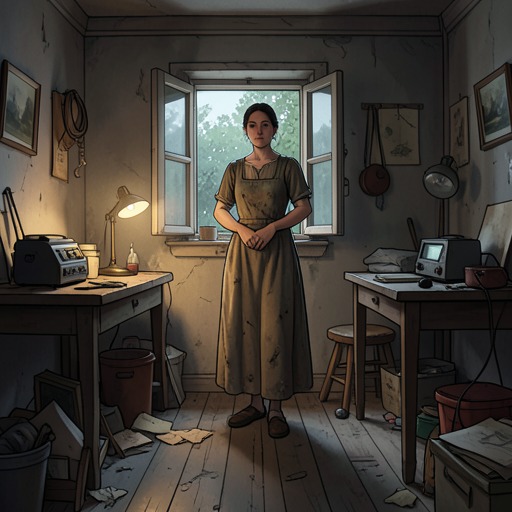
Frazer sits on a cheap folding chair on Wildmoor’s narrow sun porch, hands between his knees, feeling awkward and exposed. The house is neither grand nor huge: it has colored trim, shutters, shingles, and cast-iron ornament, but is eccentric, deteriorating, and slightly sunken in overgrown grass. Its name seems suited to its present condition, though Frazer guesses it was named in better days. He approaches with rubbery legs and clenched fists, attributing his discomfort to his injured tailbone and trying to conceal his damp palms.
The tour makes his hope seem both plausible and absurd. Any member of the public can pay to enter the house, which is hard to reconcile with his picture of Jenny as someone concealed behind the gates of a wealthy estate. He cannot imagine her here, but his anxiety worsens as he waits, preparing for the possibility that she will appear. He imagines that they would improvise a way to leave unobserved and talk in the house’s dim interior. The tour’s other visitors are an elderly retired couple from Kingston. When conversation obliges him to explain himself, Frazer says he is a carpenter, wondering if that answer will pass; his memories of house-painting work with Mike Sorsa have left him with impressive architectural terms whose meanings he cannot reliably recall.
Return, Routes, and a Message
When Frazer returns the next day, Wildmoor’s drive is blocked by a rusty chain, and a weathered wooden sign announces the tour schedule and asks visitors to come back. He is startled by the barrier and briefly imagines the familiar stories of wealthy eccentrics, hidden cameras, and elaborate precautions. Still, he approaches the sign. He does not recognize the handwriting so much as Jenny’s capacity to make it unrecognizable. The lettering recalls the work she did years earlier in Berkeley, painting Mike Sorsa’s truck and making a banner for an action Frazer planned. Remembering her decisive offer to do the sign, and how she ignored his mistaken assumption that she was flirting, connects the Rhinebeck search to an older relationship whose beginnings he had misread.
Rhinebeck also appears in the geography of their later movements. Leaving the town by a small road, Jenny leads Frazer across the river and through changing country roads. He wonders whether she is trying to lose him again; she keeps precisely to the speed limit, and on the climb through wooded terrain she slows at each turn and honks lightly before proceeding. Their route carries them away from town into open farmland, fields, and a forested canyon. Rhinebeck is not the end of the journey but a threshold to a more guarded landscape, where following Jenny’s lead requires Frazer to accept uncertainty rather than assume he knows where she is taking him.
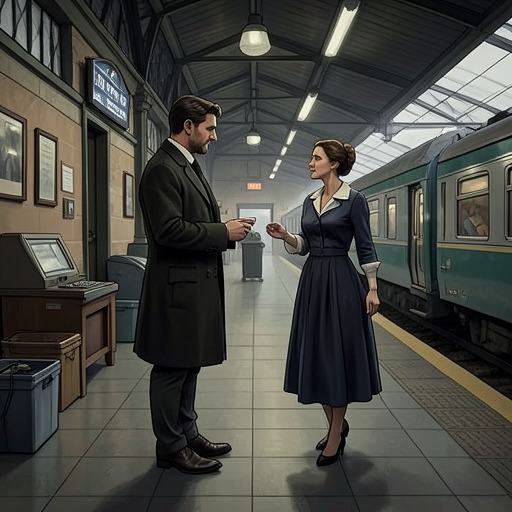
A later note makes the town an explicit meeting point. Before opening it, Jenny has to light a cigarette and smoke it to the end; her bitten nails make the envelope difficult to open, and she finally tears it with her teeth. Inside, Frazer has written the name of a Rhinebeck motel, room 10, and asked her to come, trust him, and hear him out. The terse instruction converts the town from a place where Frazer searches for Jenny into a place where she can choose whether to answer him. Across its library, coffee shop, tour route, and motel, Rhinebeck holds the distance between pursuit and consent: Frazer can find a way to approach, but the encounter still depends on Jenny’s decision.