Rob Frazer
American WomanRob Frazer moves between public argument and private pursuit: once a politically adrift Berkeley athlete, he becomes a briefly celebrated critic of professional sports, helps the revolutionary cadre find a place to lie low, and later helps investigators reach one of its hideouts without realizing the consequence. His return to Jenny, years after their flight and imprisonment, is intimate but not a simple resolution. Across the novel, his confidence in reading the moment coexists with misjudgments that carry other people into danger.
Identity and Political Formation
Rob Frazer arrives at Berkeley on a football scholarship, with the status of an athlete and the academic cushion of a guaranteed C-minus. He abandons football after his first year. Because Berkeley cannot formally expel him for refusing to play, he remains at the university, but struggles to find a place in student life. He moves toward women outside the campus’s conventional social world and gradually leftward in politics, fighting for a foothold before his views gain an audience.
Frazer understands his development as part of a cultural wave rather than as a force that created it. He imagines most people as living comfortably a decade behind their time, a few as suffering ahead of it, and a small number as riding the leading edge. He places himself in that last group, describing the fit between his own obsessions and wider changes as synchronicity. The distinction is self-flattering, but the narrative also shows why his ideas eventually attract attention: he argues that the exploitation of professional athletes resembles racial exploitation, and that the exceptional treatment of Black athletes helps expose the wider country’s fear and hostility toward Black people. Antiracist and anti-imperialist activists initially dismiss him as a joke or an irrelevance; his celebrity comes when a broader public begins to recognize the argument.
Searching for Jenny
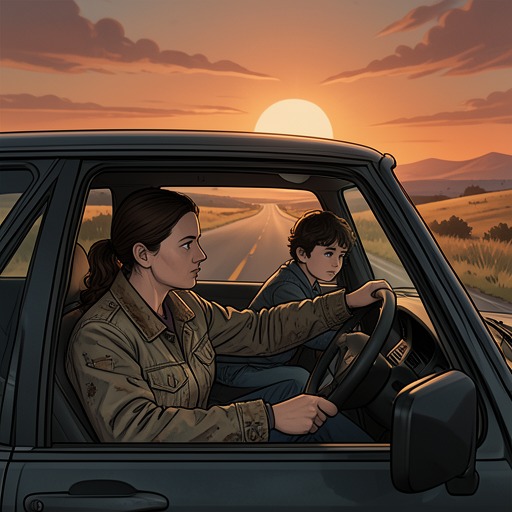
Frazer’s search for Jenny begins in Red Hook, where he repeatedly drives along the sparse roads, expecting the town’s center to lead somewhere more substantial. He checks the post office for her box and tries to infer where she might live, reasoning that she would neither want to be too close to the post office nor so far away that reaching it became difficult. He recognizes that he is concentrating on the wrong clues, yet keeps circling the same roads before considering a different route toward the Hudson River.
He also attends a tour at Wildmoor, hoping against his own skepticism that Jenny might be there. The deteriorating house seems an unlikely refuge: it is delicate, sunken into overgrown grass, and open to paying visitors rather than hidden behind the gates of one of the region’s grander estates. Anxious and physically uncomfortable from a coccyx injury, Frazer tries to pass as a carpenter when the other visitors ask what he does. He borrows the identity from work he once did on large house-painting jobs with Mike Sorsa, though the elaborate architectural vocabulary he learned there eludes him. The lie is small, but characteristic: in a search shaped by uncertainty, he tries on a usable role rather than disclose what has brought him there.
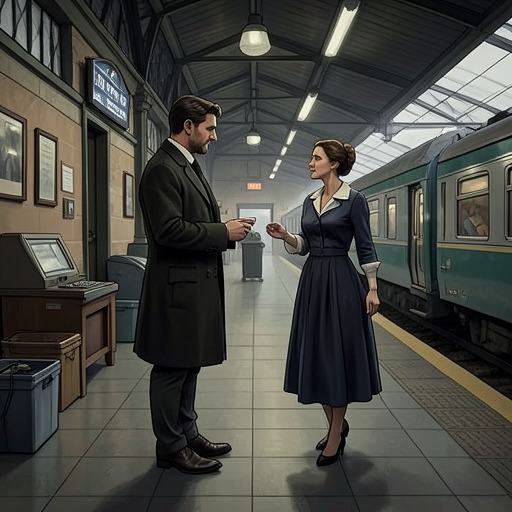
At Rhinecliff, Frazer watches a train arrive from a promenade above the station. Its approach has been anticipated so intensely that the actual moment seems almost too brief to contain everything he has imagined. Then Jenny steps off the train. The scene places the long suspense of pursuit against the plainness of a person arriving among other passengers; the reunion is not granted the expansive, perfectly composed moment Frazer has rehearsed in his mind.
The Cadre and the Cost of Connection
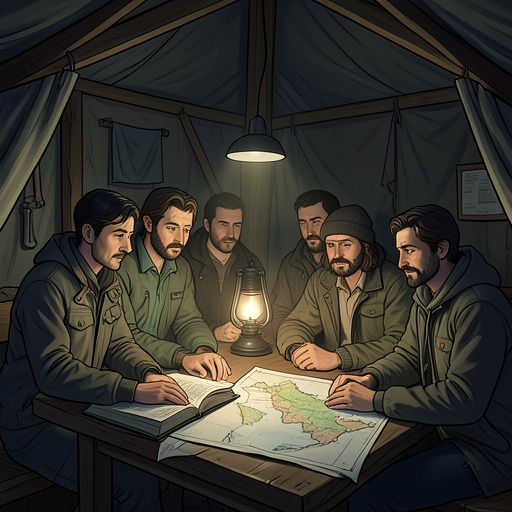
Frazer becomes involved with the cadre when Juan tells him they accept his offer, subject to conditions. They are not agreeing to move east permanently, Juan explains; they intend to lie low for a while, regroup, and obtain funds. Frazer’s offer therefore makes him a practical intermediary at a point when the group is seeking temporary security, rather than a member whose political commitment or history is established here.
Later, under the name Joe Smith, Frazer approaches Michael Levitz, a journalist working on a piece about Pauline. He says that the FBI has found a farmhouse where Pauline had been hiding and has linked her to Jenny Shimada. He claims to have gone to the farmhouse because a friend once lived there and he hoped to find that person; instead, FBI agents ambushed him and questioned him. The account is delivered with restless urgency, and his boast that the agents learned more from him than he learned from them sits uneasily beside a twitch in one eyelid. When Michael asks for something that could substantiate the story, Frazer warns him not to call the Feds, insists that Michael can trust him, writes SHIMADA in his notebook, and disappears into the crowd.
The danger in those connections becomes clearer after the arrests. Investigators trace Jenny through fingerprints on newsprint and her outstanding charges, then follow William’s prison visitors to Sandy and Tom. From those contacts the investigation branches: one path leads toward Jenny and Pauline, another toward Frazer. While Frazer, like Sandy and Tom, escapes being charged, he has inadvertently led his surveillers to the Daly City apartment where he helped Juan and Yvonne settle. His connection to them thus helps expose a place of refuge, and Juan and Yvonne are captured. The network that once allowed people to find one another becomes the net by which investigators find them.
Return to Jenny
After prison, Jenny works at a juice counter, where her minor celebrity creates a new kind of distance. Some customers appear to recognize her and quietly signal their sympathy, while she keeps to her ordinary smile, questions, and work. She notices their attention but does not acknowledge it; her conspicuousness lets her deflect strangers by behaving as if she has not understood their interest.
Frazer is the person she least expects to appear. He arrives while she is in the middle of an order, studies the juice list as if to make clear that juice is not his real reason for coming, and finally chooses carrot and ginger. Because the carrot takes time, Jenny is free to come down the counter. Frazer leans across it, pulls her toward him, and kisses her. He says, “This is your unlucky day,” then explains that “A little bird told me I’d find you here.” Jenny asks how the bird knew. His return draws together their earlier separation, her guarded new life, and his persistent appetite for improvisation. The scene offers contact again, but its joke about luck leaves the future open rather than promising that their past has been repaired.