San Francisco
American WomanSan Francisco is the setting for a crucial interval in Jenny and Pauline’s fugitive lives: after the spectacle of Pauline’s disappearance has receded, they make a home, cultivate a garden, and test whether happiness can coexist with their political past. The city offers no lasting refuge. Its domestic routines unfold beside persistent searches and the public stories that obscure Jenny, until an unexpected armed arrival breaks the quiet.
A Fugitive Home and a Changing Routine
In April, Jenny and Pauline and their companions plant lettuce, zucchini, tomatoes, and carrots in a corner of the neglected backyard of their building. The work of hacking at the earth accompanies a change in the group’s daily life: they spend less time on guns and more time with feminist books, and can meet outdoors in the mild weather. Their discussions include women’s relationships and the standing of women’s love alongside heterosexual relationships. The garden is thus both a practical shared project and part of a broader shift in what occupies the group’s time.
The household expands when Sandy leaves Tom Milner and moves in with them in May. Her distress shapes the apartment’s rhythms: she stays awake through the night and sleeps in the day, so the others tiptoe and whisper; she spreads her possessions around, then angrily heaps them back on her suitcase, and sometimes shuts herself in the bathroom to cry. During one evening together, she tells Jenny that Frazer had been in the city looking for her the previous week. Sandy had said she did not know Jenny’s whereabouts, but Frazer did not believe her. He also told Sandy not to tell Jenny he had come, reasoning that Jenny might leave town if she learned he was searching. San Francisco’s domestic life therefore remains connected to the pursuit outside it.
The City After the Public Spectacle
More than a year after Pauline’s kidnapping, Jenny and Pauline impulsively borrow Tom Milner’s car, with Jenny driving and Pauline navigating, and go to the house where Pauline grew up. Their visit takes place after the attention surrounding the case has ebbed. During its height, television vans had lined the street for months; the long curved driveway became a crowded parking area, and reporters had to coordinate their vehicles as they inched out and reassembled. Telephone booths were installed on the lawn to spare the family from opening the house and its phone to reporters. Klieg lights and a microphone stand became fixtures at the portico, while heavy foot traffic damaged the grass until the family asked visitors to use the walkway and had the lawn resodded.
When Jenny and Pauline see the property again, the lawn has been renewed, though its new growth still shows against the level surface. The hedges have become slightly shaggy, and the portico is swept clean but bare of the lights and podium. The contrast makes the former news encampment legible in its absence: the house still bears the imprint of the spectacle, but the machinery of coverage is gone. Jenny and Pauline had not imagined visiting it when they first returned to San Francisco. They knew FBI agents had occupied the lawn alongside the news crews and might have used rooms inside the house. Their speculation about the agents’ equipment underscores how surveillance, like the media presence, remains part of the place’s remembered history.
The Garden, Friendship, and Private Writing
By August, the garden has produced enough vegetables for Jenny and Pauline to give grocery bags to Tom Milner, Sandy, Mike Sorsa, Mr. Minski, Joanne, and Lena. The scale and speed of the harvest seem significant to them, though the life they are building is marked less by furtiveness than by calm. A tape recorder, donated by Joanne’s friend Julie, plays quietly in the front room; the group is considering inviting Julie to join. Flowers on the table and a cloth Jenny found at a thrift store become valued parts of their surroundings, rather than luxuries they must automatically reject.
The first zucchini also gives Jenny and Pauline the occasion to spend a day preparing a full meal for themselves. Their pleasure in the meal, and their uncertainty about whether such comforts are bourgeois or simply beautiful, enters a long letter Jenny is composing to William. She has increasingly directed her reflections and arguments to him rather than to her journal, but she is unsure whether she can see him again without losing her sense of herself. Pauline reads and edits the letters; the particular letter about happiness has been worked over by both women for so long that it has become a conversation between them, and it remains unmailed. Their shared reading and writing make the household a space where each can question the demands of the past without immediately resolving them.
Search, Arrest, and the Limits of Refuge
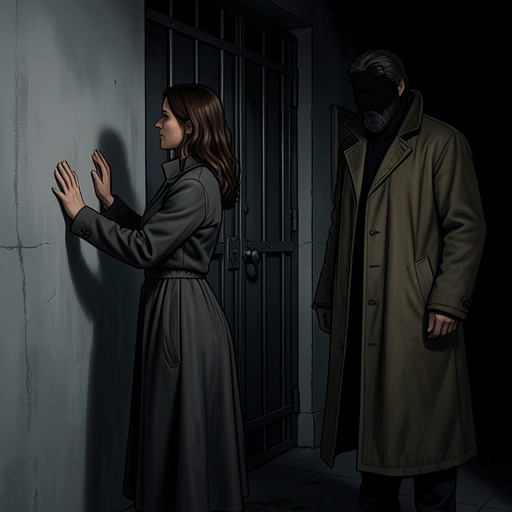
The calm is not the same as heightened vigilance. Jenny and Pauline are no longer listening constantly for signs of danger as they once did on the farm. In San Francisco, their softened attention permits ordinary domestic life, but also leaves them unaware of a man approaching the building. With the Dutch door open, they do not hear his quiet steps until he is there, holding a weapon and ordering them to raise their hands. Jenny’s body reacts with hope before her mind recognizes the situation. The arrest arrives not as the result of a consciously anticipated alarm but as a sudden rupture in the quiet they have made.
The city also appears through the effort to reconstruct Jenny’s part in events that the public has reduced to someone else’s story. Anne Casey spends five days driving in San Francisco and tracing the route Jenny and Pauline took. By then, television news has applied the phrase the lost year to the period of Pauline’s disappearance and the women’s life out of view. Earlier reports and sightings had been so numerous and contradictory that the FBI could not establish which leads mattered; Jenny’s name had surfaced among many claims, yet even once Anne learns that a report about her was true, Jenny remains largely outside the public account. San Francisco is therefore both a lived-in refuge and a point of return for an investigation that struggles to make Jenny visible.
The interval’s ending gives the city its central contrast. A garden, shared meals, a tape recorder, and letters offer evidence of attachment and a possible life beyond the fugitive routine; the old media spectacle and the new search show how readily that life can be overtaken by surveillance and public interpretation. The women’s home makes happiness imaginable, but it cannot make their whereabouts permanently private.