Smith & Wesson Short Barrel Revolver
American WomanThe Smith & Wesson snub-nosed revolver is the sole handgun available to the fugitives in the farmhouse episodes, but its significance exceeds its practical value. Delivered through Frazer, it makes the group’s imagined readiness for armed struggle materially present, unsettling Jenny and exposing the dangers of relying on one weapon. The revolver becomes at once a tool, a focus of authority, and a measure of the group’s precarious ability to survive.
Arrival and Physical Presence
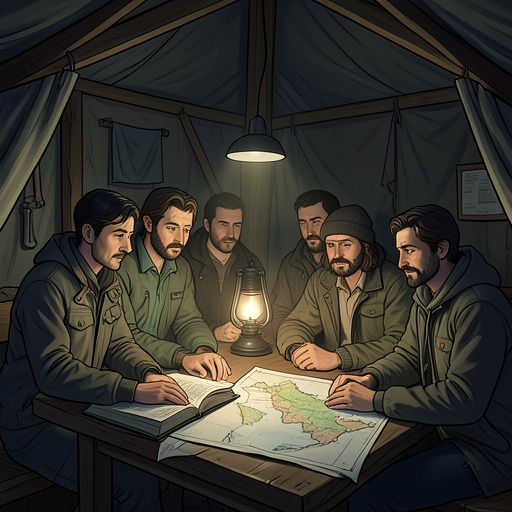
At the table, Juan identifies the weapon as a Smith & Wesson snub-nosed revolver fitted with a cop-style holster. He cleans it, wipes its exterior with a T-shirt, and lays it out for the group to inspect. The scene slows around an object that cannot be treated like the BB guns the fugitives already know: its presence makes the prospect of real armed action immediate rather than hypothetical. Juan wears the holster, and Jenny understands that the change is lasting. The weapon has entered the household, but so has the prospect of carrying it continuously.
That arrival coincides with a rainstorm. Jenny has been preoccupied with a letter and Frazer’s reaction to it; she has understood that guns might eventually appear, but their actual presence is different. While rain falls outside, she moves to the door, and Yvonne briefly leaves the room to run into the weather. Pauline joins Jenny at the doorway, though Jenny senses that the weapon affects the two of them differently. The scene places the gun among other immediate pressures—private correspondence, uneasy relations, and the group’s confined domestic life—rather than presenting it simply as new equipment.
One Weapon, Unequal Protection
Juan repeatedly returns to the problem of having only one handgun. In his account, that limitation could be overcome through speed, surprise, or even bluff: he describes bank robberies in which a person might imitate a gun with a hand concealed in a pocket, and proposes hijacking a plane as a route to Cuba. He also recounts a story about earlier activists who used a hijacking to leave the country. These examples turn the weapon into part of Juan’s argument about what a small, under-resourced group might still accomplish. They do not resolve the obvious risk: if the fugitives are cornered, the others would be unarmed.
The difference between the group’s weapons becomes explicit later, when Juan counts two BB rifles and one handgun as no real arsenal. That shortage leaves the fugitives with no choice but to prepare to run if the authorities arrive. They bundle food, clothing, and blankets into four equal packages and hide them in the woods, along with the group’s few written pages and a partly blank cassette. The firearm therefore belongs to a larger picture of inadequate defenses: it cannot substitute for an escape plan, and the group’s survival depends on provisions and concealment as well as the possibility of armed resistance.
Training and Exposure
The revolver also changes the group’s training. At dinner, Juan explains that using a handgun differs from shooting a shotgun. He expects Pauline to find the recoil difficult and to have less accuracy than she had achieved with a shotgun; when she reaches toward the weapon, he stops her, distinguishing controlled practice from shooting while moving. The gun’s practical demands thus make differences in experience and physical capacity visible within the group.
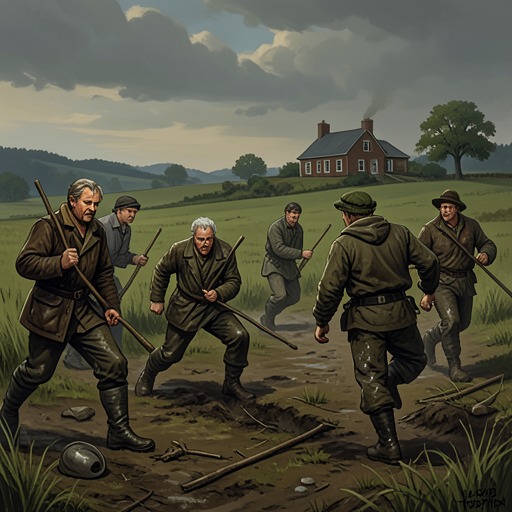
Yvonne’s turn shows that she can use it effectively enough to hit a can on her final shot, though several earlier shots strike the barn wall. Pauline’s attempt is more difficult: she is badly unsettled by the recoil, and a one-handed shot goes toward the ceiling. Jenny leaves the barn and later hears the gunfire from bed. The next morning, she discovers that Pauline is deaf and must be communicated with by written notes. The training episode consequently reveals a cost of the previous night’s shooting that Jenny had not known about; the revolver’s use has consequences beyond its target practice.
Threat, Authority, and Survival
The weapon’s most consequential appearance comes when Juan abruptly snatches it from the table and aims it at Pauline during an argument about the group’s plans. He then turns it toward Jenny. Pauline points out that it is not loaded, but the danger is not erased by that fact: Jenny still feels fear, and neither woman moves. Jenny answers Juan by playing the role of a cooperative passenger in his imagined hijacking scenario. Juan eventually lowers the revolver and throws it onto the table. What began as a demonstration of the weapon’s possibilities has become an act of intimidation, and the gun briefly makes the group’s internal solidarity feel uncertain.
Afterward, Juan continues drawing it from the holster as he moves through doorways, while the group does no combat training for the remainder of the day. The weapon’s repeated handling does not amount to settled competence or security. When an actual crisis prompts preparations to flee, Juan directs the group toward the buried supplies and acknowledges that their firearms are insufficient to defend them. The revolver remains part of their equipment, but the decisive plan is to escape and disappear into the woods.
Its narrative role rests in that contrast. The gun promises action and concentrated power, yet there is only one, its use exposes unequal confidence, and Juan’s handling of it can turn comrades into targets. Set beside the BB rifles, the revolver makes the difference between simulated and consequential force unmistakable. It gives the fugitives a limited capacity to act, but its arrival also clarifies that possessing a weapon is not the same as being safe.