The fugitive's creed of luck
American WomanThe fugitive’s creed of luck is the belief that escape from unjust law depends on chance, even when the fugitive’s politics insist that chance has no moral meaning. During Jenny and Pauline’s flight, luck is both a practical condition of survival and an almost religious explanation for survival: they know they have taken risks, fear being caught, and nevertheless interpret each failure of their pursuers to recognize them as a kind of anointment. The creed gives shape to their journey, but it also exposes the strain between their political ideals, their guilt, and their wish to be spared.
Chance on the Road
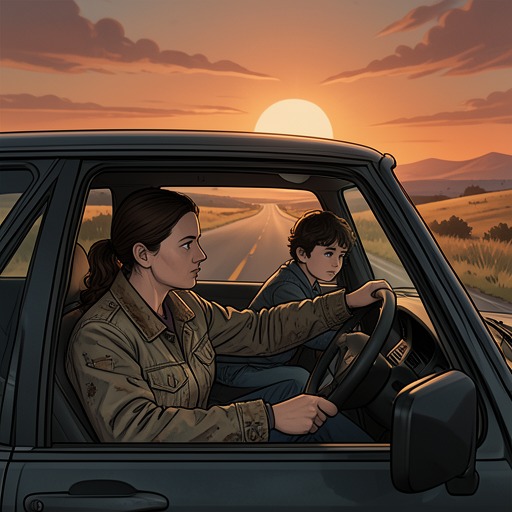
The flight makes luck visible through its uneven geography. After making a spectacle of themselves before Missouri state troopers, Jenny and Pauline drive east because they had been heading west, imagining the moment when the troopers might realize who they are and issue an all-points bulletin. Their minds also turn to Dolly: perhaps she has recognized Pauline, perhaps a later encounter with a television report will prompt her to call, and perhaps a reward will follow. These are possibilities the fugitives construct, not confirmed events. The danger exists in anticipation, in the imagined chain of recognition that might turn an ordinary witness into their pursuer.
Their route becomes a physical expression of uncertainty. They drive west, then east, then north after realizing they have gone too far east, before gradually circling back west. The movement is neither a deliberate, efficient escape route nor a straight advance toward safety. It records shifting impulses about where they might be safe and where they might be exposed. The fugitives cannot control what others notice, when suspicion will arise, or which direction will feel survivable; they can only keep moving through that uncertainty.
Even the car turns the journey into a negotiation with chance. Dolly’s car overheats, but Jenny knows how to handle it: it has to cool down, and they will be fine. The delay leaves them parked while Pauline smokes and the engine ticks. Elsewhere, their passage through the Great Plains brings the unexpected sight of sandhill cranes and white pelicans far from the ocean. The birds do not protect them or explain their escape. Their unexpected presence simply becomes a moment of happiness and wonder within a journey governed by fear and contingency.
Danger, Guilt, and the Wish for a Verdict
In retrospect, Jenny considers whether the two women may have courted the fatal encounter. They drive at night, go into bars, change disguises but keep the same car, and take what she sees as foolish risks after trying to be prudent. Their conduct contains a contradiction: they fear capture completely, yet also long to be caught through no fault of their own. Jenny suggests that they may want a verdict because they are failing to confront their crime fully. The desire is not a simple wish to surrender; it is a wish for judgment to arrive without their having to choose it.
Their explanations for guilt and responsibility gather in layers. They wonder whether they are victims of Juan and Yvonne, whether Juan too is a victim of circumstance, and whether all four have in turn been victims of Frazer. They widen the account further, locating their predicament in unjust government and, beyond that, in capitalism and a legacy of imperial violence. These arguments register the political context they believe has compromised their lives, but Jenny also recognizes the self-regard within them. Their bids for innocence remain entangled with fear and remorse, and with the temptation to describe themselves as victims rather than face their own responsibility.
At the center of that conflict is Mr. Morton’s death. Jenny recognizes that she and Pauline have not yet borne its reality fully; their knowledge of him has served, for a time, their own punishment and hope of redemption. The death remains abstract even as their flight gathers around it. In this state, the prospect of being caught and the hope of being spared can coexist: one promises a verdict, while the other promises escape from a judgment they cannot yet accept.
Luck as an Unstable Faith
Jenny sees that luck sits uneasily beside the fugitives’ stated political commitments. She regards sheer luck as having no place in a reasoned and just worldview, no fit with the principle that all people are created equal, and no place in a liberation movement or a radical’s ethical code. Their politics seek explanations in structures of power and injustice, not in arbitrary fortune. But going underground also depends on imagining that escape from unjust law can continue indefinitely. Reinvention becomes possible in that imagined hidden world, and the fugitive who believes she can remain beyond the law is, Jenny observes, also likely to believe in luck.
The creed is therefore not an argument that fortune is fair. It is a practice of living with exposure to events the fugitives cannot master. They are outlaws as well as soldiers, and the book presents luck as part of the condition of outlaw survival, not as a political principle. Jenny’s comparison between radicalism and Catholicism sharpens the tension: both can offer an all-explaining vision, strict forms of conduct, an absolute enemy, and a hierarchy of sins. In the radical faith she describes, surrender is among the worst sins. The moral framework that gives the fugitives purpose thus makes the choice to submit nearly unthinkable, even as their longing for a verdict reveals their need for judgment.
Survival Interpreted as Providence
The fugitives hope both to be spared as a sign from the gods and to make it through by luck. Jenny resists treating mere survival as meaningful, yet the events of the flight press toward that interpretation. One enemy after another looks at them without recognizing them. In retrospect, this sequence seems to confer an almost supernatural favor: they arrive on the other side not only unscathed but, in Jenny’s account, anointed. That language describes their feeling of enchantment; it does not establish that their escape was objectively guided by providence.
The journey’s remembered form reinforces the uncertainty. It may have lasted almost two weeks, but Jenny cannot recall its duration or reduce it to an efficient route and a comfortable number of driving hours. The trip does not unscroll smoothly in memory. Specific moments remain—the car trouble, the birds, the wind, Pauline beside her—while other stretches resist narrative order. Luck names the gap between what the fugitives intend and what happens, but it cannot make that gap orderly. Their survival offers no clean vindication: it carries relief and wonder alongside guilt, fear, and the unresolved wish for a verdict.