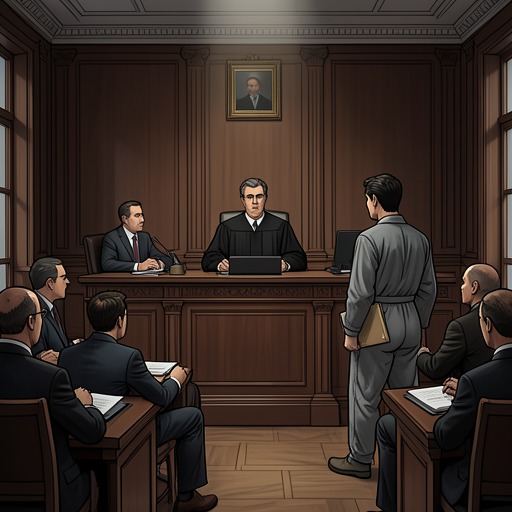
The killing of Monticello grocer Mr. Morton
American WomanThe killing of Monticello grocer Mr. Morton forces Jenny to confront the distance between political intentions and the people caught in their consequences. When Pauline names her as an accessory, Jenny’s reflections turn from the accusation to Mr. Morton himself: a shopkeeper whose death makes the possibility of innocent harm newly concrete, and whose case unsettles Jenny’s belief that righteous motives can make violence morally safe.
Disclosure and Accusation
The news reaches Jenny while she is preparing a letter to Pauline. After an evaluation has been ordered, Jenny writes to reassure Pauline that speaking openly to the evaluators does not mean she is crazy, signs the letter, and begins folding the pages into an envelope. George Elson interrupts to tell her that Pauline has named her as an accessory to the murder of a grocery-store owner in Monticello, New York. Jenny initially cannot accept what she has heard.
Elson lays a newspaper beside the unsealed letter. Its report names Jenny, Juan, and Yvonne, and identifies the make of the gun. The accusation turns a private exchange between Jenny and Pauline into evidence in a murder case; the letter, still unfinished in its envelope, sits beside the public account of Jenny’s alleged involvement.
Mr. Morton in Jenny’s Recollection
Jenny’s thoughts restore Mr. Morton from the abstraction he had been in her political understanding. She pictures him leaving his store on a bright summer day and calling to a favorite employee. His prescription glasses are years out of date, and he has to push them up and squint to see clearly. When a young blond woman calls his name, takes his arm, and holds out a gun, he is slow to understand what she is offering.
The details make the danger legible through the limits of Mr. Morton’s ordinary world: the shop, the employee he knows, and glasses that no longer give him a precise view. Jenny had once treated people such as Mr. Morton as abstractions, much as she had treated the Vietnamese people to whom she felt pledged. Now she can imagine him with painful clarity, and the case no longer fits neatly inside the categories of political purpose and impure motive.
Luck, Responsibility, and Political Violence
The killing alters how Jenny interprets her own history with William. She and William had taken pride in planning their bombings carefully, and Jenny had believed that their high intentions distinguished their violence from violence she condemned. But the targeted buildings had remained as empty as she intended them to be partly through luck: no returning employee happened to come back for a forgotten coat. Jenny can no longer treat the absence of deaths as proof that righteousness had protected anyone.
That recognition changes how she understands Mr. Morton’s death. She had wanted to attribute it to Juan’s impure motives; instead, she considers that it may have been bad luck, just as her own avoidance of killing had been good luck. The distinction does not excuse the killing or absolve its participants. It exposes the weakness of using intention as a guarantee of outcome, and leaves Jenny facing the harm violence can produce even when its agents claim to be acting for a just cause.