The revolutionary group’s fugitive status
American WomanThe revolutionary group’s fugitive status is both a practical condition of concealment and a contested political identity. After a bank robbery and a siege in Los Angeles, three members escape while the public believes the group has been destroyed. Their survival depends on improvised movement and assistance from acquaintances, but their flight is never simply a matter of finding shelter: money, weapons, publicity, and arguments over the meaning of their actions all shape what they can do next. The novel follows the gap between the fugitives’ continuing existence and the public story that has already pronounced them gone.
From public spectacle to hidden survival
The group’s precarious position follows a rapid sequence of events. Over four months, its members kidnap Pauline, the daughter of a prominent San Francisco family, convert her to their cause, and rob a bank. Their stated political program includes a demand for food distribution to people in poverty and socially marginal circumstances. The demand is presented as a goodwill gesture preceding ransom talks, but the proposal is criticized in the left-leaning press as impractical and paternalistic. The family’s public response emphasizes the difficulty and cost of determining who qualifies, and the competing accounts turn the kidnapping into a public argument over whether the group is acting in solidarity or staging an ineffective spectacle.
Two weeks after the food demand, the group robs a bank for fifteen thousand dollars. Pauline is visible in the security recording, and the money is intended to fund The People’s Liberation. The bank’s connection to Pauline’s father makes the robbery personal as well as political. The attorney general then declares Pauline a criminal rather than a crime victim and issues a Wanted poster bearing her face. The government’s designation contradicts the family’s insistence on her victimhood, while some supporters’ public expressions of affection for her draw criticism from the left-leaning press. From this point, the fugitives’ status is shaped not only by the state’s pursuit but by incompatible public labels.
In mid-May, authorities trace the cadre to a house in a Black neighborhood in Los Angeles. FBI agents, local police, and SWAT teams surround the building; calls for surrender are answered with gunfire, and a fire consumes the house. The radio report Jenny hears conveys a prolonged confrontation, but she does not know that three fugitives have survived. The public is left with the impression that all twelve members have died. The discrepancy between the apparent end broadcast to listeners and the survivors’ escape gives their fugitive status an almost paradoxical beginning: they are pursued as if alive by the authorities, yet mourned as dead by the public.
Flight, shelter, and dependence
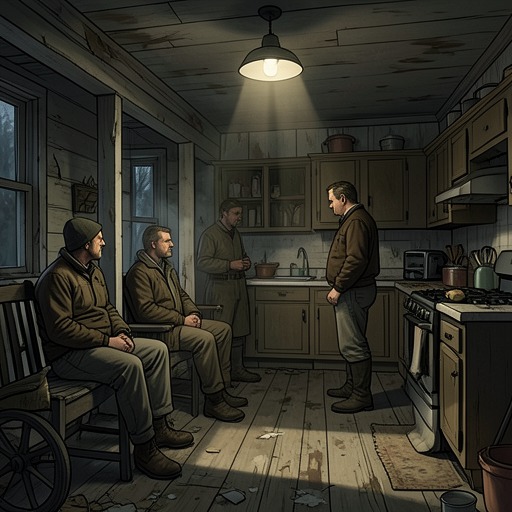
The three survivors—Juan, Yvonne, and Pauline—reach an apartment after escaping north from Los Angeles. They are armed, and the cramped, heavily obscured room where they stay signals how far their circumstances have shifted from ordinary life. When Frazer arrives to help, he proposes moving them east, financing a book that could tell their side of the story and provide money for their future. The proposal meets resistance. The fugitives do not welcome the idea of leaving California, where their comrades died, and they do not immediately accept Frazer’s plan or his account of what will help them. His offer of personal financial support eventually makes his allegiance credible to Yvonne, but trust remains something negotiated rather than assumed.
The arrangements that follow convert a loose circle of acquaintances into a temporary support system. The fugitives are moved by car one at a time, first Pauline, then Yvonne, then Juan. Carol rents a Rented farmhouse about an hour from Manhattan, and Frazer asks Tom Milner to arrange storage for the weapons among Frazer’s old friends. The guns are thereby separated from their owners, and the network of people who shelter or assist them becomes a dispersed set of possible resources—and possible vulnerabilities. Frazer knows that Sandy and Dana have helped at different moments, but he is unsure how loyal his old circle remains or how its members relate to one another. Their support makes continued flight possible without making the fugitives secure.
The fugitives’ need for help also generates conflict over control. Frazer expects his book proposal to be taken up, but the group’s attention shifts instead toward its commemorative recording. Later, he brings two long guns out from his car and proposes a trade, using their return as leverage to press the group to work on the book they had discussed. The episode makes tangible the unequal positions within their alliance: Frazer supplies money, transport, shelter, and access to weapons, while the fugitives retain their own aims and can resist the story he wants them to tell. They need his resources, but dependence does not erase their ability to contest his terms.
Maintaining a political presence
Hiding does not mean withdrawing from public life. After the Los Angeles confrontation, Yvonne’s account of the police operation reaches the fugitives over the radio. She presents detailed particulars—times, weapons, casualties among bystanders, and public expense—before Juan turns those details into a wider political indictment. His broadcast speech explains how three people could have survived and describes their life outside ordinary shelter, then presents their survival as proof that the authorities’ presumed victory was incomplete. The radio offers them a way to re-enter public debate while they remain physically concealed. It also lets them shape the meaning of the confrontation, though that message is filtered through their own rhetoric and reaches listeners without resolving the facts of what happened.
The earlier food demand and the later broadcast show the group repeatedly trying to frame its conduct as part of a wider struggle. The demand casts food distribution as an obligation to people excluded from adequate resources; its critics see a grandiose gesture detached from practical need. Juan’s broadcast turns the siege and escape into evidence of state violence and solidarity with the poor; listeners have already heard a report that appeared to confirm the group’s destruction. The fugitives are thus engaged in two contests at once: evading capture and trying to prevent the public account of their actions from being settled entirely by their opponents.
As the group’s resources dwindle, its reliance on personal connections becomes more explicit. Jenny and Pauline cannot depend indefinitely on Tom and Sandy, and their grocery money is gone. Jenny asks Tom to contact Mike Sorsa, then travels by bus to Golden Gate Park to meet him. Mike recognizes her despite her disguise and gives her five hundred dollars. This assistance extends the fugitives’ material survival while exposing how much it rests on individual loyalty. A hidden life requires more than secrecy: it requires repeated access to cash, transportation, food, and trustworthy intermediaries.
Capture, representation, and unequal aftermath
The account of flight also shows the psychological and moral pressure of remaining hidden. Jenny and Pauline later reflect that they may have taken risks despite their fear of capture, driving at night and entering public places while continuing to use the same car. They struggle to distinguish guilt from victimhood and consider whether responsibility can be displaced onto Juan, Yvonne, Frazer, or the political conditions they oppose. These thoughts do not cancel their own actions; rather, they reveal how the fugitives’ self-understanding is repeatedly pulled between personal culpability and a larger account of political violence.
When Pauline is eventually in custody, the public debate shifts again. Her lawyers and doctors describe her as malnourished and psychologically damaged, and experts claim she was brainwashed and did not willingly participate in crimes. A judge denies her bail despite the public image of her proclaiming victory before cameras. Jim, her father, sees her in the news coverage but cannot tell from it what her condition really is. Jenny, meanwhile, is initially absent from the extensive reporting on Pauline. The contrast demonstrates how the same period can be narrated as Pauline’s captivity and as the fugitives’ criminal responsibility, with each account obscuring parts of the other.
The legal outcomes do not produce equivalent consequences. Pauline is convicted of the bank robbery, serves less than two years before her sentence is commuted, and emerges without the enduring stigma the public might expect. Jenny receives the minimum sentence for her participation in selective-service recruitment-center bombings and is later transferred to work release for good behavior. Yet she experiences the favorable treatment as a source of shame and feels marked as a model minority whose apparent good conduct makes her an example to others. The group’s fugitive status therefore ends not in a single, even reckoning, but in divergent forms of confinement, public sympathy, and privilege. The novel’s account of flight is also an account of how the stories told about fugitives persist after the pursuit has stopped.