Wildmoor
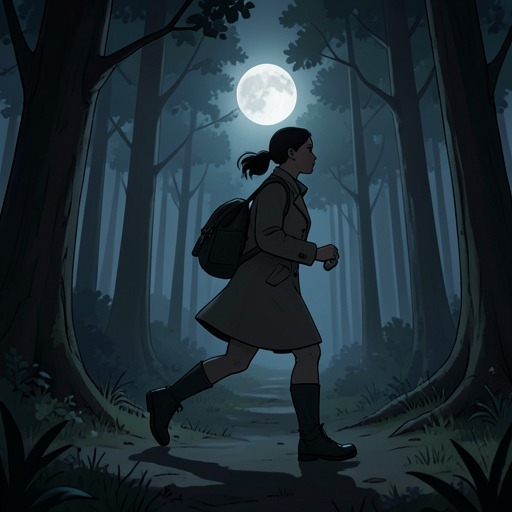
American WomanWildmoor is a deteriorating house in the Hudson Valley where Jenny, living under the name Iris Wong, finds work, shelter, and a precarious form of concealment. Its public tours make the house newly visible to the surrounding towns, but the restoration that draws visitors also leaves traces of Jenny behind. For Frazer, the place is first a destination in his search for her; for Jenny, it is a home whose routines and history offer cover without ever making her entirely unseen.
Setting and Condition
Wildmoor is neither grand nor enormous. It is an eccentric, delicate house, decorated with colored trim, shutters, shingles, and wrought-iron lace, but badly deteriorated and slightly sunken in overgrown grass. Frazer sees it as seeming to drift on a pale yellow sea. Its name appears to belong to a more prosperous period: the present house is an aging structure whose beauty survives alongside visible neglect.
The damage is especially clear in a bright, nearly square room at the back of the house. Two large windows admit more light than the other rooms, but their heavy, single panes have warped away from their frames over decades, allowing water to cause serious damage. A paint-spattered cloth covers the floor, and the room’s furnishings have been pushed aside. This is not a preserved mansion held apart from ordinary life; it is a building in which repair is actively underway.
Tours and Restoration
The house opens to visitors twice a week, with a three-dollar charge said to contribute to its upkeep. The guide presents its objects and architectural details with enthusiasm, while Frazer suspects that the money may be needed for groceries as much as repairs. The tours thus expose the difference between Wildmoor’s reputation as a historic house and its immediate material circumstances: keeping it open is also a way to manage its decline.
The plan to make the house a visitor attraction had originated with Louise Fowler, though Dolly needed the money. With Jenny’s arrival, the idea gained momentum. Jenny taught herself restoration, applying the resourcefulness she had previously used to learn oil painting, repair her car, and assemble a timer and fuse. She consulted Wildmoor scrapbooks held at the local library because Dolly’s own records were buried somewhere in the house. Restoration became both a practical job and a public feature: visitors could come not only to see the house, but to see its repair in progress.
The tours also reopen the history of Wildmoor’s relationship with its neighbors. In the scrapbooks, Jenny finds an account of a 1954 party hosted by Dolly. Guests from the river community were admitted to the house for caviar and champagne, while townspeople were directed to a field beyond a rope near the gazebo. The townspeople collectively walked out. Dolly professed bewilderment, then apologized in the newspaper after a town representative explained the insult; she also said she planned to be buried in the public cemetery at Rhinebeck rather than the family plot. The episode gives the house’s public welcome a history of exclusion and attempted repair, not simply hospitality.
Jenny’s Work and Concealment
Jenny chose Rhinecliff at random, deciding to travel as far as one fourth of her money would take her. From the station she looked out toward the river, then took a taxi to the only nearby motel, inland near Rhinebeck. The motel consumed another large portion of her funds. The next day, she saw an advertisement for work at Wildmoor in the Rhinebeck Gazette. She later learned that the advertisement had run for months without a response because Dolly rarely paid; as an immigrant with few options, Jenny accepted room and board as part of her wages. She arrived in late October 1972.
She adopted the name Iris Wong, described herself as Chinese and from San Francisco, obtained a post-office box in Red Hook, and subscribed to the local newspaper. These arrangements allowed her to build a low-profile routine, but they did not erase her need for privacy or connection. Dolly asked little about her background, and Jenny found herself increasingly angry at not being asked. She even volunteered invented details, including a claim about her parents and her interest in drawing. Wildmoor therefore shelters Jenny partly through the ordinary assumptions others make about the person they believe Iris Wong to be.
Her work and presence become visible to the community despite this concealment. Jenny cleans and restores the house, and local people notice her buying tools and doing careful work. The tours bring visitors into the same rooms where she is laboring, so the house’s preservation depends on a worker whose real identity remains unknown to them. During tea, Jenny follows a detailed domestic routine with Dolly, then slips away to continue projects. While lying on a makeshift scaffold beneath the library ceiling, she gently wipes away a century of brown pipe-smoke residue with soapy bleach water. Even when absent from the visitors’ ritual, she listens to their remarks about the young woman working in the house.
Frazer’s Visit and Jenny’s Trace
Frazer reaches Wildmoor after searching for Jenny in the area. Before the tour, he is anxious and imagines what a meeting might be like, but the house initially gives him no proof that she is there. In the bright rear room, the paint-spattered cloth quickens his pulse. He asks what is happening, only to hear the guide explain the restoration and describe the warped windows and resulting water damage. Frazer looks carefully over the chair, floor lamp, dark cabinet, and other objects; none seems to belong to Jenny. The room holds evidence of work, but not yet evidence that identifies its worker.
The next day, Frazer returns to find a rusty chain across the drive and a weathered wooden sign directing visitors to come back for tours on Monday and Friday. Its handwriting does not give him a simple signature. Instead, it recalls Jenny’s skill as a sign painter: years earlier, she had painted a truck and made a large banner for an action Frazer planned. The sign connects the anonymous visitor to the young woman he remembers through the particular quality of her work. Wildmoor has become a place where recognition arrives through a trace rather than a face.
That trace reaches Jenny’s father, Jim, much later through a reporter. She gives him a mimeographed newsletter from the Historical Society of Rhinecliff and Rhinebeck, where a short notice praises Iris Wong’s patience and workmanship and invites readers to a Wildmoor tour. Jim asks whether Iris was Jenny, and the reporter confirms it. The modest notice does not reveal Jenny’s whole life, but it establishes that she was there, that she worked, and that the community publicly valued her contribution under the name she had chosen for concealment.
Memory and Significance
Wildmoor also becomes a point of reference in Jenny’s later effort to communicate with William while he is imprisoned. When Frazer finds her in Rhinecliff, she is trying to write to William without revealing that she is among the very militants he condemns as zealots. Unable to translate her changed circumstances into a safe and honest letter, she begins again with an account of searching for a yellow croquet ball, as if she were still at Wildmoor. The house survives in her correspondence as a usable remembered setting, one she can substitute for the dangerous present.
Later, Jenny recalls Wildmoor during the winter when news coverage focused on a nineteen-year-old heiress who had been kidnapped and then joined her captors. The story prompts Jenny to revisit a durable memory from childhood and to consider how she had once found herself among confident white upper-class children while fighting for the rights of the poor and people of color. Wildmoor therefore sits within a wider reflection on class, belonging, and the roles people are assigned: Jenny enters the house as an apparent outsider who repairs the property, while its older histories reveal the social boundaries that the house once enforced.
The house’s narrative significance rests in this double function. Its restoration gives Jenny paid work and a temporary home, but each repaired surface and public tour makes her presence more discoverable. Its historical records preserve an old social slight; its local newsletter preserves a new, partial account of Jenny. Wildmoor does not resolve the difference between the name Iris Wong and the person behind it. Instead, it holds the evidence of both: a hidden life conducted through ordinary labor, and the physical and documentary traces that allow others, eventually, to recognize that she was there.