Wildmoor’s state of disrepair
American WomanWildmoor’s state of disrepair is at once architectural fact, public spectacle, and an ongoing burden of labor. The house is delicate but deteriorating, slightly sunken in the grass, and surrounded by grounds whose carefully cultivated wildness has become real overgrowth. Inside, warped windowpanes have let water damage accumulate; restoring the rooms demands sustained work that exposes how little a tour or a fresh coat of paint can do to arrest the decline.
The House and Its Visible Decline
When Rob Frazer first arrives for the ten-thirty tour, Wildmoor appears neither vast nor grand. Its colored trim, shutters, shingles, and wrought-iron ornament give it an eccentric delicacy, but it sits low in the overgrown grass, seeming almost adrift. The contrast between elaborate finish and failing condition makes the house difficult to read as a secure monument to wealth: its beauty persists, but its materials show the effects of neglect.
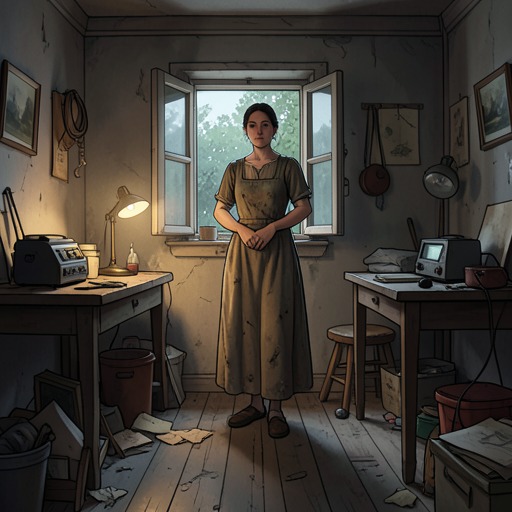
The tour makes that condition public. In a bright, nearly empty room at the back of the house, a paint-spattered drop cloth marks the work under way. The guide explains that the room was once a painting studio, with unusually large, single-piece windowpanes that are not divided by lead strips. Over decades, the heavy panes have warped away from their frames, allowing water to cause serious damage. The guide points to the room’s seventeen-foot-square dimensions and nearly sixteen-foot ceilings, but the measurements also make the scale of the repair legible: a large, exposed space whose distinctive light and windows are part of the problem as well as its appeal.
Rob Frazer looks across the room’s chair, floor lamp, cabinet, and decorative bowl, then realizes that none of these objects belongs to Jenny. What arrests him is not an encounter with her but the sight of the drop cloth and paint flecks. The scene redirects attention from the house as a furnished historic attraction to the labor required to keep it standing and usable.
Tours, Money, and Public Access
Dolly, the last surviving member of the family, has opened Wildmoor to visitors twice a week. The three-dollar admission is presented as a contribution to upkeep, although the house still looks as if little maintenance has been done. Rob Frazer suspects that the money may instead be needed for groceries; the thought registers the financial precariousness behind the public invitation, rather than establishing how the proceeds are spent.
The tours grew out of a plan associated with Louise Fowler, which Dolly needed money to carry out. Jenny’s arrival gives the plan momentum: the restoration work itself becomes part of the attraction. That arrangement makes the house’s condition both a liability and a resource. Its deterioration calls for repairs, while the visible process of repairing it gives visitors something to see. The public is admitted into a domestic world whose upkeep the family can no longer easily manage alone.
The opening of the house does not erase its history of social exclusion. While researching Wildmoor’s scrapbooks, Jenny finds an account of a 1954 wedding party at which river visitors were served caviar and champagne inside, while townspeople were directed to a field beyond a rope near the gazebo. The townspeople walked out; Dolly later apologized publicly and said she planned to be buried in the public Rhinebeck cemetery rather than the family plot. The episode gives the present-day tours a charged background: Wildmoor now depends on local visitors, after once drawing a boundary between social equals and the town beyond its grounds.
Restoration as Daily Work
Jenny approaches restoration as a practical discipline she can learn. She studies Wildmoor’s history in local-library scrapbooks because Dolly’s own records of alterations are buried somewhere in the house. She applies herself to the repairs as she had previously taught herself oil painting, car repair, and the construction of a timer and fuse. The comparison joins the house’s maintenance to a broader pattern of learning through close, hands-on work, without making the restoration easy or complete.
The first summer’s work is painstaking. As the Watergate hearings begin, Jenny finishes preparing the upstairs bedrooms and paints them: she clears furniture, vacuums accumulated dust, chooses and mixes colors, scrapes old paint from the moldings, and covers the many-paned windows. A cheap transistor radio, found in the stables, loses its signal to static every few minutes. Jenny climbs down to adjust the antenna, then lashes the radio to an extension cord and her ladder with duct tape, continuing to paint while she makes repeated adjustments. The improvised setup brings the outside world into an isolated work routine, but it does nothing to shorten the physical labor.
The floor work reveals how one repair can undo another. After renting a sander, Jenny sends sawdust up to the sixteen-foot ceiling; it settles over the moldings she has just repainted. Humidity has slowed the paint’s drying, and for three days the dust seems liable to stick permanently. Jenny cries, returns the sander, and postpones the floors rather than risk more damage. She works on the house in stages, with one unfinished task setting the limits for the next.
When the rooms are finally dry enough for her to close the windows, the first frost has arrived unusually early, in September. For the fall, she plans to clean the library ceiling. Dolly, who has inspected the rooms several times a day for three months, remarks that she does not remember the shade of the wainscoting. Jenny acknowledges that the historical color may be off by a tone or two. The exchange captures the narrow margin between restoration and approximation: even prolonged, careful work cannot guarantee an exact recovery of the house’s former appearance.
Grounds, Light, and Continuing Deterioration
Wildmoor’s deterioration extends beyond its walls. In the late afternoons, Jenny walks down the mile-long slope toward the water. The house remains visible from much of the descent, shrinking as lines of trees form successive openings toward the Hudson River. A gazebo offers a view of the water with the house’s tower behind it; farther down, the house disappears from sight. The grounds were originally designed to look like an English farm going to seed, but decades of growth and dead trees have altered the effect. Weeds now occupy fields that were once made to appear wild, and the managed landscape has become genuinely overgrown. At the last vista before the drop-off, railroad tracks and electric lines reveal the working infrastructure beside the river.
The view can make the estate seem to belong to Jenny, but the feeling does not last. She is sometimes absorbed by the unfolding landscape and the battered house rising back into view, then jolted by the realization that she is pretending the property is hers. The estate runs for miles, a scale she did not initially expect, and its grandeur never cancels her lack of ownership. Her restoration labor takes place within a setting she maintains but cannot claim.
After Dolly’s tea visitors arrive, Jenny can slip back inside and work in the second-floor ballroom. The river’s late-afternoon light reaches through its enormous windows; painters’ lights let her continue after dusk. Working late brings a private pleasure, but also cold rooms, a vast nighttime hush, and the knowledge that her bright yellow work light can be seen from the far side of the river. The radio accompanies her, yet its sound intensifies rather than cures her loneliness. In this way, the house’s scale and beauty do not simply compensate for its disrepair: they make the work feel solitary, exposed, and unfinished.
Significance
Wildmoor’s condition is presented as gradual rather than as the result of one dramatic collapse. Warped glass, water damage, dust, old paint, failed finishes, and expanding vegetation accumulate across time. The house’s decline is therefore registered through repeated acts of noticing and repair: a guide explains the damaged windows, Jenny sands and repaints, sawdust spoils fresh work, and outdoor paths reveal how the grounds have changed.
The estate’s public tours and Jenny’s restoration work give that slow deterioration a social dimension. Wildmoor’s former prestige survives in its architecture and in the history of who was admitted to its celebrations, but its maintenance now depends on a paid public attraction and Jenny’s labor. The result is neither a complete revival nor a simple ruin. Wildmoor remains beautiful enough to draw attention, damaged enough to require continuing work, and financially vulnerable enough that opening its rooms to visitors becomes part of how the household manages its decline.