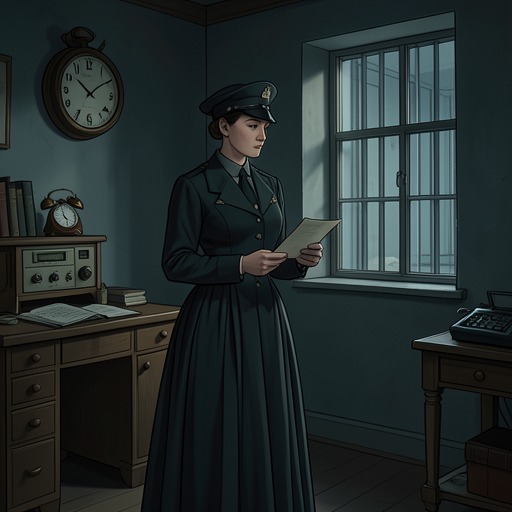
William’s imprisonment
American WomanWilliam’s imprisonment breaks the tandem life he and Jenny had built and forces their relationship into a narrow channel of coded, delayed correspondence. His arrest leaves Jenny outside prison, but not untouched by confinement: she waits for letters, measures what she can safely say, and tries to preserve a bond that no longer has the ease of shared daily life. The novel presents imprisonment not only as physical separation, but as a condition that reorganizes intimacy, political allegiance, and the possibilities Jenny can imagine for herself.
Arrest and the Unimagined Separation
Before William was arrested, he and Jenny had discussed what they would do if they were both caught. They had not discussed what would happen if only one of them were taken. Their political actions and ordinary movements had been carried out assiduously together; that unity had been part of their strength, but it had also left them without a plan for surviving separation. Jenny experiences his arrest as a freak accident. He was on his way home and planned to stop at their rented workshop, a garage, to collect a tool. Jenny was at home making dinner, peeling a carrot and listening to the police band as she waited for the sound of his steps on the stairs. The abrupt division between that domestic moment and his arrest makes the loss feel less like a chosen political risk than a life cut in two without warning.
The arrest becomes, for Jenny, almost equivalent to William’s death. He had once described a true marriage as one in which fear of outliving the other made the fear of one’s own death seem minor. Now she wants to be dead too, yet knows she must live and wait for him. That waiting gives her a purpose, but it makes any suggestion of surrender emotionally complicated. When William recommends that she seek out a friend and consider turning herself in, she hears the possibility that he is cutting her loose, even while recognizing that this is not what he meant. The prospect of surrender brings an image of visiting him at San Quentin, separated by Plexiglas, and an even harder possibility: being imprisoned without William among her few visitors. She cannot fully imagine either future.
Letters as a Constrained Connection
Imprisonment makes letters central to Jenny and William’s relationship, though neither had written to the other before his arrest. At first, their code offers a small, shared certainty in a crisis: Jenny signs herself as his sister, and William answers as her brother. But this arrangement cannot carry the whole relationship. The letters are necessarily guarded, and Jenny thinks of them as faint signals sent from opposite sides of a canyon. The more energy she gives to their correspondence, the more she feels the connection weakening.
The correspondence is also mediated. Dana passes along a note written in a manner Jenny recognizes as William’s, recommending a friend for her to contact. Jenny discovers that Dana and William have been corresponding independently about Jenny’s fate, without her knowledge. Their private discussion unsettles her, partly because she is unwilling to face what surrender would mean. The episode shows that William’s imprisonment does not simply put a barrier between the couple: it also creates a network of other people who can carry advice, messages, and decisions across that barrier, sometimes leaving Jenny outside conversations about her own future.
A letter from William, nearly four weeks old when Jenny reads it, warns about zealots who contaminate the ideas they claim to share. Jenny had initially been irritated by its elevated phrasing. Now she is living in a house with the very comrades she understands him to mean, and she must hide this fact from him. She tries to write honestly without offering prison censors a clue they could understand. In practice, that means withholding the truth from William as well. She repeatedly abandons and restarts her letter, finally writing about a yellow croquet ball as if she were still at Wildmoor. The invented subject gives her a safe substitute for the life she cannot describe, while making plain how much of her present experience has become unsendable.
The Material and Emotional Limits of Correspondence
Dana reseals William’s letters in new envelopes, and her handwriting stands between the original message and Jenny’s response. Jenny imagines her own forceful block letters, underlinings, and exclamations flattened into Dana’s regular script. She wonders whether some of her love is lost in that transcription. William’s upright handwriting remains familiar, but its measured declarations and references to work and zealots do not give Jenny the physical closeness she searches for in the letters. The gap is not proof that their love has ended; it is the painful uncertainty produced by a form of contact that can indicate feeling but cannot restore touch or ordinary shared life.
The letters acquire a physical home in Jenny’s battered brown accordion file, once discarded and marked Tax Yr ’64. The file is nearly too full for its limp ribbon to hold, yet Jenny squeezes it shut with her knees. Its worn, makeshift condition echoes the precariousness of the correspondence it contains. After putting a letter away, she can more fully remember their bedroom in Berkeley, the old bed that had settled into a soft hollow, and William’s body. Memory offers a closeness that the postal system cannot provide, but it depends on putting the letter away rather than receiving anything new.
That dependence becomes stark when Jenny expects a reply and finds her own letter returned instead. The envelope contains a note from Dana saying not to write or send anything more because she has moved. Jenny repeatedly tries to reach Dana by telephone, waiting in a park and returning to the pay phone until the call is answered. The returned letter turns the communications channel itself into a source of distress: the message has traveled back to Jenny, while the person who had carried William’s letters is no longer available to continue doing so.
Separation, Political Allegiance, and Unequal Afterlives
Jenny’s attachment to William is bound up with how they became a couple. After moving to Berkeley at eighteen, she enrolled in a night class on modern political science. William, a senior at Berkeley who had been expelled after taking over the dean’s office, taught the class. They became lovers; Jenny had never had a lover or even been kissed before him. Her relationship with William followed growing conflict with her father, whose experience of wartime incarceration in the United States Jenny learned about only at school in Japan. Her growing interest in history, politics, and oppression became another source of conflict at home. After a catastrophic visit in which her father and William traded insults, Jenny and her father broke off contact. William’s language became her language, and her life with him came to represent a life she had not previously imagined.
That history helps explain why the separation is more than the loss of a partner. While William is imprisoned, Jenny’s connection to him remains emotionally decisive, yet its channels are fragile and controlled by other people. She continues to act in a dangerous political world, including choosing to return to the house where the other fugitives are waiting after collecting her letter and postal supplies. Her first thought as she drives away is to bury the tape she is carrying, but she knows she will not. She also thinks of William’s life and of the mourning that follows actual deaths, distinguishing her unresolved grief for him from the grief the fugitives must face for their dead comrades.
The novel later sets Jenny’s imprisonment alongside Pauline’s to show that legal punishment does not determine the full social cost of confinement. Pauline is convicted of bank robbery, serves less than two years before her sentence is commuted, and emerges without the lasting stigma of prison; her class privilege is ultimately reinforced. Jenny receives the minimum sentence for her role in the selective-service recruitment-center bombings and, after a year, is transferred to work release for good behavior. Rather than experiencing this leniency as uncomplicated relief, she feels newly ashamed and treated as a token, praised for being unexpectedly good. Their cases concern acts committed before the two women met, and their time together is left outside the legal record. These later outcomes do not erase William’s earlier separation from Jenny; they extend the novel’s account of imprisonment into a broader contrast between legal outcomes and the relationships, identities, and histories that official accounts leave obscured.