Yvonne
American WomanYvonne is one of the armed members of the revolutionary cadre who take refuge with Pauline and Juan, and Juan’s wife. Initially encountered by Frazer as a wary fugitive, she later helps plan the group’s escape and a robbery intended to fund it. Her scenes reveal the strains within the group as well as its intimacy: she challenges Juan’s authority, comforts Pauline, and at times welcomes Jenny into their company. Her eventual capture belongs to the widening chain of connections that exposes the fugitives, while the evidence leaves her later legal outcome unspecified.
Identity and Place in the Group
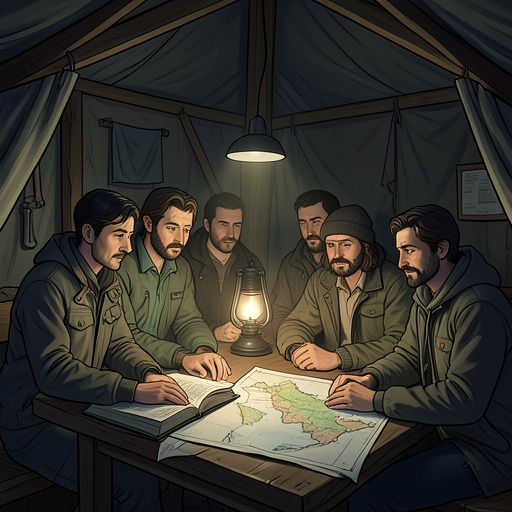
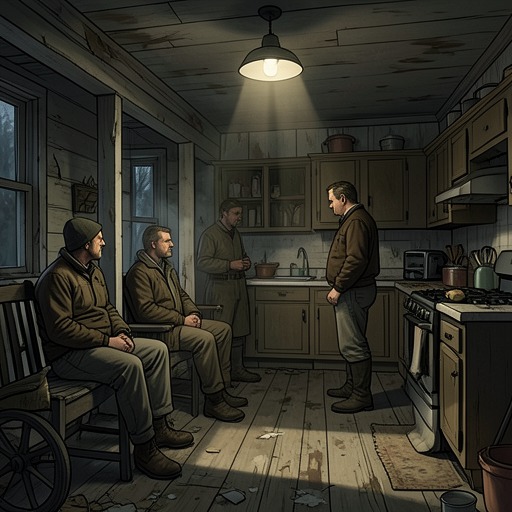
Frazer first sees Yvonne seated with Juan and Pauline in a filthy, makeshift hideout, with ammunition and weapons on their laps. He recognizes the couple as the people who call themselves Yvonne and Juan. Her blond hair and freckles distinguish her in his first impression, but more consequentially, she is not simply an observer of the armed group: she is one of its members, present with a weapon and involved in its decisions. Pauline, the kidnapped woman, sits with them, and Frazer must negotiate with all three even as Juan tries to control the conversation.
The group is physically depleted and grieving comrades who have died in a violent confrontation with police. When Frazer offers his sympathy, Yvonne interrupts Juan’s response with the reported figure of 5,400 bullets fired by police, which she calculates as 600 per dead comrade. She then counters Frazer’s description of the police response as disproportionate: in her view, the number of bullets also testified to how fiercely their comrades had fought. Her intervention turns the deaths into a point of political interpretation. The fallen are not only victims of overwhelming force; they are also remembered as fighters whose resistance gives their deaths meaning.
Negotiation, Loyalty, and Friction
Frazer’s proposal offers the fugitives a place to lie low and the possibility of writing a book. Yvonne asks why he is helping them, and Frazer answers that he is on their side. She smiles, and the group’s questioning shifts from challenge toward practical curiosity. When Juan says they must deliberate privately, the decision is not represented as his alone. The group later accepts Frazer’s offer with conditions: they intend to remain in hiding for a while, regroup, and obtain funds rather than move east immediately. Yvonne is thus part of a collective decision to accept outside assistance, even as the arrangement depends on Frazer’s authority and resources.
Her relationship with Juan is both intimate and politically unequal. During an early negotiation he takes the lead, while Yvonne appears displeased that he speaks for everyone. Later, when Juan worries aloud about whether the group will keep its bargain with Frazer, Yvonne reassures him and puts her arms around his waist. The gesture offers personal support, but it does not erase the tension over who is entitled to speak or decide. At another point, Juan explains the group’s prohibition on drugs while also describing its leader’s use of wine; the episode suggests that the group’s rules can be interpreted selectively, though the evidence does not establish Yvonne’s own view of that exception.
Yvonne’s relationship with Pauline also combines solidarity and conflict. In a private exchange Jenny overhears, Yvonne tells Pauline that she knows Pauline blames Juan for the comrades’ deaths, then turns the criticism back on Pauline for failing to provide cover quickly enough. When Pauline begins to cry, Yvonne softens, hushes her, and addresses her with maternal tenderness. The shift from accusation to consolation makes their closeness visible without resolving their disagreement. Yvonne can hold Pauline responsible for a failure and still respond to her grief as someone she cares for.
From Refuge to Action
Yvonne’s life with the group is marked by practical preparation. When Frazer visits with supplies, she stands beside Juan as he holds two guns, wrapping her arms around him. The group’s mood changes over the course of the visit: Frazer talks with them, shares food and drink, and tells stories; by evening, Yvonne, Juan, and Pauline are laughing and sprawled on the grass. Yvonne embraces Frazer as he leaves, and Jenny is invited to join the farewells. This scene contrasts with the guarded, weapon-centered first meeting. The fugitives remain under pressure, but for a time they can occupy a social world shaped by hospitality and ease rather than immediate negotiation.
The group’s plans later become more dangerous. Juan tells Jenny that the cadre intends to rob the employer of Thomas, who makes a bank deposit alone, and explains that Yvonne and Juan have already checked on him. Yvonne participates in the preparation for the robbery, adopting the name Sandra Smith and planning to approach Mr. Morton in a powder-blue dress and light coat. In the proposed disguise, she presents herself as someone returning home for a visit and claims a connection to the store. The plan relies on ordinary friendliness to get close to the intended target while concealing the group’s purpose. Yvonne’s role is not incidental: she is assigned the face-to-face approach, while the others coordinate the escape and the rest of the operation.
After the confrontation, Yvonne returns with Juan and Pauline in a visibly distressed state, and the group rushes to leave. Jenny drives them away as Juan talks through the practical consequences and the need to move, obtain cars, and avoid detection. The episode marks a sharp break from the earlier moments of fellowship around Frazer. The robbery’s violence transforms the group’s immediate concern from fundraising to escape, and the evidence later confirms that Mr. Morton has been killed. No one is charged with his murder. The account does not provide a separate explanation of Yvonne’s actions or thoughts during the confrontation, so her part is best understood through the planned role and the aftermath rather than through an invented account of her intentions.
Women, Knowledge, and Revolutionary Leadership
Yvonne’s part in the cadre sits within a wider reconsideration of women’s place in political movements. Jenny, Pauline, and other women later learn about firearms together, beginning with names of parts, ballistics, and the uses of different kinds of weapons. Their lessons develop into a discussion of how women often present themselves as more knowledgeable than they feel, while men benefit from a culture of presumed expertise. The account does not make Yvonne a participant in this later group, but the debate illuminates the gendered hierarchy she has already inhabited: Juan often speaks for the cadre, and Yvonne’s dissatisfaction with that arrangement is apparent when he controls a negotiation.
Pauline argues that women must assume leadership roles in revolution and interprets the group’s history through the violence of men, including her own abduction by male comrades. Jenny resists treating men’s methods as fixed by their sex. This disagreement gives context to Yvonne’s earlier behavior without turning her into a spokesperson for either position. She has challenged Juan’s dominance, but the evidence does not show her articulating a general theory of women’s leadership. Her significance lies partly in the gap between the group’s rhetoric of collective struggle and the unequal distribution of voice within its own meetings and relationships.
Capture and Consequences
Yvonne and Juan are eventually captured after investigators follow connections among Jenny, Sandy, Tom, Frazer, and the fugitives. The chain begins with Jenny’s fingerprints in the news and her outstanding charges; investigators then trace links through William’s prison visitors, Sandy and Tom, and Frazer. Frazer’s connection leads them to the apartment in Daly City where he helped settle Yvonne and Juan. The group’s efforts to stay hidden have depended on a web of acquaintances, but those same contacts allow investigators to reconstruct its movements. Yvonne’s capture is therefore presented not as an isolated discovery but as the result of a network gradually tightened around the fugitives.
The account specifies that Yvonne and Juan are caught, but does not establish Yvonne’s sentence or what happens to her afterward. That limit matters beside the later contrast between Pauline’s prison sentence and Jenny’s treatment: the narrative describes those women’s divergent consequences in detail, but supplies no equivalent resolution for Yvonne. Her arc remains caught between the group’s shared ambitions and its unraveling—between the armed refuge where she challenged Juan, the robbery plan she helped carry out, and the network of relationships that ultimately exposed them.