École Militaire
An Officer and a SpyThe École Militaire is both a working military institution and the defining stage of Alfred Dreyfus’s public degradation. For Georges Picquart, who had taught there and later watched the ceremony from within its grounds, the place gathers the Dreyfus case into a single landscape: a school where officers were formed, a parade ground where a condemned man was exhibited to soldiers and spectators, and, years later, the setting of his return in honour.
Military Setting and Public Stage
Before the degradation ceremony, Picquart crossed the grounds of the École Militaire as a crowd streamed towards the official assembly point in the place de Fontenoy. He had served there as professor of topography until the previous year. The building’s military purpose was audible before the ceremony began: drums, bugles, horses, shouted orders, and marching boots filled its spaces. Its cour Morland, where thousands of soldiers mustered on frozen mud, became the immediate stage for the proceedings.
The event was designed for military witnesses as well as a mass public. Each of the nine infantry regiments stationed in Paris had been ordered to send two companies: one of experienced soldiers and one of recruits. The arrangement made the ceremony a lesson as well as a punishment. The soldiers were not simply present to enforce order; the recruits, in particular, were expected to take the degradation as an example. Beyond the railings, the place de Fontenoy was packed with spectators. People filled every available space, climbing onto benches, carriages, omnibuses, and tree branches; one man even reached the top of the 1870 war memorial. The police prefecture’s estimate, as relayed by Picquart, was twenty thousand people.
The Degradation of Alfred Dreyfus
At nine o’clock, as the clock struck, four thousand soldiers brought their boots together at the command for attention. Four gunners then escorted Alfred Dreyfus across the parade ground. Their tightly timed march placed his approach inside the ceremony’s military choreography: their right feet met the chime on every fifth step. Once the escort halted and saluted, the gunners turned away, leaving Dreyfus alone to face General Darras.
An official read the court’s verdict aloud. The sentence combined lifelong deportation to a fortified enclosure with discharge from the army and an order that the degradation take place before the Paris garrison’s first military parade. Darras drew his sword and pronounced Dreyfus unworthy to bear arms, declaring him degraded in the name of the French people. Dreyfus wore rimless spectacles after his pince-nez had been taken from him. The removal of insignia and the general’s formal words made the loss of military status visible in the very institution where Dreyfus had once been a student of Picquart’s.
The ceremony continued as a march around all four sides of the cour Morland. In his torn uniform, Dreyfus passed each detachment so that the assembled soldiers could remember how the army dealt with a traitor. The circuit lasted about seven minutes by Picquart’s watch, although it seemed much longer to him. Dreyfus repeatedly protested his innocence; spectators answered with jeers and cries of Judas and Jewish traitor. Their abuse exposed the distance between the court’s official verdict and the crowd’s antisemitic certainty: the parade ground turned punishment into a public performance whose audience supplied its own accusations.
Picquart’s Changing Relation to the Site
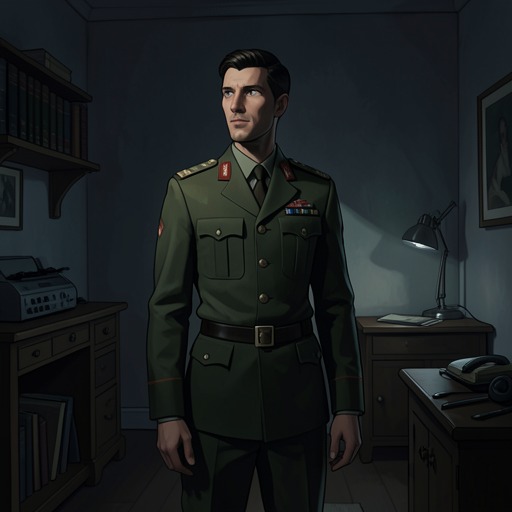
Picquart’s presence at the degradation carries a sharp personal contradiction. He knew Dreyfus as a former student of the École Militaire, yet at the time of the ceremony he describes feeling nothing for him and wishing him removed from Paris, France, and Europe. His duties brought him to the garrison office, where Dreyfus was held in the custody of Captain Lebrun-Renault of the Republican Guard. Picquart did not want to see the condemned man again. The familiarity of the school did not soften his judgment; instead, the same grounds that had once belonged to instruction now framed his estrangement from a former pupil.
Later, Picquart returned to the École Militaire’s parade ground not as an officer overseeing punishment but as a witness to its long aftermath. Standing behind the railings of the place de Fontenoy, he watched cadets drill and remembered the different layers of his own life there: his training as a young officer, his work as a teacher, Dreyfus’s degradation, and his duel with Henry in the riding school. The grounds had not changed into a different institution; their significance had accumulated through events that placed military discipline, personal history, and the dispute over the Dreyfus case in the same frame.
Return and Reversal
On 13 July 1906, after the Court of Cassation had quashed the Rennes verdict and fully exonerated Dreyfus, the Chamber of Deputies voted to restore him to the army with the rank of major and award him the cross of the Legion of Honour. The motion passed by 432 votes to 32. A separate motion restored Picquart to the army at the rank he might have expected to attain had he not been dishonourably discharged in 1898; it passed by 449 to 26. Picquart was astonished to find himself walking back onto the École Militaire parade ground in the uniform of a brigadier general for Dreyfus’s medal ceremony.
That return reverses, but does not erase, the earlier spectacle. The same parade ground that had displayed Dreyfus as a condemned officer now witnessed his recognition, while Picquart’s presence marked his own restoration alongside it. The first ceremony had used military formation and public exposure to fix the identity of a traitor before the garrison and the crowd. The later ceremony placed restored rank and an honour upon the man who had been degraded. The location thus holds two opposed official acts: the army’s public enactment of condemnation and the state’s eventual recognition that Dreyfus had been wronged.
Narrative Significance
The École Militaire matters because the case’s reversals become spatially legible there. Its parade ground makes military judgment visible in bodies, uniforms, commands, and the movement of an escorted prisoner; its repeated appearance in Picquart’s recollections gives those actions a personal as well as institutional history. In the degradation scene, the vast crowd and ordered ranks make the individual appear overwhelmed by the authority surrounding him. In the later recollection, the railings and familiar drill ground become a place from which Picquart can measure the distance between the army’s verdict and the eventual correction of that verdict.
The site’s force rests in this return. Dreyfus’s earlier passage around the cour Morland was intended to preserve a lesson about how the army treated traitors. Yet Picquart’s later presence at the medal ceremony makes the same grounds testify to the instability of that lesson: what had been publicly presented as settled guilt was ultimately overturned, and the degraded officer came back to receive military honour. The École Militaire is therefore not merely a backdrop to two ceremonies, but the physical link between the original spectacle of disgrace and its belated reversal.