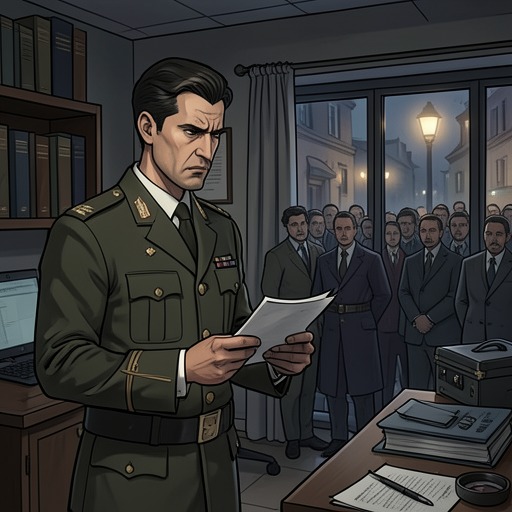
“I am innocent!”
An Officer and a Spy“I am innocent!” is the defining expression of Alfred Dreyfus’s public protest, repeated under military humiliation and again in court years later. Its force lies not in changing his circumstances but in the constancy of the claim: the army can strip his rank, escort him before hostile spectators, and reopen the accusation, yet he continues to name himself innocent. The phrase becomes a measure of the distance between what Dreyfus says and what the institutions around him are prepared to hear.
The Degradation Ceremony
At the ceremony, Dreyfus first speaks after the proceedings have begun. As Georges Picquart recounts the moment to Auguste Mercier, he checks his notebook to reproduce the words accurately: “Soldiers, they are degrading an innocent man . . . Soldiers, they are dishonouring an innocent man . . . Long live France . . . Long live the army . . .” Picquart says that Dreyfus raised both arms and delivered the protest without emotion, with a slight German accent. The speech joins two claims: that the punishment is being inflicted on an innocent man, and that the man being punished remains loyal to France and its army.
The ceremony’s organizers had planned to drown out a speech with a march, but General Darras judged that a few shouts did not count as one and that music would disturb the occasion’s gravity. That decision leaves the protest audible. Dreyfus shouts again, “Long live France! I swear I am innocent!”; his brief declaration is not silenced by the ritual surrounding his degradation.
The denial continues during the march around all four sides of the cour Morland. Dreyfus is escorted in his torn uniform past each detachment, and periodically calls out, “I am innocent!” The procession lasts seven minutes by Picquart’s watch, though it seems much longer to him. The phrase recurs against the jeers of the crowd, including cries of “Judas!” and “Jewish traitor!” Its repetition is set against an organized spectacle meant to teach soldiers how the army deals with traitors. The scene therefore stages two competing public meanings: the crowd’s accusation and the prisoner’s insistence that the accusation is false.
An Insistence Misread
The spectators do not treat Dreyfus’s controlled conduct as evidence that his protest might be true. A representative of the Foreign Ministry wonders aloud how an innocent man could submit to humiliation without struggling, then turns that suspicion into an antisemitic generalization. Jean Sandherr answers with an even broader denunciation of Jews as lacking patriotism, honour, and pride. In this exchange, Dreyfus’s composure is not allowed to speak for itself: observers interpret his failure to resist as confirmation of a stereotype rather than as a response to the situation.
The later file-reading scene complicates the expression’s reception from another direction. Picquart reads Dreyfus’s account of the degradation and encounters his explanation that he understood why former comrades would despise an officer they had been assured was a traitor; the painful point, Dreyfus writes, is that “there is a traitor, but I am not the man”. Picquart says he does not believe Dreyfus’s protestations, treating such insistence as something a guilty person might use to survive captivity. Yet he feels sympathy for Lucie Dreyfus, who trusts and venerates her husband and anticipates his rehabilitation. The expression thus passes through sharply opposed readings: for Dreyfus it is an assertion of truth, for Picquart at this point it resembles a criminal’s self-persuasion, and for Lucie it belongs to the endurance of an innocent man.
The Phrase at the Retrial
At the 1899 trial, the expression returns in a courtroom rather than on a parade ground. When the presiding judge hands Dreyfus the bordereau, Dreyfus studies it, trembles, and struggles to maintain his composure. He tells the court, “I am innocent. I swear it, Colonel, as I affirmed in 1894.” He then invokes the honour of his name and his children as he repeats that he is innocent. The words connect the present proceeding directly to the first trial: the renewed accusation has not displaced his account of himself.
The morning’s questioning takes the bordereau item by item. Dreyfus answers in a dry, technical manner, denying knowledge of particular military information and correcting claims about his service, access to documents, and remarks about German rule. The contrast between procedural detail and the recurring declaration matters: he addresses the particulars one by one, but the central dispute remains whether the accused man is the traitor the court says he is.
When questioning turns to the alleged confession made during the degradation, Dreyfus distinguishes a conversation from a monologue. He says he had been about to face a huge crowd and wanted to cry out that he was innocent; he explicitly denies confessing. The account returns the reader to the earlier ceremony and clarifies the purpose of his words there: the protest was directed outward, to be heard by the crowd, not a private admission to an officer.
Repetition and Public Meaning
The phrase’s recurrence links two scenes separated by years but bound by the same accusation. At the degradation, “I am innocent!” interrupts the army’s attempt to make disgrace legible as proof of treason. At the retrial, its renewed appearance shows that the original verdict has not ended the argument; Dreyfus must again answer the charge and the story of his supposed confession. The words remain nearly unchanged while their setting shifts from military spectacle to legal examination.
Their simplicity also throws the surrounding language into relief. The accusation is supported by a file, itemized questions, and the authority of a court; the denial is brief and repeatedly spoken by the person under judgment. Neither its recurrence nor its emotional weight settles the case by itself. Instead, the expression records Dreyfus’s unwavering claim while exposing how readily official procedure and public prejudice can contain, reinterpret, or refuse to credit it.