“Lowlife D” letter
An Officer and a SpyThe “Lowlife D” letter is a purported note from Schwartzkoppen to Panizzardi, dated 16 April 1894, that connects an unnamed “D” to twelve master plans of Nice. It gives the prosecution’s account of a supposed exchange a suggestive private texture, but never identifies Alfred Dreyfus by name. Read by Georges Picquart within the secret file, it remains circumstantial: the document hints at a relationship and a transfer of plans without establishing that Dreyfus was the person involved or that he committed treason.
Form and contents
Presented as the third reconstituted letter, the note begins with the abbreviated dateline “P 16.4.94” and the salutation “My dear friend,”. Schwartzkoppen says he regrets not seeing Panizzardi before leaving and expects to return in eight days. He then claims to enclose twelve master plans of Nice, which “that lowlife D” had given him for Panizzardi. The letter thus places the plans inside a personal exchange, not a formal intelligence report; its account of how they passed from one person to another depends on the writer’s assertion.
The note adds a second strand to that account. Schwartzkoppen says he had told D that Panizzardi did not intend to resume relations with him. D, he reports, claimed there had been a misunderstanding and that he would do his utmost to satisfy Panizzardi; he also insisted that Panizzardi would not hold the matter against him. Schwartzkoppen dismisses the prospect of renewed relations, calls D crazy, and leaves the decision to Panizzardi with “Do as you wish!” The sequence supplies no explanation of what the disagreement involved. Its insinuation rests instead on the language of a broken relationship and an attempted reconciliation.
The closing, “Alexandrine” followed by “Don’t bugger too much!!!”, preserves the letter’s markedly personal and coarse register. That tone contrasts with the military significance assigned to the plans. It may make the exchange feel intimate, but intimacy is not identification: neither the nickname-like “D” nor the letter’s account, as presented, names Dreyfus. The note’s distinctive force lies partly in that mismatch between its private voice and the grave accusation for which it is used.
Place in the secret file
The letter appears among reconstructed documents in the secret file and is followed by a handwritten commentary signed by Armand du Paty. That compilation attempts to join scattered material into a continuous account of Alfred Dreyfus’s alleged espionage. In its version, Dreyfus had access to plans of Nice while attached to the First Department and passed them to the German Embassy, from which they were later forwarded to the Italian military attaché. The letter’s phrase “that lowlife D” is made to serve as a link in this narrative, although the phrase itself does not supply a full identity.
This arrangement matters because the compilation’s coherence exceeds what the individual fragment establishes. The letter asserts that D supplied the plans to Schwartzkoppen for Panizzardi; du Paty’s commentary situates the alleged transfer within a larger story about Dreyfus, the General Staff, and the foreign attachés. Those are connected claims in the file, but the letter, as presented, does not itself demonstrate the steps that would make them one proven chain. Its place among other scraps lends the accusation the appearance of cumulative support without removing the uncertainty inside each inference.
Picquart’s assessment
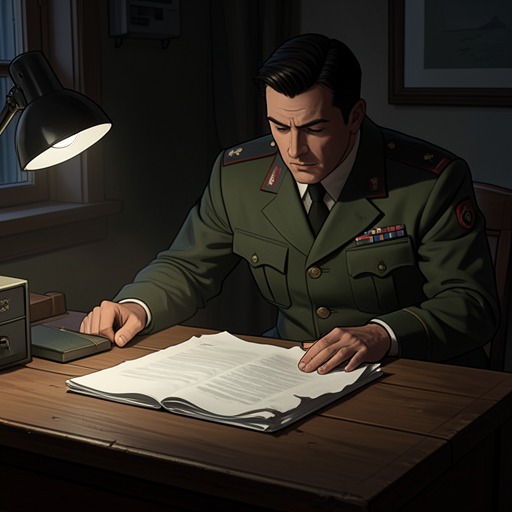
When Georges Picquart finishes examining the file, he is struck by the difference between its suggestive contents and the direct evidence he expected. He finds no document or witness that explicitly calls Dreyfus a traitor; the nearest approach, he concludes, is the initial letter referring to “that lowlife D.” The letter’s anonymity is therefore not incidental to his reading. It is the very point at which an insinuation must be converted into an identification, and the file does not make that conversion explicit.
Picquart also tests the accompanying story against the procedures and dates he knows. He judges it practically impossible for Dreyfus to have removed architectural plans from the First Department unnoticed: missing originals would have been noticed, and there had been no complaints of stolen documents. The alternative implied by the accusation—that Dreyfus copied the plans and returned the originals—raises further questions about the time and opportunity required. Picquart notes a chronological problem as well: Dreyfus did not join the First Department until July 1893, whereas Henry’s account placed stolen plans in Schwartzkoppen’s possession by June. These objections do not change the wording of the letter, but they weaken the larger narrative built around it.
Evidentiary and narrative significance
The letter’s role in the episode is to make an unnamed initial carry the weight of a named accusation. It offers the file a vivid phrase, a specified number of plans, and an apparent route from D to Schwartzkoppen and Panizzardi. Yet each detail remains inside a claim whose connection to Dreyfus has to be supplied by the surrounding compilation. Picquart’s reading separates what the note actually says from what the military narrative wants it to prove.
That separation also shapes the scene of discovery. After reaching the end of the documents, Picquart shakes the envelope again, finds nothing more, and locks the file in his safe. The gesture closes the search while leaving the evidentiary problem open: the dossier’s apparent substance reduces, under scrutiny, to circumstance and innuendo. The “Lowlife D” letter is significant less as a conclusive identification than as an example of how suggestive language can be recruited into an accusation that the documents themselves do not directly establish.