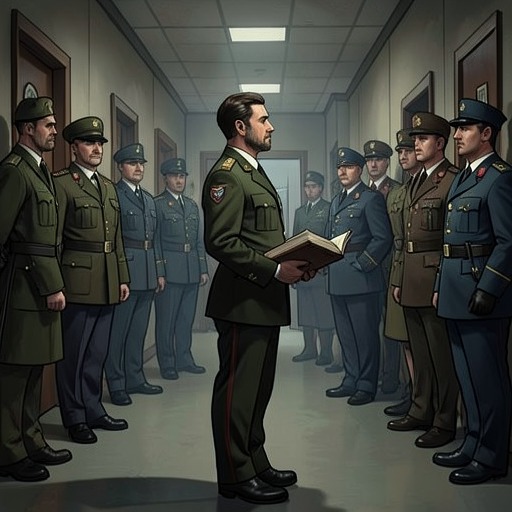
“You have to give them what they want, Colonel — they’re the chiefs.”
An Officer and a Spy“You have to give them what they want, Colonel – they’re the chiefs” is Hubert-Joseph Henry’s blunt rule for survival within a military hierarchy: when senior officers demand compliance, a subordinate should comply, whatever the truth of the matter. The line first confronts Georges Picquart’s refusal to abandon his inquiry into Alfred Dreyfus, then returns as Picquart hands the file to Charles-Arthur Gonse. Its recurrence turns a piece of practical advice into a measure of the choice Picquart is being pressed to make.
Form and Immediate Meaning
Henry’s sentence is brief and declarative. Its first clause states the required action; its second supplies the rationale, invoking rank as if authority settled the question. The address to a colonel makes the hierarchy especially pointed: Henry is counseling an officer who is senior in rank to him, but the “chiefs” he invokes stand above them both. The advice therefore reaches beyond a simple exchange between two men. It names the pressure exerted by the institution through its chain of command.
The wording also leaves the object of compliance deliberately broad. The chiefs’ demand is not spelled out in the maxim itself; its meaning comes from the surrounding scenes. At their earlier conversation, Henry is urging Picquart to drop the matter. Picquart insists that he cannot, and asks whether he is being told to drop it even though Dreyfus is innocent. Henry replies that he does not know whether Dreyfus is innocent or guilty and does not care either way; he says he followed orders and would carry out an order to shoot, even if told afterward that the wrong man had been named. In this context, the maxim expresses obedience detached from the truth or justice of the command.
First Use: Advice Against Conscience
The line follows Picquart’s resistance, not a discussion in which the two men discover the facts together. Picquart says that abandoning the matter is not what he joined the army to do. Henry’s response—“You have to give them what they want, Colonel – they’re the chiefs”—treats Picquart’s refusal as a failure to accept how the institution works. The address is deferential on its surface, but the advice is coercive in effect: it recasts a decision about responsibility as a subordinate’s duty to satisfy his superiors.
Henry makes that position concrete by describing his own conduct as a soldier. He says that he did as he was told and would shoot a man on command, accepting that a later correction of the name would not make the error his fault. The distinction he draws is between carrying out an order and answering for whether it is right. Picquart’s question about Dreyfus puts that separation under pressure. Henry does not answer by establishing guilt; he says that guilt is immaterial to his obedience. The maxim is thus less a defense of a particular conclusion about Dreyfus than a defense of following orders without taking responsibility for their justice.
The scene’s physical gestures reinforce the change in tone. Henry hisses when he tells Picquart to drop the matter, then looks around and leans over the table to speak quietly. He pours them both another cognac and begins an anecdote about catching a thief in the barracks at Hanoi. In the excerpt, the anecdote introduces a major whom Henry describes as somewhat like Picquart, an idealistic type; it does not supply the story’s ending. What the scene does establish is Henry’s method of counsel: he turns from Picquart’s moral objection to the example of military obedience and the consequences of resisting it.
Reprise at the Transfer of the File
The phrase returns when Gonse visits Picquart and the question of compliance becomes immediate. Picquart would like to argue, glances at Henry, and sees him raise his eyebrows slightly. The earlier counsel then reappears in the narration: “You have to give them what they want, Colonel – they’re the chiefs.” This recurrence does not introduce a new argument. It brings Henry’s earlier rule back at the precise moment Picquart is about to act on Gonse’s demand.
Picquart slowly bends to unlock his safe, searches for an excuse not to comply, and takes out the file marked “D.” Reluctantly, he hands it to Gonse, who opens it and thumbs through its contents. Picquart asks pointedly whether everything is there. The hesitation, the marked file, and the question all preserve the sense of resistance; nevertheless, the transfer takes place. The maxim’s return accompanies a concrete change in control: the file leaves Picquart’s safe and passes into Gonse’s hands.
Gonse calls the change a reshuffle of responsibilities and tells Picquart that everything else remains with him, while clasping the Dreyfus file to his chest and promising to look after it. After Gonse has gone, Henry looks at Picquart, shrugs apologetically, and says that Picquart should have taken his advice. That closing exchange makes the earlier words consequential without making them a triumphant prediction. Picquart has complied, but the gesture and the apology register the cost and the pressure behind that compliance.
Ethical and Narrative Significance
The expression condenses a conflict between institutional obedience and Picquart’s stated obligation not to abandon his inquiry. Henry treats the chiefs’ wishes as the decisive practical fact; Picquart’s concern is whether Dreyfus is innocent and whether he can continue acting according to what he believes he joined the army to do. The contrast is not between a man who knows the truth and one who possesses it: Henry explicitly says he does not know whether Dreyfus is guilty. It is between different standards of responsibility—obedience to command on one side, and a refusal to set aside the question of justice on the other.
As a repeated sentence, the maxim links an argument to an action. The first occurrence tells Picquart what Henry believes a subordinate should do; the second accompanies Picquart’s reluctant surrender of the file. The recurrence gives the phrase the force of an internal refrain, while the later apology leaves its meaning unsettled: Henry’s advice has described the path Picquart takes in that moment, but it has not resolved Picquart’s objection to the system that demanded it. The words make hierarchy sound like an answer; the repeated scene shows the human and evidentiary stakes that answer cannot erase.