Alfred Dreyfus
An Officer and a SpyAlfred Dreyfus is a French army officer whose conviction for treason turns him into the exposed body at the center of a national spectacle: degraded before a crowd, confined for years on Devil’s Island, and required to defend himself again at Rennes. The novel’s account follows the distance between that public certainty and the later correction of the verdict. Even after his release, Dreyfus does not immediately regain his name or his place in the army; full exoneration and formal restoration come only in 1906.
Identity and Conviction
In 1894, a court-martial convicted Dreyfus of delivering confidential military documents to a foreign power. The charge concerned documents identified in court as the bordereau. At the public announcement of the verdict, the court declared him guilty and sentenced him to lifelong deportation to a fortified enclosure, along with discharge from the army. The proceedings had included a secret dossier unavailable to the defence; Georges Picquart later acknowledges that passing evidence to the judges without allowing the defence to challenge it was unlawful and that he had been party to the practice.
The conviction makes Dreyfus’s case appear closed to the authorities and to much of the public. Yet the novel presents that apparent finality as an institutional decision, not proof of guilt. In 1896, while Dreyfus remains imprisoned, his brother Mathieu Dreyfus writes to the Minister of War that the handwriting on the bordereau matches that of Major Esterhazy, whom he identifies as its author. Mathieu’s intervention names a different suspect and directly challenges the foundation of his brother’s conviction.
Public Degradation
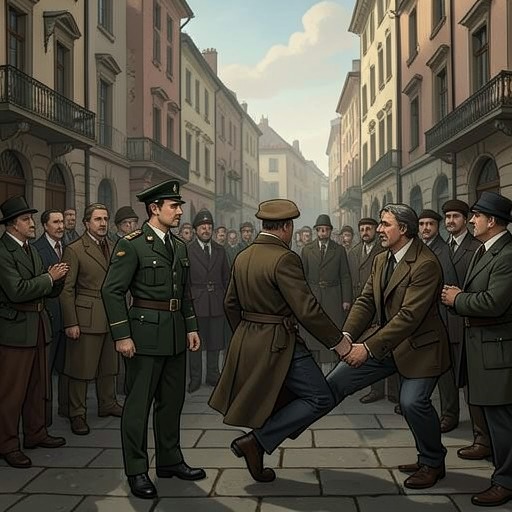
In January 1895, Georges Picquart witnesses Dreyfus’s military degradation before an estimated twenty thousand spectators in Paris. At nine o’clock, four thousand soldiers stand to attention as an escort brings the prisoner onto the parade ground. Dreyfus is separated from the escort and left to face the presiding general alone. The verdict is read aloud, and the general declares that Dreyfus is unworthy to bear arms before formally degrading him.
The ceremony turns a legal judgment into a carefully staged display of military authority. Dreyfus’s uniform is torn, and he is marched around the four sides of the courtyard so that the assembled soldiers can see the army’s treatment of a supposed traitor. The march lasts seven minutes. As Dreyfus repeatedly insists on his innocence, spectators jeer at him and direct antisemitic abuse toward him. The public ritual thus attempts to make the verdict visible and memorable, while Dreyfus’s continued protest prevents the spectacle from fully controlling what it means.
Picquart recounts that Dreyfus spoke during the ceremony, an account that surprises Auguste Mercier, who is listening to the recollection. That remembered moment gives the degradation a counterpoint: the ceremony strips Dreyfus of rank and public standing, but it does not make him accept the accusation. His insistence on innocence recurs at the later trial, binding the public humiliation to the renewed struggle over his name.
Imprisonment on Devil’s Island
After the degradation, Dreyfus is sent to Devil’s Island for life in solitary confinement. His own account describes a tightly controlled existence: after thirty days of close confinement, he is allowed to walk only within a small designated area, followed by armed warders. At night he is locked in a hut measuring four metres square, while guards keep watch in shifts. He must prepare his food and care for his clothes himself, with limited provisions and water. The account records both the physical restrictions of the regime and the anguish and sleeplessness that accompany isolation.
The conditions become harsher after two security scares. One is a newspaper report claiming that Dreyfus has escaped; the other is a letter sent to him under the name Weiler, containing an apparent instruction about secret documents and an escape plan. Dreyfus frowns and puts the letter aside, and both the authorities and the French Sûreté consider it a malicious hoax. Nevertheless, the incidents are used as a pretext for tighter confinement. He is restrained at night, a high double timber fence is erected around his hut, and his permitted daytime movement is restricted to the narrow space between the barriers. The fence also cuts off his view of the sea. The episode shows how suspicion can intensify punishment even when the supposed evidence is judged fraudulent.
The Rennes Trial
When Dreyfus returns to France for the Rennes trial, the public appetite to see him is immense. Three hundred journalists arrive, special telegraph operators are engaged to transmit the expected volume of reports, and the Bourse de Commerce is equipped with 150 desks for reporters. Before the trial, only four outsiders have been allowed to see him: his wife Lucie Dreyfus, his brother Mathieu, and his two lawyers, Edgar Demange and Fernand Labori. Lucie visits him in prison and is reported to leave deeply dejected.
Dreyfus enters the courtroom after a month in the military gaol. Georges Picquart sees a small, diminished-looking man in an ill-fitting uniform, moving stiffly and with difficulty. At the opening of proceedings, the charge is again put in terms of the bordereau and the delivery of documents to a foreign agent. Dreyfus studies the document and renews his claim of innocence, connecting his defence to both the honour of his name and that of his children. Questioned about the military information listed in the bordereau, he answers item by item, distinguishing what he might technically have been able to learn from what he says he neither requested nor possessed.
The court also hears about the severity of Dreyfus’s imprisonment on Devil’s Island. When asked to comment on the account of his confinement, he declines to describe the suffering and says that his purpose is to defend his honour and his children’s. Picquart interprets this restraint as a refusal to become a figure of pity. The choice marks a contrast with the public degradation: at both moments Dreyfus is watched, but at Rennes he controls what he will and will not offer as testimony about himself.
The trial nevertheless ends with another conviction. After an hour and a half of deliberation, the judges find Dreyfus guilty by five votes to two and reduce the sentence to ten years’ imprisonment. The outcome repeats the central reversal of his case: the proceedings return him to France and reopen the evidence, yet the court still upholds guilt. A second verdict has not resolved the original injustice.
Release and Restoration
Dreyfus is released on 20 September 1899, but the news is kept from the public for a day so that he can travel without being accosted. In disguise, wearing a dark blue suit and a soft black hat, he leaves the prison at dusk in a car accompanied by officers of the French Sûreté. He joins Mathieu at the railway station in Nantes, and the brothers take a southbound sleeper. At a family house in Provence, Dreyfus is reunited with Lucie and their children; afterwards he moves to Switzerland. He does not return to Paris, fearing assassination. Release ends his immediate confinement, but it does not itself amount to acquittal.
The final correction proceeds through legal and political steps over several years. In 1903, a speech by Jean Jaurès leads the Minister of War, General André, to examine the evidence again. The resulting inquiry prompts the Criminal Chamber to take up the case, and in 1906 the Supreme Court of Appeal quashes the Rennes verdict and fully exonerates Dreyfus. On 13 July, the Chamber of Deputies votes 432 to 32 to restore him to the army as a major and award him the Legion of Honour. At the ceremony on the parade ground of the École Militaire, he receives the distinction that the 1895 ceremony had seemed to make impossible.
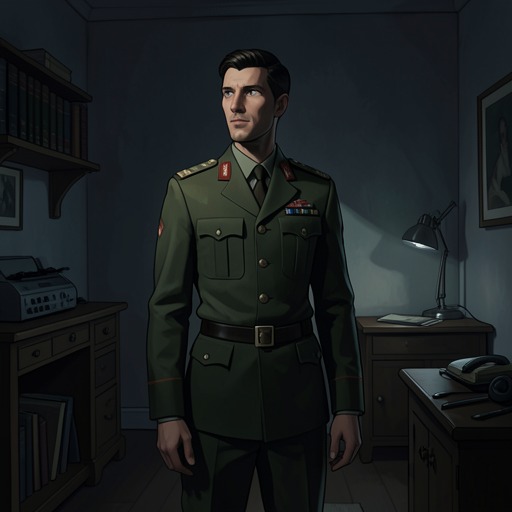
In November 1906, Dreyfus comes to see Georges Picquart, now Minister of War. His uniform and military bearing recall the officer he had been before degradation, with the red ribbon of the Legion of Honour newly added to his tunic. The visit brings the long movement from conviction to formal restoration into a final, personal encounter. The novel’s account does not make the later honours erase the years of isolation or the second conviction; instead, the return of uniform and rank makes visible how long the institutions took to correct a judgment they had once staged as conclusive.