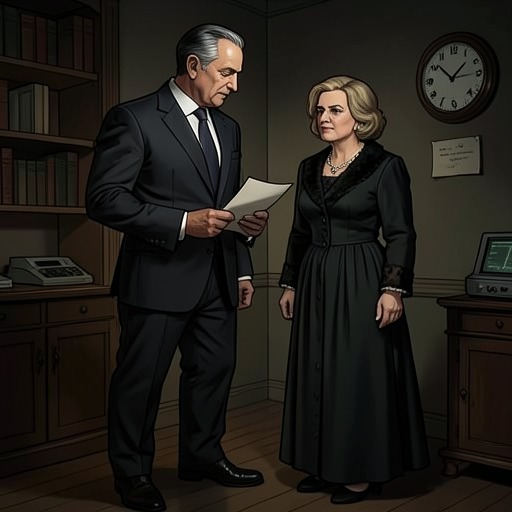
Alfred Dreyfus—Lucie Dreyfus
An Officer and a SpyAlfred Dreyfus and Lucie Dreyfus’s marriage is tested by a punishment designed to separate them: first the restrictions of military custody, then years of imprisonment and exile. Their letters preserve an intimate bond across those barriers, but Lucie’s devotion is not confined to private consolation. She becomes a persistent advocate for her husband, eventually breaking her public silence to demand justice.
Marriage Under Accusation
A file of copied letters gives the relationship its earliest sustained portrait after Alfred Dreyfus’s arrest. Writing from Cherche-Midi Prison on 5 December 1894, more than seven weeks after his arrest, Dreyfus tells Lucie that his trial is approaching and that he is not allowed to see her. He describes the accusation as an incomprehensible catastrophe, while his attention repeatedly returns to the family life they had shared. His letter ends with affection for Lucie and kisses for the children, a domestic tenderness set against the enormity of the charge.
The next letter, written from his cell after his conviction, reveals how sharply confinement has affected him. Dreyfus says that bitterness has brought him close to taking his own life, but that thoughts of Lucie and fear of adding to her grief have held him back. Her reply is an act of both love and resolve: she urges him to live, promises that they will struggle together until the guilty man is found, and describes the children as the ties that still connect her to the world. Their exchange makes the family bond a practical means of endurance, not merely a declaration of affection.
The letters also make clear how differently the spouses experience the accusation. Lucie trusts her husband and regards his suffering as inseparable from the injustice done to him. When Alfred writes about the scorn of former comrades at his degradation ceremony, he allows that their contempt was understandable if they believed him guilty, but insists that the real traitor is not him. Picquart, reading the file, remains unconvinced by Dreyfus’s protestations; nevertheless, he feels sympathy for Lucie, whose faith in her husband appears to him almost veneration. The contrast preserves both the intimacy of the marriage and the suspicion surrounding it.
Separation, Censorship, and Farewell
The authorities turn even a final meeting into a tightly controlled procedure. Lucie writes to the minister for permission to visit Dreyfus on the Île de Ré and say goodbye before his deportation. The request is granted for 13 February, but the conditions deny the couple ordinary physical closeness: Alfred must stand between two guards at one end of the room, Lucie must remain seated at the other with a third guard beside her, and the prison governor must stand between them. They may not discuss the trial or touch. Lucie offers to have her hands tied behind her back if that would permit her to approach more closely; the offer is refused.
Their letters after the visit register the emotional force of this brief encounter without undoing its restrictions. Dreyfus calls the moments together joyful, though he could not tell Lucie everything in his heart. Lucie recalls the shock of seeing him again, while he writes of his admiration for her character and devotion. Hours after his last letter, he is aboard the Saint-Nazaire, bound across the Atlantic. The sequence makes separation not a single departure but an imposed condition of their marriage.
Letters Across the Atlantic
During the voyage, Dreyfus is kept in an unheated cell on an upper deck, exposed to winter weather and watched by warders who carry revolvers and refuse to speak to him. He does not know his destination; only on the fifteenth day does he identify the small islands where the ship has anchored, including Devil’s Island. From there, his letters describe an isolation so complete that it feels like being buried alive. His repeated concern is whether his messages reach Lucie and the children.
Communication from home is delayed and controlled as carefully as his confinement. Lucie cannot discuss the case or related events in her letters, which she must deposit at the French Colonial Ministry by the twenty-fifth of each month. Officials in that ministry and the Ministry of War copy and examine them; Major Étienne Bazeries also scrutinizes both Lucie’s letters and Dreyfus’s for possible coded messages. Lucie’s first batch reaches Cayenne at the end of March but is sent back to Paris for further checking. Dreyfus receives no word from home for four months, until 12 June.
Lucie’s surviving message shows how she sustains the family in the interval. She writes of anxious days and frightening nights, then describes the children as the reason she must gather her strength. She undertakes to raise them according to Alfred’s wishes, shaping their character so that they will be worthy of their father if he returns. The letters make the marriage a shared effort under conditions in which even ordinary correspondence is treated as a security risk.
From Private Loyalty to Public Advocacy
Lucie’s support eventually takes a public form. As accounts of the secret file circulate, she petitions the Chamber of Deputies and argues that a man has been convicted on evidence presented to the court without his knowledge, leaving neither him nor his counsel able to answer it. The petition’s publication on the front page of Le Figaro marks a decisive change: after nearly two years of silence amid slanders in the press and among the public, she says it is her duty to speak and demand justice. Her intervention carries the private certainty expressed in her letters into a constitutional and political claim about the trial.
The Dreyfus family’s attempts to investigate and publicize the case are also watched by military intelligence. Guénée tells Picquart that the family is behind a hostile L’Éclair article, alleges that its editor has met both Mathieu Dreyfus and Lucie, and reports that the family has hired the Cook Detective Agency in London. He further attributes a false report of Dreyfus’s escape to a journalist employed by the agency. These claims are presented as intelligence suspicions rather than as independently established facts, but they show the pressure placed on Lucie’s advocacy: the family’s efforts to seek information and challenge the official account are interpreted by its opponents as covert maneuvering.
Reunion and the Cost of Release
When Dreyfus returns to France for the Rennes proceedings, Lucie is among the very few outsiders permitted to see him. At 8:30 on the morning of his arrival, she enters his cell alone while her father, mother, and brother accompany her to the prison. A captain of the gendarmerie remains present but keeps discreetly at a distance. Lucie stays until 10:15; she finds Alfred less changed than she expected, yet leaves deeply dejected. The visit restores direct contact, but the prison setting and the guard’s presence continue to shape their reunion.
As Dreyfus’s health deteriorates in captivity, Mathieu tells Picquart that his brother has asked to see the children for the first time since his arrest. Mathieu fears Alfred would not expose them to his condition unless he meant to say goodbye. A specialist sent by the government reports malnutrition and malarial fever, with possible tuberculosis of the spinal marrow, and doubts that Dreyfus will survive much longer in prison. The family decides to accept a pardon. That decision secures his immediate release but does not erase the wrongful conviction or give the couple an uncomplicated return to life in Paris.
Dreyfus is released on 20 September 1899. The news is withheld for a day so he can travel without being accosted; in disguise, he leaves Rennes at dusk with officers of the Sûreté and meets Mathieu at the railway station in Nantes. The brothers travel south, and Alfred is reunited with Lucie and their children at a family house in Provence. He later moves to Switzerland and does not return to Paris, fearing assassination. Their reunion is therefore real but shadowed by the conditions of release: the marriage that survived prison and distance can resume family life, yet the pardon leaves Dreyfus still living under the danger and consequences of the case.