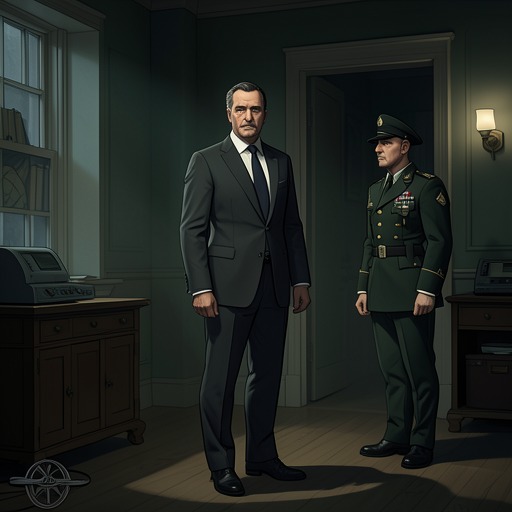
Alfred Dreyfus—Mathieu Dreyfus
An Officer and a SpyAlfred Dreyfus and Mathieu Dreyfus are bound by kinship, but the affair gives that bond a public and political burden: Mathieu becomes his brother’s most persistent advocate, while Alfred’s conviction and imprisonment place the family’s hopes in conflict with the military establishment’s insistence on his guilt. Their relationship is shown through the work Mathieu undertakes in Alfred’s name, the evidence he tries to make public, and the painful decision to accept Alfred’s release by pardon rather than risk his death in captivity.
Family Bond and Early Perceptions
Mathieu is Alfred’s older brother. The military authorities treat him as a subject of surveillance soon after Alfred’s conviction. In a briefing, an agent reports that Mathieu, aged thirty-seven, has moved from the family home in Mulhouse to Paris for the sole purpose of organizing a campaign on his brother’s behalf. A studio photograph circulated among the officers becomes part of the file assembled on him. The detail captures the imbalance in their positions: Alfred is imprisoned and convicted, while Mathieu is free to act, but his efforts are monitored as though advocacy itself were suspect.
The account of Alfred before the case had already registered how social prejudice could shape the way others saw him. As a young officer and student, he was described by Georges Picquart as reserved, financially comfortable, and conspicuous among poorer unmarried classmates. Picquart also recalls that Alfred once asked directly whether a low mark he had received was because he was Jewish. The question exposes the possibility that professional judgment was being filtered through prejudice. This context matters to the brothers’ later relationship: Mathieu’s campaign challenges not only the verdict but also the assumptions that made Alfred’s guilt seem credible to some of those around him.
During the public degradation ceremony, an official from the Foreign Ministry questioned how Alfred could maintain his innocence while submitting to humiliation, then suggested that his conduct reflected Jewish character. Jean Sandherr answered with an openly antisemitic generalization. The exchange shows the climate in which Mathieu’s defense of his brother had to operate: Alfred’s actions were interpreted through hostile stereotypes, and his composure could be turned into evidence against him rather than understood as a response to punishment.
Mathieu’s Campaign and the Search for Information
Mathieu’s advocacy takes practical forms. The surveillance briefing records that he wrote to prominent people and was willing to pay for information. The authorities also learned that Dr Gibert, a physician and friend of President Fauré, had offered to intercede with the president. After meeting Fauré at breakfast at the Élysée Palace on February 21, Gibert went to a hotel where Mathieu was waiting. An agent followed and reported that Gibert told Mathieu the judges had been given secret evidence that was not presented in court. Mathieu was visibly affected by the news.
That information gives the family a reason to challenge the fairness of Alfred’s conviction. Mathieu and his associates held a family conference in Basel, where they brought in Bernard Lazare, a journalist. The authorities subsequently suspected the family of playing a part in the public disclosures surrounding the secret file. Their surveillance reports described contact with Lucie Dreyfus and the hiring of the Cook Detective Agency in London to investigate. The campaign thus extends beyond private appeals: Mathieu seeks information through intermediaries and investigators, while the army watches those same efforts and treats them as a possible threat.
The secret file itself strengthens the family’s case in a different way. When Picquart examines its contents, he finds circumstance and insinuation rather than a document or witness directly identifying Alfred as a traitor. The closest link is an initial in a reference to a supposed agent, and a later search of the intelligence archives establishes that the agent called D was Jacques Dubois, not Alfred. These findings do not come from Mathieu’s campaign alone, but they clarify what his efforts are opposing: an accusation sustained by material withheld from the defense and by interpretations that collapse when checked against the records.
Public Accusation and the Brothers’ Shared Cause
Mathieu eventually names a specific alternative suspect. In a letter to the Minister of War, he identifies Major Walsin Esterhazy as the author of the unsigned, undated document used to establish that confidential papers had reached a foreign agent. He argues that Esterhazy’s handwriting matches the document and asks the minister to act once the actual perpetrator is known. The allegation makes Mathieu’s defense more than a plea for reconsideration: he publicly points away from his brother and toward another officer.
The letter circulates in the press while Alfred remains in exile and Mathieu continues to press the case. At the Rennes retrial, Alfred’s wife and brother are among the four outsiders permitted to see him before the proceedings begin. Their access is limited, and Picquart says he has not spoken with them; what he knows of Alfred’s condition comes from newspaper reports. Even in that restricted setting, Mathieu’s presence marks the continuing family effort to remain close to Alfred and to contest the story told about him.
The brothers’ cause is also joined by Lucie Dreyfus’s public appeal. Her petition to the Chamber of Deputies argues that Alfred had been convicted using evidence unknown to him and his counsel, and demands justice after nearly two years of what she describes as cruel suffering. The appeal belongs to the family’s broader campaign rather than to Mathieu alone, but it reinforces the shared objective that has shaped his relationship with Alfred: to secure recognition that the conviction was not reached through a fair procedure.
The Pardon and Its Cost
After Alfred is again convicted at Rennes, Mathieu visits Picquart at home. He appears grey and worn, turning his bowler hat nervously in his hands. He is on his way to Rennes because he fears Alfred is preparing for death. Alfred has asked to see his children for the first time since his arrest, and Mathieu believes the request may be intended as a farewell. A government specialist has diagnosed malnutrition and malarial fever, with possible tuberculosis of the spinal marrow, and judged that Alfred may not survive much longer in captivity. Faced with that prognosis, the family decides to accept the offer of a pardon.
Picquart opposes the choice because he fears that a pardon will end the immediate crisis without establishing Alfred’s innocence in court. Mathieu understands the distinction, but answers that his family wants Alfred back alive. He says Alfred himself is not reconciled to the decision and asks Picquart for a message of agreement. Picquart refuses to support the pardon, yet adds that he understands. That qualification registers the cost of the family’s decision: it does not settle the question of justice, but it recognizes that continued imprisonment may take Alfred’s life.
Alfred is released on September 20, 1899. In disguise, he is driven from the prison at Rennes by officers of the Sûreté and taken to join Mathieu at the railway station in Nantes. The brothers travel south together by sleeper train. Alfred is reunited with his wife and children at a family house in Provence and later moves to Switzerland, fearing assassination. The reunion and journey give the brothers’ bond a concrete outcome: Mathieu’s campaign has helped bring Alfred out of prison, though not yet clear his name. Their relationship therefore ends this phase in a tense balance—relief at his survival, continued separation from ordinary public life, and an unfinished demand for full exoneration.