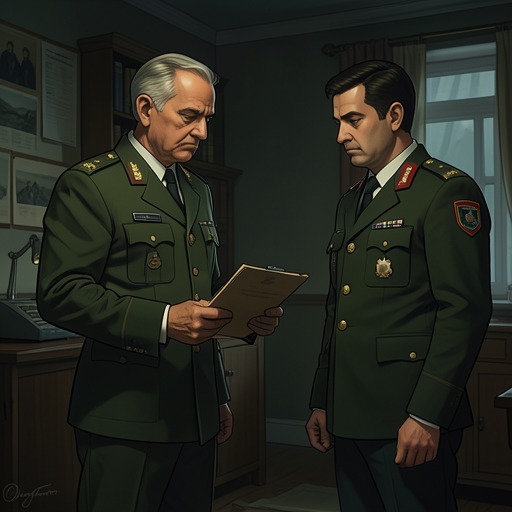
Cherche-Midi Prison
An Officer and a SpyCherche-Midi Prison was where Alfred Dreyfus was secretly held in solitary confinement before his court-martial, cut off from letters, visitors, and lawyers. Across the street from the military courthouse, it stood at the center of both the concealed preparations for his prosecution and the daily movement between the trial and the officials overseeing it.
A planned disappearance
Before the court-martial, Armand du Paty described Cherche-Midi Prison as the destination if Dreyfus did not take the expected course. Major Henry would escort him there while du Paty and Cochefort searched the Dreyfus apartment. Du Paty said he would warn Dreyfus’s wife not to disclose what had happened, and that the prison governor had agreed to keep Dreyfus in solitary confinement around the clock, without letters, visitors, or lawyers. Even the commander of the Paris garrison would not be told where he was. The plan was to make the captain appear to have vanished from public view.
Confinement and interrogation
Dreyfus was made to produce more than a hundred handwriting samples over several weeks, with labels recording the conditions in which he wrote, including whether he was standing, sitting, or lying down. Alphonse Bertillon, the handwriting expert from the Préfecture of Police, wanted a large sample to support his theory that Dreyfus had disguised his writing. Armand du Paty and the narrator visited Dreyfus at Cherche-Midi, usually around midnight, and interrogated him through the night. Du Paty also devised a method of startling Dreyfus from sleep by entering his cell and shining a powerful lantern in his face.
Felix Gribelin later described Dreyfus’s mental state as fragile. Solitary confinement kept him from letters and visitors, and he was often tearful as he asked after his family. Gribelin recalled abrasions on Dreyfus’s temple; warders said he had struck his head against the wall. The prison’s isolation was therefore not merely a matter of secrecy: it formed the conditions under which the interrogations and handwriting tests took place.
Across from the court
Dreyfus’s court-martial was scheduled to begin on 19 December in the military courthouse directly across the street from Cherche-Midi Prison, and was expected to last three or four days. At the close of each of the next three afternoons, the narrator left the courthouse, passed waiting journalists, and walked exactly 720 metres along the icy pavements from rue du Cherche-Midi to Hôtel de Brienne. There, he briefed the Minister of War, who then sent him to repeat the account to Boisdeffre; he was subsequently taken by carriage to brief President Jean Casimir-Perier. The measured route linked the prison and trial to the offices where their progress was reported, making Cherche-Midi part of a larger machinery of custody, prosecution, and official oversight.