Death of Hubert-Joseph Henry
An Officer and a SpyThe Death of Hubert-Joseph Henry follows the exposure of his forgery and turns a confession into another unresolved crisis in the Dreyfus case. Found dead in his cell at Mont-Valérien, Henry is said to have killed himself; Georges Picquart, imprisoned elsewhere, receives the news from Fernand Labori and can neither verify the official account nor dismiss the possibility of murder. The event closes Henry’s part in the conspiracy while leaving the truth of his last hours unsettled.
Exposure and Imprisonment
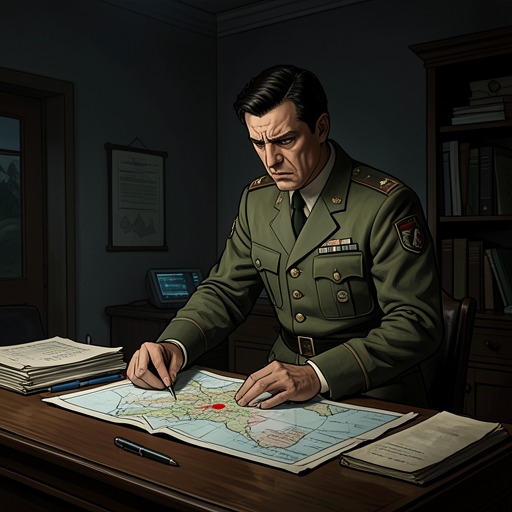
Henry’s death comes after the forged document known as the absolute proof has been exposed. On 30 August, during a meeting in the Minister of War’s office, Henry is forced to admit that the document is a forgery. The evidence against it is irrefutable: after Picquart’s accusation, the new Minister of War, Cavaignac, orders the Dreyfus file checked for authenticity. By then it contains 360 items. An aide examines the supposed letter under a strong electric lamp and notices that its heading and signature are on paper with bluish-grey lines, while its body is on paper with mauve lines. The document had been assembled from a genuine letter, disassembled and then fitted with a forged central passage. The original letter dates from June 1894.
The discovery makes the forgery visible through the physical construction of the document: different paper lines expose the seam that an official file had preserved without scrutiny. Henry’s admission therefore does more than discredit one piece of evidence. It confirms that evidence presented to sustain the case against Alfred Dreyfus was deliberately fabricated, and makes Henry’s position within the General Staff untenable. Cavaignac orders him arrested on the spot and sent to Mont-Valérien, where he is confined in rooms Picquart had occupied during the winter. Henry spends the night there after his arrest. The next day he writes to Charles-Arthur Gonse requesting a visit and to his wife, Berthe, expressing his fear that everyone but her will abandon him, despite his belief that he acted in his chiefs’ interests.
The News Reaches Picquart
In prison, Picquart spends the day consumed by uncertainty about Henry. At around nine in the evening, a warder takes him to the visiting room. Before Labori speaks, Picquart knows from his expression that the news is grave. Labori tells him that Henry is dead. He reports that Henry was found that afternoon in his cell at Mont-Valérien with his throat cut, and that the authorities are calling it suicide. His observation that such deaths keep happening connects Henry’s case to a wider pattern of suspicious deaths without establishing that they share a cause.
Picquart turns away and weeps. He cannot determine whether the tears come from exhaustion, strain, or grief for Henry. Despite their conflict, he had never been able to hate him entirely; he understood him too well. That response gives the news a personal weight beyond its political consequences. Picquart’s enemy has also been a man whose conduct and allegiance he believes he can comprehend, and Henry’s death removes the possibility of further questioning or explanation.
Conflicting Accounts and Unanswered Questions
In the weeks that follow, Picquart tries to piece together what happened from newspaper reports and scraps of gossip Labori gathers on the legal circuit. The account he receives places Henry on his bed at noon, drinking rum; six hours later, a lieutenant and an orderly find him dead. He has slit his throat twice with a razor, which is in his left hand although he is right-handed. These details sharpen the mystery but do not resolve it. Picquart acknowledges that he may never know the full truth.
Labori believes Henry was murdered to silence him, as Labori also believes Lemercier-Picard was killed to keep him quiet. He cites medical acquaintances who say that a person could not physically cut both sides of the carotid arteries. Picquart is not persuaded that murder was necessary. In his imagined reconstruction of the interrogation, Charles-Arthur Gonse and Raoul le Mouton de Boisdeffre fail to defend Henry when Cavaignac orders his arrest. Picquart supposes Henry would have understood what his chiefs expected after they remained silent. The narrative presents this as Picquart’s reasoning, not as proof of either suicide or murder; the crucial interval between noon and six remains beyond his knowledge.
Narrative Significance
The event makes the exposure of a forged document both a turning point and an incomplete revelation. Henry’s confession establishes the forgery, while his death prevents the case from yielding a full account of his motives, his superiors’ knowledge, or his final hours. His letters suggest that he considered himself to have acted for his chiefs, but Picquart’s report of them does not settle what those chiefs knew or intended. The official suicide account, Labori’s murder theory, and Picquart’s own doubts remain in tension.
That uncertainty is also shaped by the book’s form. Its author’s note says that the novel retells the Dreyfus affair through novelistic techniques and that Picquart never wrote the secret account imagined by the book. The novel distinguishes the historical basis of the affair from its invented framing device; within that frame, Picquart must reconstruct Henry’s death at a distance, using second-hand reports and imagining scenes he did not witness. The gap between what he can establish and what he fears or suspects is not filled by a final answer. Henry’s death thus leaves the forged evidence exposed but the circumstances of the forger’s end unresolved.