Dreyfus secret file
An Officer and a SpyThe Dreyfus secret file is the sealed-looking but repeatedly handled dossier used to bolster Alfred Dreyfus’s conviction without being shown to him or tested openly at trial. Its contents, as Georges Picquart later inspects them, amount to circumstance and insinuation rather than direct proof; its changing custody and disputed appearances show how secrecy could manufacture authority for evidence while obscuring who had seen, altered, or circulated it.
Form, Contents, and Evidentiary Limits
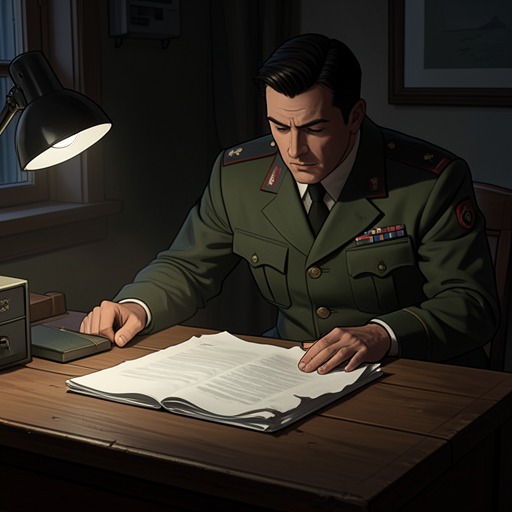
The file presents itself as an unremarkable manila envelope marked with the letter “D.” Picquart recognizes it as the envelope he had handed to the president of the court martial twenty months earlier. Its seal has been broken, but it feels as light as he remembers it. When he opens it, he finds five documents. The physical smallness of the packet contrasts with the immense claim attached to it: Auguste Mercier says it proves Dreyfus’s crimes beyond any doubt.
Picquart’s examination reaches the opposite conclusion. He empties the envelope and checks it again, finding no additional papers. Nothing in the file, he concludes, directly names Dreyfus as a traitor. The nearest approach to an incriminating statement is an initialed reference to “that lowlife D.” The distinction matters: a fragment that can be associated with a letter is not direct identification, yet the file’s secrecy had allowed its contents to function as decisive evidence without the defense being able to examine or challenge them.
The dossier’s contents are not fully itemized in the surviving account, so its evidentiary weakness is clearest in the contrast between what officials claim and what Picquart can actually find. Its authority depends less on a plainly incriminating document than on restricted access, the confident assertions of senior officers, and the implication that the unseen material must settle the case.
Use at the Court Martial and Disputed Handling
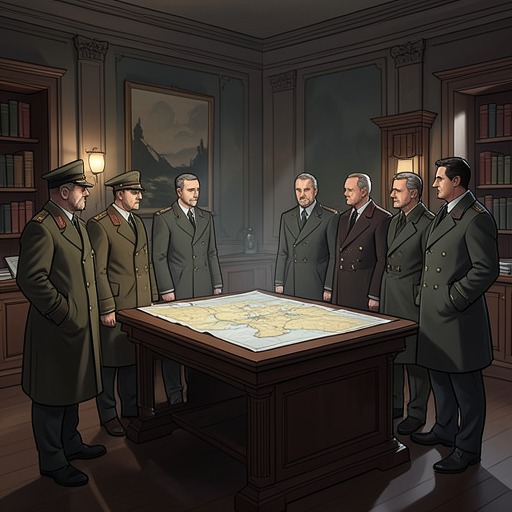
Mercier asks Picquart what should be done with the file. Picquart rejects showing it to Dreyfus, recognizing that such disclosure would violate the secrecy imposed around it; instead, he suggests that the judges might be allowed to see it confidentially. That proposal would still deny the accused access to the material, but it would at least expose the judges to the basis of the accusation. The exchange makes clear that the file’s handling is not incidental: the question is who may know what it contains, and under what conditions.
A later account from an officer present at a meeting in the minister’s office supplies a different part of the custody history. He says that, after Dreyfus’s conviction, Auguste Mercier specifically ordered Colonel Sandherr to break up the file: intercepted letters were to be returned to the archive and the commentaries destroyed. The witness recalls Mercier being unequivocal. That instruction makes the dossier’s later existence and handling especially consequential. A file said to have been dismantled could still be brought out, inspected, and discussed, leaving open the question of what was preserved and how its parts were subsequently treated.
When Picquart presents the file to General Gonse alongside the Petit bleu and surveillance photographs, Gonse studies the materials methodically and remains outwardly unperturbed. He tells Picquart to forget about the bordereau, redirecting attention from the evidence linking another suspect to the accusation against Dreyfus. Later, Gonse initially does not recognize the envelope marked “D”; Picquart must explain it and lay out the contents. The moment reveals that access to the file is uneven even among senior officers, and that its supposed centrality to the case does not mean every authority figure has examined it.
Circulation, Exposure, and Control
The file’s secrecy proves difficult to contain. Picquart makes a list of those who know about it: nine military and intelligence figures, including Auguste Mercier, Boisdeffre, Gonse, Sandherr, du Paty, Henry, Lauth, Gribelin, and Guénée. After a briefing, Billot becomes the tenth. Picquart then counts seven judges, President Fauré, the president’s doctor, and Mathieu Dreyfus, who had learned of the matter from the doctor. That brings the known circle to twenty, before accounting for anyone Mathieu may have told. The count turns a supposedly controlled secret into a spreading chain of access and hearsay.
A newspaper report adds another layer. Picquart finds an account that he judges grossly inaccurate, although it contains details consistent with the file’s actual history: it says the secret dossier was given to the judges in their deliberation room, refers to confidential letters between the German and Italian military attachés, and reports a description of “that animal Dreyfus.” It calls this irrefutable proof and says it determined the verdict. The report is not reliable simply because some details correspond; rather, its mixture of error and revealing specifics shows how the file’s guarded contents have entered public circulation in distorted form.
Gonse responds to Picquart’s efforts by insisting that the investigation into Dreyfus was mishandled but cannot now be reopened without reopening wounds and tearing the country apart. He then formalizes the prohibition: Picquart is ordered not to investigate anything connected with the case or disclose information to unauthorized people. Gonse’s instructions place the secret file within a larger system of command, where controlling access to information becomes a way to control the investigation itself. When Picquart is due to leave on an inspection tour, Gonse orders that Major Henry, rather than Picquart, bring all Agent Auguste material directly to him.
The “D” Misidentification and Competing Testimony
Picquart’s later search of the intelligence archives for Agent Auguste material changes the meaning of the file’s most suggestive mark. His conclusion is explicit: “D” is not Dreyfus; it is Dubois. The initial that had served as the dossier’s nearest link to Dreyfus therefore points elsewhere. The discovery does not merely weaken one document; it exposes how an ambiguous mark could be made to carry the burden of an accusation when the file was withheld from ordinary scrutiny.
The file also becomes central to a dispute over whether Picquart showed it to Louis Leblois. At Picquart’s inquiry, an accuser claims to have seen the envelope open on Picquart’s desk and to have watched him show Leblois a document containing the words “that lowlife D.” The claim emphasizes that the witness recognized the “D” because he had written it himself. Leblois denies the alleged meeting and says there was no such file, only what he calls nonsense about pigeons. He asks the court to establish when the incident supposedly occurred.
Henry gives a specific date and a different arrangement of objects: one evening in October 1896, he says, he entered Picquart’s office to request leave and saw a carrier-pigeon file to Picquart’s right and the secret file to his left. He claims that Leblois was being shown the latter. The juxtaposition matters because the pigeon file is the alternative Picquart and Leblois identify as the file actually discussed. The testimony does not erase the contradiction; it makes the dossier’s alleged presence in the room, and the difference between two files, part of the case against Picquart.
Narrative Significance
The Dreyfus secret file is both an object in the investigation and a model of the investigation’s distorted logic. Its envelope, broken seal, five documents, and identifying initial give it a tangible presence, but no direct accusation emerges from Picquart’s inspection. Meanwhile, officials can invoke it as conclusive, order its destruction, keep it from the defense, or dispute who saw it. The file’s authority grows through restricted access even as its actual contents fail to support that authority.
Its history is therefore a contest over custody as much as interpretation. The dossier passes through the court martial, senior officers’ offices, the intelligence archive, Picquart’s inquiry, and public reporting, while the people who handle or discuss it disagree about what it contained and who was shown it. The revelation that “D” refers to Dubois sharpens the central irony: the mark that seemed to confirm the accusation instead demonstrates how easily a secret file could turn ambiguity into apparent proof. Its continued use in accusations against Picquart further shows that concealment did not end with Dreyfus’s conviction; the dossier remained a political instrument long after its evidentiary claim had begun to collapse.