Dreyfus’s Conviction by the Rennes Court-Martial
An Officer and a SpyThe Rennes court-martial’s conviction of Alfred Dreyfus renewed the injustice of his earlier condemnation: after the court found him guilty by five votes to two, it reduced his sentence to ten years’ imprisonment rather than acquitting him. The verdict prolonged the consequences of a false accusation even as the divided vote exposed that the judgment was not unanimous; its reversal and Dreyfus’s full exoneration came only in 1906.
The courtroom and the returning judges
At the Rennes trial, Georges Picquart sat behind Mathieu Dreyfus as the lawyers and judges entered. Alfred Dreyfus appeared as a diminished figure: old, stiff-limbed, and in a baggy tunic that his shrunken frame could scarcely fill. He climbed the steps to the platform with difficulty, saluted the judges, and was told to stand. The physical impression of a man worn down by years of imprisonment preceded the court’s decision to return him to confinement.
After the judges’ deliberations, the courtroom waited through several minutes of tension. A joke briefly eased the mood; then a court official signalled for silence as word came from the other end of the line. The announcement was quiet but decisive: Dreyfus was guilty by five votes to two, and the sentence was reduced to ten years’ imprisonment. The split vote did not undo the conviction. Instead, the reduced sentence left him condemned while making the ruling’s lack of unanimity impossible to overlook.
A verdict set against the earlier degradation
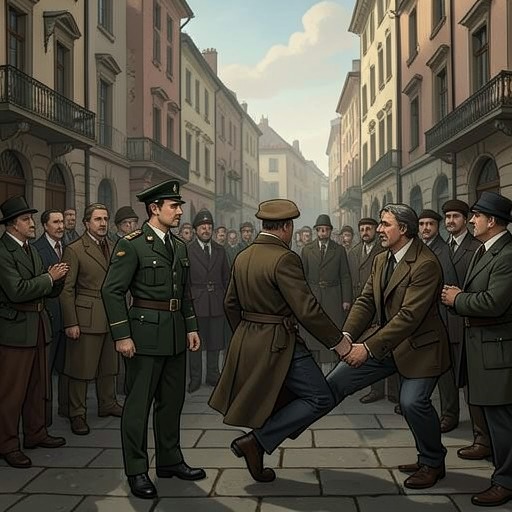
The Rennes judgment belongs to a longer sequence of public punishment. In 1895, after the earlier court-martial, four gunners escorted Dreyfus across the parade ground at the École Militaire. Their precise marching gave the degradation ceremony the order of a military display; when they left him alone before the general, he was formally stripped of the standing associated with his rank. The verdict was thus not merely a court’s finding. It had already been translated into a spectacle designed to make the army’s judgment visible to its own ranks and to the watching crowd.
During that ceremony, Dreyfus called out that he was innocent and affirmed his loyalty to France. As he was marched around the courtyard in his torn uniform, he repeated his claim, while spectators answered with jeers and accusations of treachery and antisemitic abuse. The seven-minute procession made the imposed identity of traitor public; the Rennes conviction later renewed that judgment through legal procedure rather than parade-ground ritual.
Reversal and aftermath
The Rennes verdict did not stand as the final legal judgment. In 1903, after Jean Jaurès set out the affair in the Chamber of Deputies, Minister of War General André agreed to examine the evidence again. The inquiry led the Criminal Chamber to take up the case and recommend review by the Supreme Court of Appeal. Political turmoil delayed the process, but on 12 July 1906 the court quashed the Rennes verdict and fully exonerated Dreyfus.
The following day, the Chamber of Deputies voted to restore Dreyfus to the army with the rank of major and award him the cross of the Legion of Honour, by 432 votes to 32. On the same day, a separate motion restored Picquart to the army; it passed by 449 votes to 26. Picquart then returned to the parade ground at the École Militaire for Dreyfus’s medal ceremony, now in the uniform of a brigadier general. The contrast was stark: the same military space that had staged Dreyfus’s degradation became the setting for his public recognition, after the Rennes judgment had been overturned.