Dreyfus’s Final Exoneration
An Officer and a SpyDreyfus’s Final Exoneration was the eventual judicial reversal of Alfred Dreyfus’s wrongful conviction, achieved after years in which military secrecy and official resistance had obstructed scrutiny of the evidence. The book contrasts the spectacle of his public degradation with the quiet, patient work of review: a parliamentary speech, an inquiry, and successive court proceedings finally culminated in the French Supreme Court of Appeal overturning the Rennes verdict on 12 July 1906. The victory repaired Dreyfus’s legal status, but only after his imprisonment, a second conviction, and a long struggle to separate release from vindication.
A Public Verdict and a Private Hearing
The process began in a climate already shaped by the secret proceedings against Dreyfus. At the earlier military hearing, prosecutor Brisset asked that the case be heard in private, arguing that the evidence involved national defence. Dreyfus’s lawyer, Edgar Demange, objected that his client had the right to treatment equal to that of any other accused person. The dispute exposed a central obstacle that would recur throughout the affair: the claim of secrecy could limit the very scrutiny needed to test the accusation.
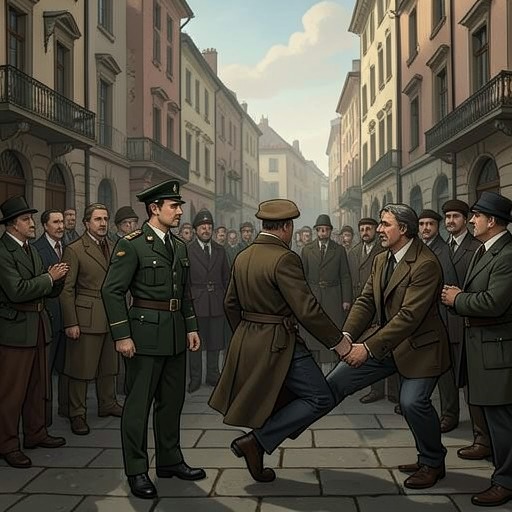
The original judgment was then turned into a public military spectacle. At the École Militaire, four thousand soldiers stood on the parade ground as an escort brought Dreyfus before the authorities. General Darras declared that he was unworthy to bear arms and announced his degradation. Dreyfus was marched around the Cour Morland in his torn uniform, calling out that he was innocent while spectators jeered and hurled anti-Semitic abuse. The procession lasted seven minutes. Its elaborate visibility made condemnation a lesson for the army; the later exoneration would have to undo a judgment that had been displayed to the public as though it were settled fact.
Evidence Confronted and Contained
Georges Picquart’s investigation brought the case’s central evidentiary problem into sharper view. General Gonse told him to forget the bordereau: Picquart could investigate Esterhazy, Gonse said, but must not connect that inquiry to the document used against Dreyfus. The instruction attempted to divide two questions that Picquart’s investigation had brought together.
Picquart later put the connection directly to the inquiry examining him. He argued that Esterhazy had plainly written the bordereau and that even the government’s principal handwriting expert considered the match exact. The inquiry answered that this was outside its scope. Picquart also raised the use of falsified material in the dossier that had convicted Dreyfus. Instead of addressing those central issues, the inquiry’s limits kept attention away from the evidence bearing most directly on the original verdict.
The next day, with Fernand Labori’s help, Picquart drafted an open letter to Prime Minister Henri Brisson. He said he could establish before a competent tribunal that the two secret documents dated 1894 could not be applied to Dreyfus, and that the document dated 1896 showed every sign of being forged. He further argued that the Minister of War had been misled, along with those who accepted the relevance or authenticity of the documents. The letter converted claims that had been hemmed in by military procedure into a public appeal for scrutiny before a competent court.
From Pardon to Judicial Review
A pardon offered Dreyfus release, but Picquart objected that accepting it would amount to an admission of guilt. He was told that Jean Jaurès had prepared a statement for Dreyfus to issue on leaving prison: freedom granted by the Republic meant nothing without honour, and Dreyfus would continue seeking to overturn the judicial error of which he remained the victim. The distinction mattered. Release could end confinement without correcting the conviction; the campaign therefore had to pursue legal vindication beyond the immediate relief of a pardon.
The decisive institutional opening came in 1903. Jean Jaurès, the socialist leader, delivered a forensic speech in the Chamber of Deputies that lasted a day and a half and set out the affair as a whole. General André, then Minister of War, agreed to reconsider the evidence. The resulting André inquiry prompted the Criminal Chamber of the Court of Cassation to take up the case and conclude that it should be reviewed by the French Supreme Court of Appeal. That stage occupied 1904. Political turmoil over the separation of Church and State then consumed 1905, delaying the final resolution for another year.
Reversal and Restoration
On 12 July 1906, the French Supreme Court of Appeal quashed the Rennes verdict and exonerated Dreyfus entirely. The outcome reversed the judgment that had survived the earlier proceedings at Rennes, rather than merely releasing Dreyfus or granting him a qualified reprieve. The narrative presents this as victory through careful examination of the record: facts were sifted and sifted again by jurists after public tempers had cooled, not settled by one triumphant courtroom scene.
The following day, the Chamber of Deputies voted to restore Dreyfus to the army as a major and award him the Legion of Honour, passing the motion by 432 votes to 32. Picquart was restored separately, with a rank he might have expected to attain had he not been dishonourably discharged in 1898; that resolution passed by 449 to 26. Mercier’s attempt to argue against Dreyfus’s restoration was drowned out. Picquart then returned to the parade ground at the École Militaire for Dreyfus’s medal ceremony, now in the uniform of a brigadier general. A place associated with public degradation became the setting for an official act of recognition.
The ending resists the idea that justice arrives as instant spectacle. Dreyfus’s full exoneration followed years of failed opportunities, restricted inquiries, renewed proceedings, and political delay; restoration required separate votes after the court had cleared him. Picquart’s later appointment as Minister of War by his friend Georges Clemenceau extended the reversal into public office, but it did not erase the cost of the intervening years. The sequence makes the distinction between freedom and honour, and between a verdict and its eventual correction, central to the meaning of the case’s final resolution.