Dreyfus’s isolation regime on Devil’s Island
An Officer and a SpyDreyfus’s isolation regime on Devil’s Island was a system of confinement designed not merely to punish Alfred Dreyfus but to cut off communication in every direction. Its methods joined the island’s natural barriers to guarded movement, restricted contact, inspected letters, and later physical restraints. The regime made distance itself part of the sentence, then tightened control over the small space and few connections that remained.
Purpose and Geography
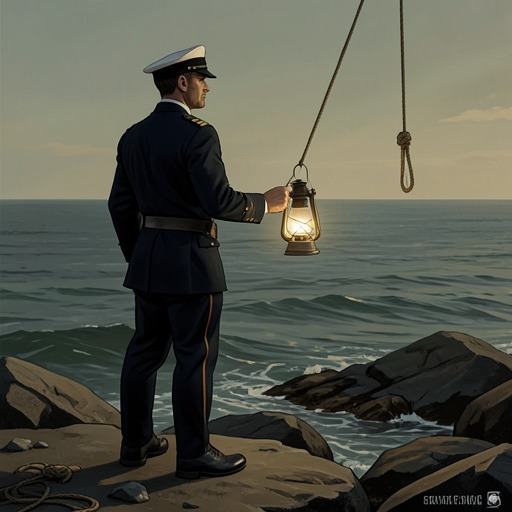
The plan was presented by the Minister of War as a way to prevent Dreyfus from sending further messages and to stop anyone from communicating with him. On a globe beside his desk, the minister located Devil’s Island off the coast of South America, roughly seven thousand kilometres from Paris. The choice was deliberate: the island lay fifteen kilometres from the mainland, while sharks, immense waves, and strong currents made landing difficult. The sea did not simply surround the prison; it served as one of its barriers.
The penal colony at Cayenne was considered less secure. Devil’s Island, by contrast, had been closed after serving as a colony for convict lepers. The minister intended to seek the Chamber’s approval to reopen it specifically for Dreyfus. The plan therefore began with an administrative decision to revive an abandoned place of confinement and assign it a single prisoner. Its remoteness answered the stated objective of isolating him, while making ordinary contact and access exceptionally difficult.
Confinement and Daily Conditions
After the Saint-Nazaire reached the tropics, Dreyfus spent four days locked in a steel box under the sun without being allowed on deck. He was then landed on Royal Island while his quarters were being prepared on Devil’s Island. For a month he remained in a cell with closed shutters and was not permitted to go outside. This preliminary confinement prolonged the journey’s restrictions rather than ending them at arrival.
After thirty days, guards transferred him to Devil’s Island. During daylight he could walk only within an area a few hundred metres square, with armed warders following every step. At six in the evening he was locked into a hut four metres square, enclosed by an iron grille; guards took turns watching outside throughout the night. His movement was thus divided by a strict daily boundary: limited exercise under escort, followed by confinement in a small hut under continuous watch.
The regime also made ordinary necessities part of the prisoner’s work. His ration was half a loaf of bread each day, a third of a kilo of meat three times a week, and tinned bacon on other days; water was his drink. He had to collect wood, light a fire, prepare his own food, wash his clothes, and try to dry them in the humid climate. At night the cage, the guard’s repeated passage, vermin, and distress left him unable to sleep. These details show confinement operating through the organization of food, labour, rest, and bodily movement as well as through locks and walls.
Communication and Surveillance
Isolation extended beyond the guards’ refusal to speak with Dreyfus. He wondered whether his letters reached his wife, Lucie Dreyfus, and described days passing without a word. The correspondence rules made contact conditional and delayed: Lucie could not mention the case or related events, had to deposit letters at the French Ministry of the Colonies by the twenty-fifth of each month, and could send them only after official scrutiny. Officials in that ministry and the Ministry of War copied and read the letters; copies also went to Étienne Bazeries, who examined them for possible coded messages. Dreyfus’s letters to Lucie were scrutinized as well. A first batch sent to Cayenne was returned to Paris for another check, and he received word from home only after four months of silence.
This inspection system treated private correspondence as a possible channel for intelligence. Even affection and family news were enclosed within administrative procedures, while the prohibition on discussing the case restricted what the letters could convey. The guards’ silence and the officials’ examination of mail enforced different parts of the same policy: one prevented direct human exchange at the island, and the other supervised the connection that could still cross the distance.
Escalation and Effects
Two later security scares became the pretext for a harsher confinement. An English newspaper reported that Dreyfus had escaped. Separately, a letter addressed to him in the Rue Cambon, signed with a name resembling Weiler, carried an apparent invisible-ink message asking for information about documents and a cupboard. After he received it, guards watched him closely; he frowned and put it aside. Both the authorities and the French Sûreté judged the letter a malicious hoax, and the file offered no indication that he recognized the name.
Despite that assessment, the Colonial Ministry used the episodes to justify new restrictions. For three weeks, Dreyfus was put in irons every night: U-shaped pieces of iron fixed to his bed enclosed his ankles, and a bar was passed through them and padlocked until dawn. A double fence of heavy timber, two and a half metres high, was built around his hut. The inner fence stood only half a metre from the window, completely blocking his view of the sea. His daytime access was also curtailed; he could no longer go beyond the second perimeter fence. The strip between the two walls, bare rock and scrub without trees or shade, became the whole extent of his world.
The escalation exposes the regime’s defining imbalance. A letter treated as a hoax and an escape report were followed not by a demonstrated change in Dreyfus’s conduct, but by additional restrictions on his body, sight, and movement. What began as a plan to prevent communication expanded into a system that enclosed the prisoner more completely, until even the ocean that marked the island’s isolation disappeared from view.