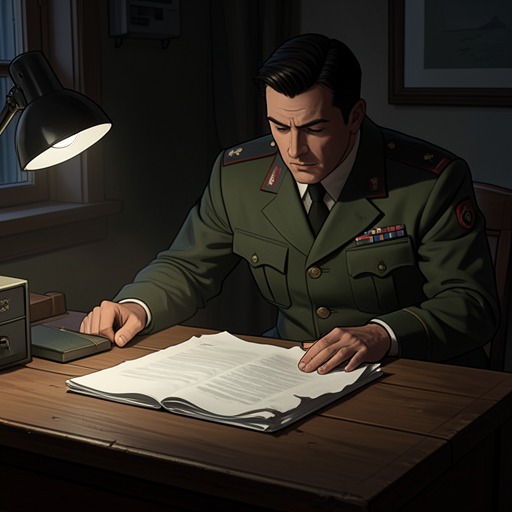
Dubois note
An Officer and a SpyThe Dubois note is a damaged intelligence document whose modest offer about smokeless powder helps Georges Picquart resolve one of the file’s most consequential ambiguities: the agent identified as “D” was Dubois, not Alfred Dreyfus. Its importance lies not in the value of the information offered, but in the name that connects it to other correspondence and an earlier military report.
Material Form and Discovery
The note is written in thin black ink on squared white paper. Torn into twenty pieces, with several fragments missing, it appears among documents Picquart is examining in his office. Much of the surrounding material seems incomplete or meaningless, and Picquart briefly moves past the crucial paper before its details draw him back. The object’s broken condition makes its contents difficult to read as a self-sufficient record; its significance emerges only through comparison with other papers in the file.
The circumstances of the discovery sharpen that effect. Picquart has been at work without food since noon, his eyes gritty, and he recognizes that fatigue may explain why he initially overlooks the note. He has also just reflected on the danger of reading too much into scraps of evidence, comparing such interpretation to ancient haruspices scrutinizing animal livers. The torn paper seems to embody that problem: incomplete in itself, it can be misread as meaningless, yet a name on it acquires force when set beside other records.
The Offer and Its Follow-Up
Dated 27 October 1894, the note offers Maximilian von Schwartzkoppen “the secret of smokeless powder.” Its date places it two weeks after Alfred Dreyfus’s arrest, but the document does not accuse Dreyfus or identify him as its writer. It is signed “your devoted Dubois,” a signature Picquart recognizes as the useful clue.
A second letter, written two days later, makes the offer more specific: Dubois says he can procure a cartridge from the Lebel rifle so that the German attaché can analyze the smokeless powder. The promised item does not appear to have prompted action from Maximilian von Schwartzkoppen. Picquart considers the offer unimpressive on its practical merits: in his estimation, a Lebel cartridge could be bought in almost any French garrison town for the price of a beer. The correspondence therefore matters less as evidence of valuable secrets transferred than as a trace of the person writing to the attaché.
The Name in the Intelligence File
The signature leads Picquart back to letters from Panizzardi to Maximilian von Schwartzkoppen. In a note from 1893, Panizzardi says that he has seen M. Dubois. That earlier appearance makes the name recur across separate pieces of correspondence, but Picquart still needs to identify which Dubois is meant and what the intelligence file has made of him.
An attached cross-reference takes him, after several minutes spent working out intelligence archivist Gribelin’s filing system, to a report Major Henry addressed to Colonel Sandherr in April 1894. The report concerns the possible identity of the agent designated “D,” said to have supplied the Germans and Italians with “twelve master plans of Nice.” Henry identifies the agent as Jacques Dubois, a printer employed at a factory handling Ministry of War contracts. According to the report, Dubois could make extra copies while setting a printing machine and had probably supplied large-scale drawings of fortifications at Toul, Reims, Langres, Neufchâteau, and elsewhere.
The report also sharply limits the apparent importance of the material. Henry says that Dubois had no access to classified information and that the plans he supplied were publicly available. He describes Dubois as a miserable fellow, a criminal fantasist of limited intelligence, and recommends that no further action be taken. The report’s conclusion turns the apparent espionage trail into something far less decisive than the phrase “master plans” might suggest: the documents were not secret, and their source was not a high-ranking officer with privileged access.
Resolution and Narrative Significance
Read together, the note, the follow-up letter, Panizzardi’s earlier mention, and Henry’s report give Picquart a specific answer to the identity concealed by the initial. His conclusion is that “D” is Dubois, not Dreyfus. The note does not establish that every reference to Dubois concerns the same individual beyond the identification Picquart makes from the file, nor does the offer itself demonstrate that Schwartzkoppen obtained any secret information. Its decisive contribution is narrower: it supplies a name that redirects the case’s suggestive letter “D” away from Alfred Dreyfus.
The clue works through accumulation rather than dramatic disclosure. A fragmentary offer is easy to pass over; the follow-up makes its subject clearer, an earlier letter repeats the name, and the cross-referenced report supplies an identity and context. The result also exposes the peril of treating an initial as a verdict. In this instance, “D” points to a printer whose plans were publicly available, not to Dreyfus. The note’s evidentiary force comes from its place in a chain of records, while its torn, incomplete form recalls how much interpretation depends on locating and comparing documents that do not explain themselves.