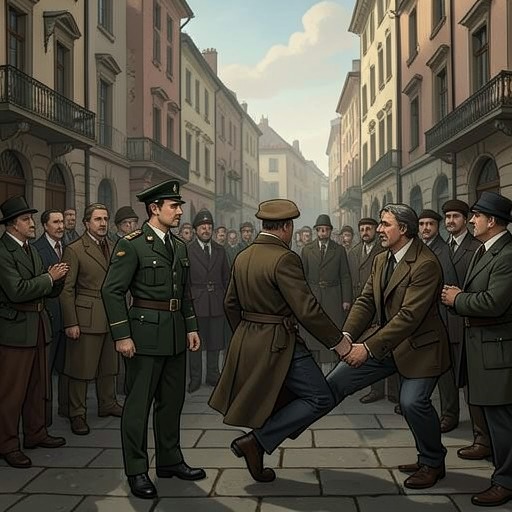
Edgar Demange
An Officer and a SpyEdgar Demange is Alfred Dreyfus’s defense lawyer across the case’s first military trial and its later retrial at Rennes. He represents continuity in a defense repeatedly forced to work within military procedure: faithful to his client for almost five years, he argues against a closed hearing, seeks time to replace an injured colleague, and insists that the case’s objective is Dreyfus’s freedom. Yet his cautious manner and limited preparation at a decisive moment expose the constraints of that role and bring him into conflict with the more aggressive Fernand Labori.
Identity and Role
Demange is introduced as the attorney for Alfred Dreyfus. By the Rennes proceedings, he is described as the faithful lawyer who had represented Dreyfus since the first court-martial, nearly half a decade earlier. His long service makes him an established member of the defense, not a late addition: when Labori joins the team, brought in by Mathieu Dreyfus to strengthen the challenge to the army, Demange remains the senior and enduring advocate.
At the opening of the Rennes trial, Demange enters in his black legal robe and conical hat alongside Labori. Labori courteously gestures for the older man to go ahead of him. The small courtesy captures their different positions within the team: Demange is the experienced representative whose commitment predates the retrial, while Labori has been recruited to sharpen the defense’s attack.
Defense at the First Court-Martial
At Dreyfus’s first military hearing, the prosecution seeks a private session on the ground that its evidence concerns national defense. Demange immediately objects, arguing that his client has the right to be treated like any other accused person. The prosecutor answers that the case necessarily involves sensitive defense matters, but Demange’s objection identifies the basic procedural inequality at stake: the military invokes secrecy where the defense asks for ordinary public treatment.
The hearing’s course makes that inequality more than an abstract concern. Hubert-Joseph Henry points at Dreyfus in court and identifies him as the alleged traitor, after invoking an informer whose identity is not disclosed. Demange’s objection to a private hearing had sought to resist the exceptional procedure surrounding the accusation, but the proceeding still exposes Dreyfus to a case framed by secret and untested assertions. In the account of the later trial, Demange is remembered as the attorney who represented him at that original court-martial.
Strategy and Conflict with Labori
At a legal strategy meeting attended by Mathieu Dreyfus, Demange sets out a restrained objective: the defense must secure the client’s release, not simply attack the army for its errors. Because military officers will decide the case, he argues, the lawyers need to be diplomatic. Labori rejects the implication that moderation is an adequate response to the system that sent Dreyfus to Devil’s Island. The disagreement is practical as well as temperamental: Demange emphasizes the immediate outcome before a military tribunal, while Labori presses for a harder confrontation with the institution and its conduct. Demange, red-faced, gathers his papers and leaves the meeting.
The difference between them becomes consequential when Labori is shot during the Rennes proceedings. Demange asks the court for a two-week adjournment, allowing time either for Labori to recover or for a replacement to be fully briefed. Albert Clemenceau has agreed to take the case, but Colonel Jouaust refuses the requested delay. The court grants only a brief adjournment, requiring Demange to return to the examination of Mercier without adequate preparation. Demange’s request shows his concern with the defense’s ability to function after Labori’s removal; the refusal turns that concern into an immediate disadvantage.
Cross-Examination at Rennes
Demange is not prepared for the resumed examination of Mercier, and the narrative contrasts his performance with Labori’s forensic force. His habit of prefacing questions with long speeches gives Mercier time to consider his answers. When questioned about the falsified Panizzardi telegram in the Ministry of War archive, Mercier denies knowing about it. Asked why it was not included in the secret dossier shown to the judges, he says that the French Foreign Ministry would not have liked it. After only a few more minutes, Mercier is allowed to leave the stand.
The scene does not erase Demange’s loyalty or the importance of his long service, but it reveals the cost of proceeding without Labori or a fully prepared substitute. Demange remains civil and committed; the weakness lies in the mismatch between the urgent examination and his manner of questioning, which gives a senior military witness room to shape his response. The defense’s immediate attempt to secure more time had been denied, and the resulting examination fails to press Mercier effectively on the telegram.
Commitment and Limits
Demange’s conduct is defined by a tension between fidelity and caution. He has stood beside Dreyfus from the first court-martial, challenges the demand for a private hearing, and frames success as the client’s release rather than the humiliation of the army. At Rennes, however, his commitment does not make him interchangeable with Labori: their disagreement over diplomacy exposes competing ways of defending the same client, and Labori’s sudden absence leaves Demange with too little time to meet the demands of the moment.
Demange remains in Rennes after the proceedings begin to draw toward their end. On the evening of Thursday, 7 September, Georges Picquart and Edmond have a farewell supper at Les Trois Marches; Labori and Marguerite attend, but Mathieu Dreyfus and Demange do not. The account gives no reason for Demange’s absence. It closes his visible role not with a dramatic break, but with the separation of the defense team as Picquart and Edmond leave Rennes by evening train while the verdict is still pending.