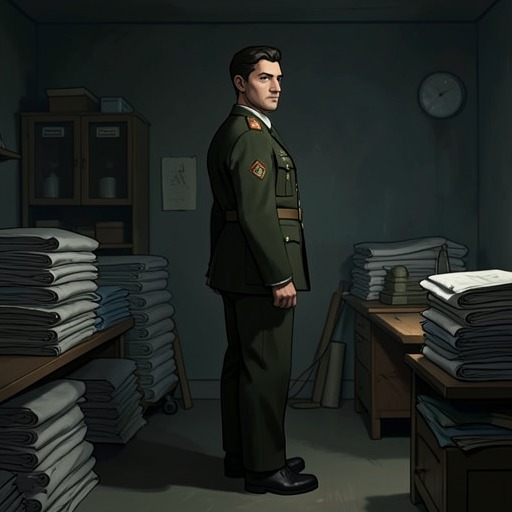
Edmond Gast
An Officer and a SpyEdmond Gast is one of Georges Picquart’s dependable personal allies in the novel’s account of the Dreyfus affair. When Picquart decides to face Hubert-Joseph Henry in a duel, Gast accepts a role in arranging it, then helps him prepare rather than merely witnessing the confrontation. Later, after Picquart’s imprisonment ends, Gast is again at hand: he waits outside the prison with a motor car and takes Picquart back to Ville-d’Avray. His appearances mark practical support at two moments when Picquart’s freedom and security are uncertain.
Identity and Narrative Context
Gast is presented through his actions in Picquart’s personal circle, not through an independent biography. The evidence establishes that Picquart trusts him enough to ask him to witness a duel and that Gast is willing to put himself at risk by helping. It also shows him providing transport and a place to practise fencing. The novel does not supply further biographical particulars about him, so his significance rests chiefly on this sustained, concrete assistance.
The author’s note describes the book as a novelistic retelling of a historical affair: its principal and minor characters are not wholly fictional, while events are dramatized and personal details invented. It specifically cautions that Picquart never wrote the secret account on which the novel’s device depends. This general framing does not identify which details about Gast are documented or invented; his scenes therefore belong to the novel’s representation of events rather than serving, by themselves, as proof of his historical actions.
The Duel and Its Preparations
Picquart asks Gast to act as one of the two witnesses needed to arrange his duel with Hubert-Joseph Henry and ensure fair play. They speak on Gast’s terrace after lunch, sitting with a blanket across their knees and smoking cigars. Gast agrees, but urges Picquart to reconsider. Picquart replies that he has issued the challenge publicly, cannot withdraw it, and does not want to do so. Gast’s response combines loyalty with apprehension: he will help, but does not treat the danger as trivial.
Gast’s role becomes more active when the arrangements proceed. He and Arthur Ranc go to Henry’s apartment to deliver the formal challenge. Henry is apparently at home, but his wife receives the letter and says he will answer the next day. Gast later reports what he and Ranc observed: Henry’s boots were in the passage, and they heard a child calling for his father and a man trying to quiet him. He infers that Henry is anxious to avoid the fight. The account makes Gast both an intermediary in the formal process and a source of information about its uncertain progress.
When Picquart needs to prepare physically, Gast takes him to Ville-d’Avray for fencing practice. He says that he does not want to witness Picquart being killed, making his intervention an effort to reduce the risk rather than an endorsement of the duel. On the Friday before the encounter, he trains Picquart in his barn for hours, reviewing compound attack, circular parry, riposte, and remise. The next morning they drive back to Paris. Gast’s support thus moves from accepting the witness’s responsibility to providing practical instruction, even though he has already advised Picquart not to proceed.
Support After Imprisonment
Gast’s assistance continues after Picquart’s release from prison. On the same Friday that Picquart is freed, Alfred Dreyfus is disembarked from Devil’s Island and begins the voyage back to France aboard the warship Sfax. Gast is waiting outside the prison gates with a motor car, described as his latest toy, and drives Picquart to Ville-d’Avray. Picquart refuses to speak to the journalists gathered outside; Gast’s immediate presence offers a private way out of the crowd and back to the household.
The novel contrasts this practical welcome with Picquart’s disorientation after confinement. The noise and social demands of his return overwhelm him, and he struggles with ordinary conversation and climbing the stairs. Gast’s part is not described as a cure or a solution to these effects: he provides transport and receives Picquart at home as the consequences of imprisonment become apparent. Across both episodes, his loyalty takes a consistent form—he accepts personal involvement, gives candid counsel, and supplies concrete help when Picquart needs preparation or safe passage.