Esterhazy Is Acquitted by Court-Martial
An Officer and a SpyEsterhazy Is Acquitted by Court-Martial is the military trial at which Charles Ferdinand Walsin Esterhazy is unanimously declared innocent, despite evidence linking him to the bordereau and despite Georges Picquart’s attempts to make that evidence heard. The proceeding does more than spare Esterhazy: it blocks reconsideration of Alfred Dreyfus’s conviction, turns the accused officer into a public champion of the army, and leaves Picquart exposed to a hostile crowd. The verdict’s immediate certainty makes its underlying injustice all the more stark.
Causes and the Limits of Inquiry
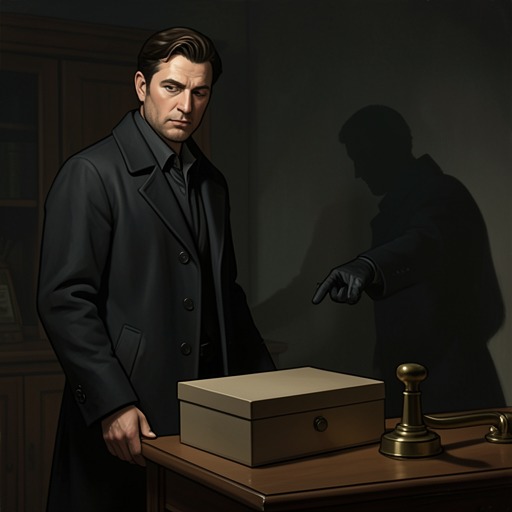
The court-martial takes place in a case already constrained by decisions about what may be examined. Earlier, Charles-Arthur Gonse had told Georges Picquart to investigate Esterhazy but to leave the bordereau out of the inquiry. Picquart later challenged that boundary directly, pointing out that Esterhazy’s handwriting was, even in the government’s expert assessment, a perfect match for the document. The response was that the matter lay outside the inquiry’s scope. The central question of authorship was thus acknowledged and excluded at once.
The trial’s procedure repeats that exclusion on a larger scale. When Alfred Dreyfus appears at an earlier hearing, the prosecutor requests that the proceedings be held in private because the evidence involves national defence. Edgar Demange objects that Dreyfus has the right to be treated like any other accused person, but the security claim narrows public scrutiny. At Esterhazy’s trial, the Dreyfus family’s civil suits are rejected, so the original court-martial verdict will not be reconsidered; the judges also vote to hear all evidence from military personnel in secret. The secrecy intended to protect military matters instead prevents the public from assessing the officers’ testimony.
The scheduled hearing is fixed for Monday, 10 January 1898. Georges Picquart and Louis Leblois are summoned as witnesses, but Leblois’s father dies shortly before the proceeding, and Leblois is excused to return to his family in Strasbourg. Picquart urges his friend to go. That absence leaves Picquart to face the trial’s proceedings and aftermath without the companion who had shared the campaign to expose the affair.
The Proceeding and Verdict
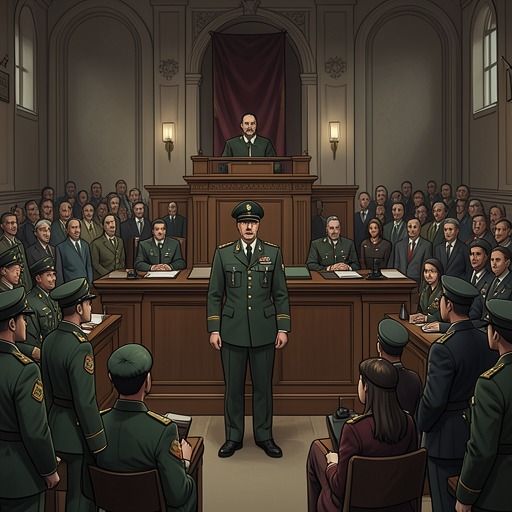
As the hearing gets under way, Picquart sits with the civilians while the military occupy the other side of the room. He hears the judges arrive and waits for news from upstairs. The clerk eventually announces both the rejection of the Dreyfus family’s suits and the decision to hear military evidence in secret. Lucie Dreyfus rises, embraces Mathieu Dreyfus, and leaves without speaking. Her departure marks the practical consequence of the rulings: the family has been denied a route to reopen the original conviction, while the evidence most likely to illuminate the military’s conduct will not be public.
Witnesses are called one by one. Mathieu Dreyfus, who first complained to the Minister of War about Esterhazy, goes in and does not return. Auguste Scheurer-Kestner is called next and also does not return. The room gradually empties of handwriting experts and officers. When Charles-Arthur Gonse and the men of the Statistical Section are summoned together, they file out avoiding Picquart’s eyes. Gonse pauses at the threshold to look back at him, then leaves. The silent departures and that final look give the waiting room a second, unspoken trial: Picquart is isolated even before he hears the verdict.
Esterhazy’s lawyer delivers a closing speech lasting five hours, and the hearing continues until eight in the evening. During the speech, Esterhazy appears to nod off. When the judges rise to deliberate, he passes Picquart with a stiff salute that seems faintly mocking. Picquart expects a long wait, but within five minutes the judges return. They declare Esterhazy unanimously innocent and say he leaves without a stain on his honour. The verdict is emphatic, not provisional: the court presents acquittal as settled fact.
Public Celebration and Immediate Danger
Applause overwhelms the remainder of the clerk’s announcement. Picquart’s fellow officers stamp, clap, and cheer for the army and France; anti-Semitic cries join the celebration. The scene makes the court’s decision into a public spectacle of institutional solidarity. For Picquart, the outcome is disastrous but not surprising: he believes it was predetermined. Dreyfus, he reflects, is now worse off than before, having been condemned a second time, and a third hearing seems impossible.
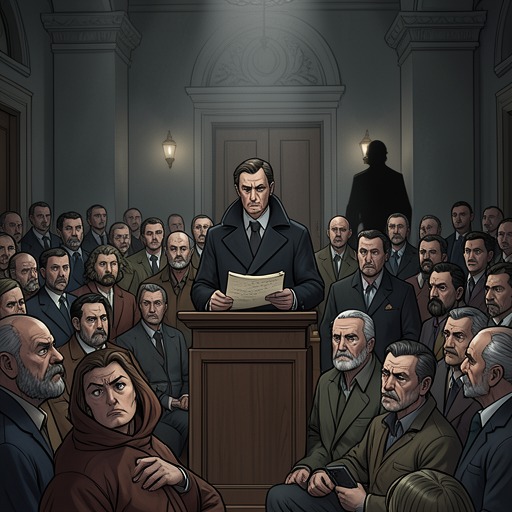
Outside, more than a thousand people have gathered despite the cold, rhythmically applauding and chanting Esterhazy’s name. Louis Leblois warns Picquart not to go out because his picture has appeared in the newspapers and he may be lynched. When Esterhazy emerges, he is accompanied by his lawyer, Hubert-Joseph Henry, and Armand du Paty de Clam, followed by applauding soldiers in black uniforms. He sweeps his cape onto his shoulder and steps into the crowd’s acclaim. Someone hails him as a martyr to the Jews: public enthusiasm has converted the suspected traitor into a nationalist hero.
Mathieu Dreyfus helps Picquart conceal his distinctive uniform by putting his overcoat over it. With Mathieu on one side and Leblois on the other, Picquart keeps his head down and moves along the wet rue Cherche-Midi in the direction opposite to Esterhazy. The courtroom’s verdict therefore has an immediate physical consequence: the officer who has pressed for scrutiny must leave under protection, while the acquitted man is celebrated in the street.
Consequences and the Longer Reckoning
The acquittal does not resolve the Dreyfus affair; it hardens the separation between official judgment and the evidence Picquart says it ignores. After the Minister of War cites secret documents in the Chamber of Deputies, Picquart drafts an open letter to Prime Minister Henri Brisson with Fernand Labori’s help. He states that the two documents dated 1894 cannot be applied to Dreyfus and that the 1896 document shows signs of forgery. The letter carries the dispute beyond the military courtroom, challenging the use of secret evidence in public political argument.
The struggle over the meaning of release also shows how the acquittal’s consequences persist. When Alfred Dreyfus is offered a pardon, Picquart objects that accepting it would amount to an admission of guilt. A statement prepared by Jean Jaurès is intended to make clear that freedom does not restore honour and that Dreyfus will continue seeking reversal of the judicial error. The distinction matters: release can end imprisonment without undoing the verdict, just as Esterhazy’s acquittal can establish his public honour without answering the evidence against him.
The eventual correction comes through years of legal and political review rather than a dramatic courtroom reversal at this trial. Following the André inquiry and further consideration by the Criminal Chamber, the Supreme Court of Appeal quashes the Rennes verdict and fully exonerates Dreyfus on 12 July 1906. The next day, the Chamber of Deputies votes to restore Dreyfus to the army as a major and award him the Legion of Honour; it also votes to restore Picquart to the rank he might have reached had he not been dismissed. That later restoration contrasts sharply with the court-martial’s immediate display of unanimity: the acquittal had closed one inquiry, but it could not permanently close the case.