Esterhazy court-martial
An Officer and a SpyThe Esterhazy court-martial was the January 1898 military trial that declared Charles Ferdinand Walsin Esterhazy innocent, despite evidence identifying him as the writer of the bordereau. By keeping the central handwriting issue beyond the inquiry’s scope, hearing military testimony in secret, and affirming Alfred Dreyfus’s original conviction, the proceeding transformed the effort to investigate a suspected spy into a renewed defense of the army’s earlier judgment.
Background and the Limits of the Inquiry
The case arose within a controversy already shaped by the secret procedures used to convict Alfred Dreyfus. At his court-martial, prosecutor Brisset requested a private hearing on the grounds that the evidence involved national defense; Edgar Demange objected that Alfred Dreyfus had the right to be treated like any other accused person. That earlier dispute established a pattern: military authorities invoked secrecy not merely to protect information, but in a way that restricted what could be examined openly.
Georges Picquart’s own investigation had exposed a further limit. General Gonse told him to forget about the bordereau, while allowing him to investigate Charles Ferdinand Walsin Esterhazy as long as he did not connect that inquiry to the document. During the later inquiry into Picquart’s conduct, Picquart challenged the exclusion directly: the handwriting expert employed by the government accepted that Charles Ferdinand Walsin Esterhazy’s writing matched the bordereau, yet the investigating officers ruled the issue outside their remit. Picquart also raised the use of falsified material in the secret dossier that had convicted Alfred Dreyfus. The court-martial therefore took place amid a dispute over what counted as relevant evidence, and who had authority to define it.
Proceedings and Secret Testimony
The military hearing was fixed for Monday, 10 January 1898. Georges Picquart was summoned as a witness, as was Louis Leblois. On the Friday before the hearing, however, Louis Leblois’s father died in Strasbourg, and Louis Leblois was excused to return to his family. Georges Picquart urged his friend to go. This absence left Picquart to face the proceedings without the companion whose role in the affair had made him a fellow target of scrutiny.
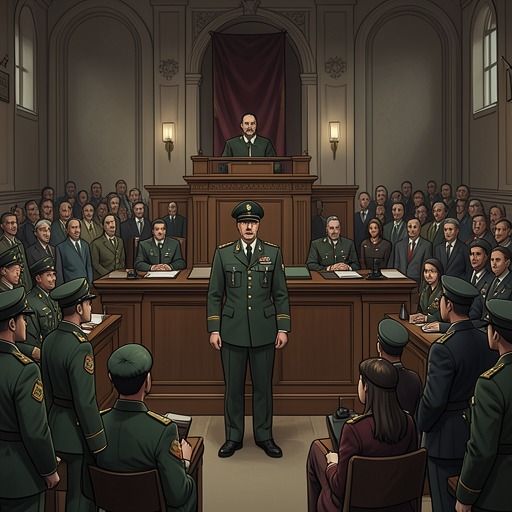
The civil suits brought by the Dreyfus family were rejected, leaving Alfred Dreyfus’s original court-martial verdict in force. The judges also decided by a majority that testimony from military personnel would be heard in secret. Lucie Dreyfus, who had entered with Mathieu Dreyfus, embraced him and left without speaking after the decision. As the hearing continued, witnesses were called away one by one. Mathieu Dreyfus and Auguste Scheurer-Kestner did not return after being summoned; later, General Gonse and the men of the Statistical Section were called together. Georges Picquart watched General Gonse pause at the doorway and look back before the door closed, leaving Picquart alone in the room. The ceremony of a public trial thus concealed much of its most consequential evidence from public view.
Acquittal and Public Celebration
Charles Ferdinand Walsin Esterhazy’s lawyer spoke for five hours, and the hearing lasted until eight in the evening. During the closing speech, Charles Ferdinand Walsin Esterhazy seemed to nod off. When he was led past Georges Picquart before the judges announced their decision, he gave him a stiff, faintly mocking salute. Georges Picquart expected a long wait while the court deliberated. Less than five minutes later, the judges returned and the clerk read a unanimous verdict declaring Charles Ferdinand Walsin Esterhazy innocent and free to leave without dishonor.
The announcement was swallowed by applause. Officers stamped their feet and cheered the army and France; cries of “Death to the Jews!” also rang out. For Georges Picquart, the verdict was not a surprising reversal so much as the confirmation of a result he believed predetermined. Yet its consequences were worse than he had imagined: Alfred Dreyfus, already convicted, was now effectively condemned again, and Georges Picquart thought a third hearing by the army impossible. Outside, more than a thousand people had gathered in the cold, chanting Charles Ferdinand Walsin Esterhazy’s name. He emerged with his lawyer, Hubert-Joseph Henry, and Armand du Paty de Clam, accompanied by applauding soldiers. Sweeping his cape onto his shoulder, he stepped into the crowd to cheers and congratulations.
Georges Picquart could not safely leave by the same route. Louis Leblois warned that his picture had appeared in newspapers and that the crowd might lynch him. Mathieu Dreyfus helped him cover his distinctive uniform with an overcoat; with Mathieu Dreyfus and Louis Leblois beside him, Georges Picquart slipped into the street and walked away in the opposite direction from Charles Ferdinand Walsin Esterhazy. The verdict’s public celebration and its danger to the witnesses who challenged it unfolded almost simultaneously.
Consequences and Significance
The acquittal did not settle whether Charles Ferdinand Walsin Esterhazy had written the bordereau. Instead, the proceedings made that question harder to pursue by separating the suspected author from the document and by withholding military testimony from open scrutiny. The rejection of the Dreyfus family’s suits also meant that the court-martial neither reconsidered nor displaced Alfred Dreyfus’s conviction. The process that might have tested the army’s case therefore reinforced it, while leaving the evidence Georges Picquart considered decisive outside the inquiry.
The contrast between formal acquittal and public acclaim exposed how the verdict functioned beyond the courtroom: Charles Ferdinand Walsin Esterhazy was celebrated as a vindicated figure, while opposition to the ruling drew jeers and threats. In later proceedings, Georges Picquart again insisted that the matching handwriting and falsified material could not be dismissed as irrelevant. After the Minister of War publicly cited secret documents, he helped draft an open letter to Prime Minister Henri Brisson stating that two documents dated 1894 could not be applied to Alfred Dreyfus and that the document dated 1896 showed evidence of forgery. Still later, when Alfred Dreyfus’s pardon was discussed, Georges Picquart objected that accepting it would amount to an admission of guilt. These later disputes did not change the court-martial’s verdict; they show how its unresolved evidentiary exclusions continued to shape the struggle over Alfred Dreyfus’s name and freedom.