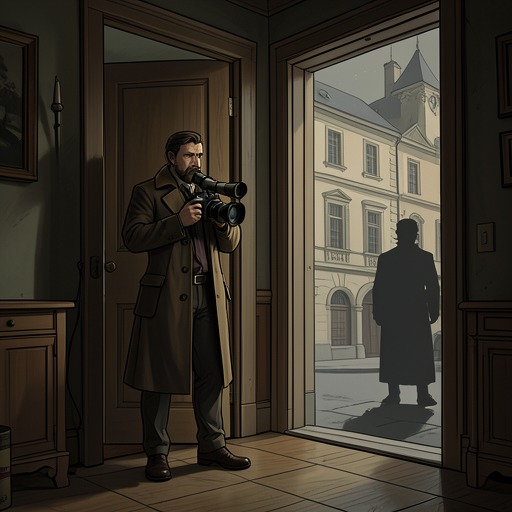
Esterhazy embassy surveillance photographs
An Officer and a SpyEsterhazy embassy surveillance photographs turn a shadowed figure and a white object into a consequential sequence of evidence. Shown to Georges Picquart by Desvernine, the images depict Esterhazy at the German embassy: one catches him leaving, while a later-presented companion photograph shows him entering with something in his hand. Together, their contrasting clarity and details support an inference of a transfer without revealing what the item was or who received it.
The First Image and Identification
Desvernine first produces an envelope and a magnifying glass. The photograph inside measures ten by thirteen centimetres. Picquart takes it to the window for better light, but the image remains difficult to read: a man is leaving through the embassy gates, and his forward movement has blurred his figure. The bright May sun has cast a shadow behind him that is sharper than the man himself.
Prolonged examination makes the indistinct photograph more persuasive, not less. The decisive clues are the figure’s distinctive round eyes and extravagant ram’s-horn moustache, which Picquart recognizes as Esterhazy’s. The image therefore depends on close scrutiny rather than immediate legibility: its evidentiary force emerges from particular features that survive the blur. It captures a departure, but on its own it says nothing about what the departing man may have brought into or taken out of the embassy.
A Sharper Portrait and a Paired View
At a later meeting, Desvernine sets another photograph face down on the café table at Gare Saint-Lazare. This time no magnifying glass is needed. The picture is so sharp that Picquart compares it to a studio portrait: Esterhazy, wearing a grey bowler, is coming out through the German embassy gates, with what appears to be a half-smile on his face. His return to the embassy is immediately noticeable, but Desvernine directs Picquart’s attention to a more consequential detail: what Esterhazy has in his hand.
Picquart initially sees an empty hand. Desvernine then slides over a second photograph. It shows a man in three-quarter profile, blurred in motion as he turns from the street to enter the embassy. In his right hand is something white, possibly an envelope or package. The image does not establish the object’s contents or identify a recipient; its significance comes from comparison with the picture of Esterhazy leaving.
The Sequence and Its Evidentiary Limits
Laid side by side, the photographs connect the figure entering with the figure exiting through the grey bowler, as well as his height and build. The timestamps give the comparison its force: the interval between the two images is twelve minutes. In the entry photograph, the matching figure carries a white object; in the exit photograph, his hand is empty. Picquart’s conclusion that Esterhazy has been careless follows from this visible contrast and the short interval between the images.
The pair makes a stronger case than either photograph alone. The blurred image of the entrance supplies the otherwise missing object, while the clearer departure image helps identify the man and shows no object in his hand. Taken together, they support the inference that Esterhazy entered the German embassy carrying something and left without it. They do not show what happened inside, prove that the item was handed over, or disclose its contents. Their value is the narrow but important connection they establish between Esterhazy, the embassy, and a brief sequence of movements.
Significance in Picquart’s Investigation
The photographs make surveillance evidence visible in a form Picquart can inspect and compare for himself. Their details matter differently: the first image’s moustache and eyes establish identity despite blur; the later pair’s grey bowler, stature, build, hand, and twelve-minute interval establish a sequence. What begins as a difficult likeness becomes a pattern of entry and exit, giving Picquart a concrete visual reason to treat Esterhazy’s embassy visits as significant.
At the same time, the images retain the limits of observation. They record figures at the gates, not the encounter within the embassy. The white object remains only an envelope or package as far as the photograph allows, and the empty hand afterward suggests a transfer without showing one. That gap between what the camera records and what the investigator can infer is central to the photographs’ importance: they sharpen suspicion and connect Esterhazy to the German embassy, while leaving the decisive contents and recipient outside the frame.