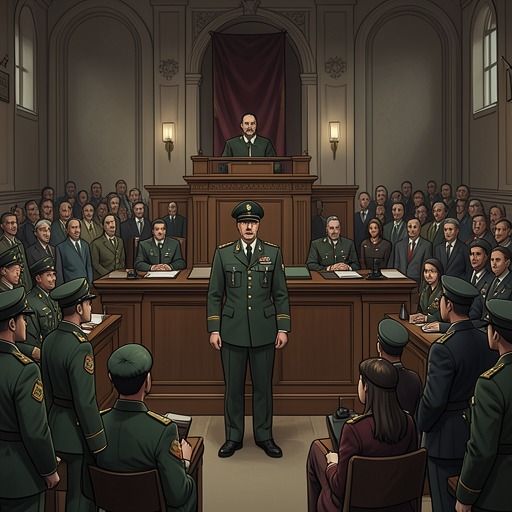
First Permanent Court-Martial of the Military Government of Paris
An Officer and a SpyThe First Permanent Court-Martial of the Military Government of Paris is the tribunal that convicted Alfred Dreyfus in the case at the center of the Dreyfus Affair. Its decisive act was not simply to find him guilty: the court first excluded the public from the hearing on grounds of national security, then announced its verdict in public, converting a closed examination of contested evidence into a public declaration of treason. The sentence led directly to Alfred Dreyfus’s discharge, life deportation, and military degradation, while the trial’s secrecy became one of the central conditions against which later challenges to the conviction had to contend.
Authority and the case against Alfred Dreyfus
The court’s role followed a prosecution assembled before the hearing. At a meeting chaired by Auguste Mercier, the proposed arrest warrant was ready for signature while officials discussed conflicting handwriting opinions. The first expert, from the Banque de France, had concluded that the writing was not Alfred Dreyfus’s; Armand du Paty de Clam reported a contrary assessment from Alphonse Bertillon, who argued that the bordereau contained features of Alfred Dreyfus’s handwriting and that differences were deliberate. The disagreement was treated as a difference between experts rather than as a reason to suspend the prosecution. Auguste Mercier authorized the plan to proceed, and signed the arrest warrant.
That preliminary decision-making establishes the evidentiary difficulty that would define the trial: the case rested on material whose interpretation was disputed even within the authorities handling it. The court did not originate the arrest or the competing handwriting claims, but it became the institutional forum in which the accusation was to be judged. Later, when Georges Picquart showed Charles-Arthur Gonse the petit bleu, surveillance photographs, and the secret file, he said he had found nothing in the file that could establish Alfred Dreyfus’s guilt beyond doubt. Charles-Arthur Gonse urged him to investigate Ferdinand Walsin Esterhazy if he wished, but to leave the bordereau out of that inquiry. The instruction did not alter the original verdict, but it showed how the most consequential evidence remained politically sensitive after the trial.
The hearing and the closed courtroom
The hearing took place in a former convent. Its small chamber was crowded with reporters, gendarmes, soldiers, and spectators; a judges’ table covered in green baize stood beneath a mural of the Crucifixion. Carpets covered the windows, shutting the room off from the outside. Alfred Dreyfus sat opposite the judges, with his attorney Edgar Demange and the prosecutor Brisset nearby. Georges Picquart, attending as an observer for the minister, had a chair behind and to one side of the judges. His position gave him a view of the proceedings without making him one of the decision-makers.
The turning point came when Brisset asked for the hearing to be held in private, arguing that the evidence concerned national defence. Edgar Demange objected that his client had the right to be treated like any other accused person. The court withdrew briefly to consider the request. When the judges returned, Colonel Maurel ordered the spectators out, again invoking the gravity and sensitivity of national security. The press and public were cleared in about two minutes. Only thirteen people remained, including Alfred Dreyfus, his defender and prosecutor, the seven judges, the clerk, a police official, and Georges Picquart. The decision did more than restrict attendance: it removed public observation from the proceedings and left the defence to confront the accusation inside a sealed institutional space.
The public and private phases gave the trial a strikingly divided form. The room had been filled with spectators and reporters, but after the doors closed, the hearings proceeded beyond their view. At the verdict, the courtroom was opened again. The contrast meant that the public could witness the result without having witnessed the full evidentiary process that produced it.
Verdict, sentence, and public degradation
When the verdict was read in public, the clerk invoked the authority of the French people and the court’s in-camera proceedings. The seven judges raised their hands to their caps in salute. At the word Guilty, a voice from the back of the courtroom shouted Vive la patrie, and reporters rushed out. Edgar Demange remained behind with his head in his hands, crying. The verdict had become public, but the scene also registered the human shock of its delivery and the abrupt passage from legal decision to public reaction.
The court sentenced Alfred Dreyfus to deportation for life to a fortified enclosure, ordered his discharge from the army, and directed that his degradation take place before a Paris garrison parade. At the École Militaire, four gunners escorted him across the parade ground as four thousand soldiers stood in formation. After the escort halted and saluted, the condemned man was left alone before General Darras. The official proclamation stated the sentence; Darras then declared, “Alfred Dreyfus, you are not worthy to bear arms. In the name of the French people, we degrade you!”
The ceremony made the court’s judgment visible on Alfred Dreyfus’s body and uniform. His insignia were stripped away, and he was marched around the cour Morland before the assembled detachments. He repeatedly called, “I am innocent!” while people in the crowd jeered and called him a traitor. The march lasted seven minutes by Georges Picquart’s watch, though it seemed to drag on. A legal finding had thus been made into a military lesson: the spectacle was intended to impress on the soldiers how the army dealt with a traitor. Its public force depended on the audience accepting the court’s conclusion, even as Alfred Dreyfus continued to deny it.
Secrecy, scrutiny, and the challenge to the verdict
The court’s closed proceedings acquired renewed significance as the case was questioned. In a later inquiry, Georges Picquart asked whether he would be allowed to address the central facts, including that Ferdinand Walsin Esterhazy had plainly written the bordereau and that the government’s principal expert accepted the handwriting as a match. He also raised the use of falsified material in the dossier used to convict Alfred Dreyfus. The inquiry’s response placed those matters outside its scope. Although this was not the original court hearing, it exposed the continuing limits on review: the questions most directly bearing on the conviction could be excluded from the very process meant to examine the affair.
When Godefroy Cavaignac later cited secret documents in the Chamber of Deputies, Georges Picquart drafted an open letter to Prime Minister Henri Brisson with the help of Fernand Labori. Picquart stated that he could establish before a competent tribunal that the two documents dated 1894 could not be applied to Alfred Dreyfus, and that the document dated 1896 showed signs of forgery. The letter moved the dispute beyond military channels and called for evidence to be tested before a competent tribunal. It also underscored the difference between asserting that secret papers proved guilt and demonstrating that they did so.
The same distinction surfaced when Alfred Dreyfus accepted a pardon. Georges Picquart objected that accepting it amounted to an admission of guilt. The answer was that Alfred Dreyfus would issue a statement on leaving prison insisting that freedom did not restore his honour and that he would continue to seek reversal of the judicial error. A pardon could end imprisonment without settling the truth of the charge. The court’s conviction therefore remained a legal and public problem beyond the immediate sentence.
Aftermath and institutional reversal
The eventual correction came through a prolonged sequence of political and judicial steps, not through a sudden reversal inside the original courtroom. In 1903, after Jean Jaurès set out the affair in a speech to the Chamber of Deputies, General André agreed to examine the evidence again. The resulting inquiry led the Criminal Chamber to take up the case and recommend review by the Supreme Court of Appeal. Political turmoil delayed the process, but on 12 July 1906 the court quashed the Rennes verdict and fully exonerated Alfred Dreyfus.
The following day, the Chamber of Deputies voted to restore Alfred Dreyfus to the army as a major and award him the cross of the Legion of Honour, by 432 votes to 32. A separate motion restored Georges Picquart to the rank he might have attained had he not been dishonourably discharged in 1898; it passed by 449 votes to 26. Alfred Dreyfus’s medal ceremony took place on the parade ground of the École Militaire, the same setting associated with his degradation. The later ceremony did not erase the earlier judgment or its consequences, but it reversed the public military meaning imposed there: the man once presented as a traitor was restored to rank and honour. The First Permanent Court-Martial of the Military Government of Paris remains central to the affair because its conviction, its reliance on a secret hearing, and the public punishment that followed became the starting point for a long struggle over what evidence could be examined and what justice required.