French General Staff Statistical Section
An Officer and a SpyThe French General Staff Statistical Section was a secret intelligence office whose work shaped both the Dreyfus investigation and the later effort to uncover its errors. Operating from a concealed, shuttered house rather than an identifiable ministry office, it gathered discarded embassy papers through agents, rebuilt torn documents, monitored individuals, and kept a substantial archive. Its methods created powerful channels of information, but the records also showed how easily fragments and insinuations could be made to support a false accusation.
Identity, leadership, and hidden premises
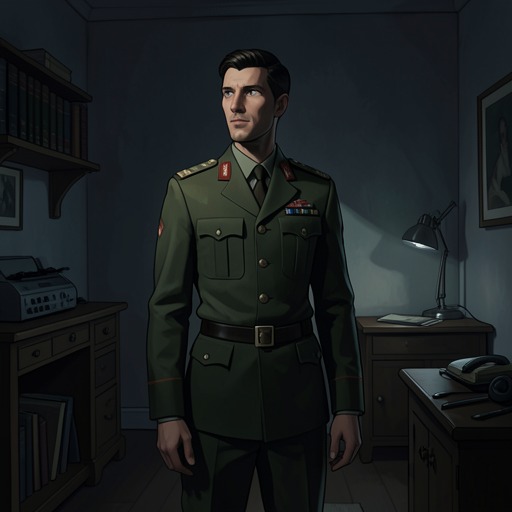
The Section was headed by Colonel Jean Sandherr from 1887 to 1895, then by Colonel Georges Picquart from 1895 to 1897. Major Hubert-Joseph Henry and Captain Jules-Maximillien Lauth were among its officers. Its very existence was little known: when Henry showed Picquart the premises, he led him out through a back gate and along the road to an old, grimy house on the rue de l’Université. Picquart had passed the building before and assumed it was derelict. Its windows were shuttered, there was no nameplate, and its damp, gloomy interior offered no public sign that an intelligence office operated there.
The building’s obscurity was not incidental to its work. Henry explained that Colonel Sandherr had stopped the house from being demolished because, as Picquart understood it, nobody disturbed them there. The Section’s secrecy thus depended not only on concealed files and coded sources but on an unremarkable address that kept the institution itself out of view. Picquart compared its private customs to those of a religious sect, a striking contrast with the visible offices of the Ministry of War and the General Staff.
Informants, documents, and surveillance
A central source was an agent inside the German Embassy who retrieved documents thrown away for destruction in the embassy furnace. Many arrived torn into pieces, and the Section had to reconstruct them. Henry credited Lauth with skill in this work and said that the first clue against Dreyfus had emerged from a reassembled letter. The source was called Auguste, while the documents obtained through it were referred to by a code name. Picquart pressed Henry for the source’s identity because, as the new head of the Section, he wanted to understand how the service functioned; the exchange establishes the importance of the information channel without identifying the agent in the account.
The reconstructed petit bleu demonstrated what this practice could recover. Lauth brought Picquart a thin manila folder containing the blue telegram, carefully pasted together despite missing pieces along one edge. Its fragile, jagged surface preserved the evidence of its recovery, while the French message remained legible. In the Section, physical fragments were not merely discarded remnants: once joined, they could redirect an investigation.
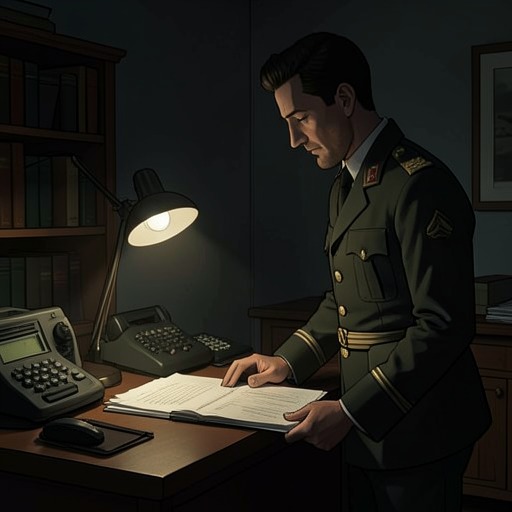
The office also worked through human informants and surveillance. In a briefing arranged by Henry, the Sûreté agent Guénée reported on monitoring the Dreyfus family under Colonel Sandherr’s instructions. His inquiries focused on Mathieu Dreyfus, whom he described as having moved from the family home in Mulhouse to Paris to organize a campaign for his brother. Guénée brought a file and a studio photograph to Picquart’s office, turning surveillance into a formal briefing supported by material gathered outside the Section.
Another account in Henry’s later deposition traced reports about a possible spy in the General Staff. In March 1894, Guénée met the Spanish military attaché, the marquis de Val Carlos, who warned that a General Staff officer was informing German officials. Henry’s deposition said that Val Carlos could not name the officer; when Henry met him in June, the attaché again asserted that a French officer had passed information to German and Italian military attachés but did not know his identity. The report led Colonel Sandherr to order more rigorous surveillance. The Section therefore received intelligence through an indirect chain of attaché, police agent, and military officers, with the crucial name still absent.
Picquart’s operations and the archive
Under Picquart, the Section mounted a surveillance operation against Charles Ferdinand Walsin Esterhazy under the name Operation Benefactor. Picquart opened an active case file and arranged for Ducasse to rent an apartment opposite the German Embassy at 101 rue de Lille, across from the embassy at number 78. Desvernine, posing as Houdin, explained the work to Ducasse; a delivery van brought sealed cases of optical and photographic equipment and darkroom chemicals, carried upstairs by technical staff from the Sûreté. Picquart later inspected the apartment himself. The operation made the Section’s work a coordinated undertaking involving covert housing, equipment, personnel, and observation of the embassy.
The files that Picquart later searched reveal the breadth of the archive built around Agent Auguste. During a clandestine examination of the cabinets, he gathered its surviving materials: letters and telegrams from Berlin, correspondence addressed to Max von Schwartzkoppen by German, Italian, and other foreign officials, and an envelope of cinders dated November 1890. The folders also held dozens of intimate letters from Hermance de Weede and many more from Alessandro Panizzardi. The archive joined military and diplomatic intelligence to private correspondence, preserving documents whose evidentiary value varied widely but whose accumulation made the Section a powerful custodian of other people’s secrets.
A particularly consequential trail connected a note offering the secret of smokeless powder to the name Dubois. Picquart found that Panizzardi had written of seeing M. Dubois, then located an April 1894 report by Henry identifying Jacques Dubois, a printer working for a factory with Ministry of War contracts, as a possible source of plans. Henry’s report concluded that Dubois had no access to classified material and that the plans he supplied were publicly available; it recommended no further action. Picquart’s conclusion was explicit: the D implicated in this material was Dubois, not Dreyfus. The Section’s own records thus contained a correction to the inference that had helped implicate Dreyfus, although that correction had not prevented the accusation from taking hold.
Secret evidence and public exposure
The Section’s part in the Dreyfus affair also appears in the secret dossier submitted to the judges. When Picquart examined its five documents, he found circumstance and insinuation rather than a document or witness directly identifying Dreyfus as a traitor. The nearest approach was an initial attached to an allegation. He questioned the dossier’s chronology and its practical claims about how plans could have been removed from a safe, copied, and returned undetected. The material’s official status could make it seem conclusive, but Picquart’s inspection exposed gaps between the accusations and what the documents actually established.
Secrecy proved difficult to contain. After a newspaper alleged that a secret file had proved Dreyfus’s guilt and demanded publication of its contents, Picquart counted the people who knew of the dossier. His list reached twenty, including military leaders, Section officers, the judges, the President, and the President’s doctor, before accounting for anyone Mathieu Dreyfus might have told. The leak prompted alarm inside the office, and Picquart feared that senior officers would respond by restricting the investigation rather than allowing disclosure to clarify the case.
Charles Ferdinand Walsin Esterhazy’s subsequent accusation against Picquart brought the Section’s covert work into public controversy. In an interview printed in Le Matin, Esterhazy said that Picquart had opened an investigation against him, passed information through his lawyer to supporters of Dreyfus, and been sent to Tunisia by his superiors. The accusation cast Picquart’s intelligence methods as a conspiracy against Esterhazy, even as it made the previously shadowed investigation visible to newspaper readers. Across these episodes, the French General Staff Statistical Section is both an engine of surveillance and a contested archive: it gathered the fragments from which powerful claims were built, but its own records could also reveal the mistaken identities and unsupported leaps beneath them.