French government
An Officer and a SpyThe French government is a central but internally divided force in the Dreyfus Affair: it can invoke national defence to close proceedings and prosecute disclosures, yet its efforts to contain the case repeatedly carry the dispute into public and legal arenas. The narrative distinguishes the government’s actions from the military command’s resistance, while showing how closely their authority and interests overlap. The result is a shifting institutional response in which access to evidence, the scope of inquiry, and the meaning of justice are all contested.
Executive power and military secrecy
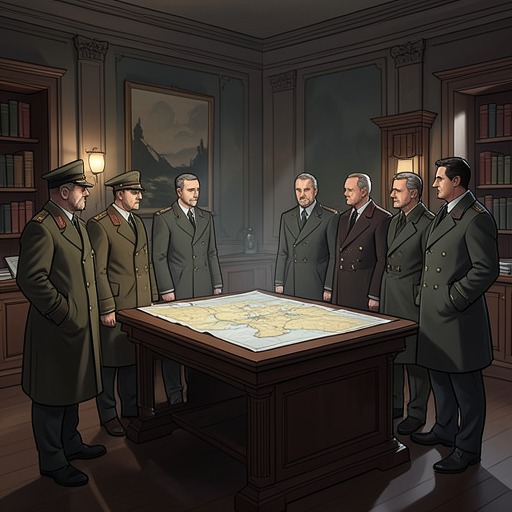
The government’s handling of the case begins within a system that treats military secrecy as a reason to restrict what may be heard and seen. At Alfred Dreyfus’s court-martial, the prosecutor asks for a private hearing because the evidence concerns national defence. Edgar Demange objects that Dreyfus should receive the same treatment as any other accused person. The request puts the conflict plainly: the government’s security rationale can narrow the public’s access to a proceeding whose outcome depends on evidence the defence cannot freely examine.
That secrecy does not remain confined to the courtroom. When Georges Picquart takes possession of the secret file, he counts the people who know of it: senior officials, intelligence staff, the judges, the court president, the president’s doctor, and Mathieu Dreyfus, who has learned of it through another person. The list reaches twenty before Picquart considers how many more people Mathieu may have told. The file’s circulation makes secrecy less a stable safeguard than a growing institutional risk. Picquart fears that its appearance in the press will prompt Raoul le Mouton de Boisdeffre and Charles-Arthur Gonse to tighten their resistance to an investigation.
The government’s relationship to that resistance is not identical to the General Staff’s. Gonse tells Picquart to investigate Charles Ferdinand Walsin Esterhazy if he wishes, but not to connect the inquiry to the bordereau. The instruction exposes the boundary the military leadership wants to impose on investigation: a suspect may be pursued only so long as the evidence that could reopen Dreyfus’s case is kept out of view. The narrative presents this as institutional pressure within the state, not as a single, uniformly stated government policy.
Proceedings, evidence, and public scrutiny
A report in L’Éclair marks the first mention in the press of the secret file. It claims that secret evidence proved Dreyfus’s guilt and urges the army to publish it. The disclosure comes just after Picquart has taken possession of the dossier, making him suspect that someone inside the circle of officials has spoken. He recognizes the paradox: disclosure might vindicate his position, but it could also strengthen the leaders’ resolve to restrict the investigation.
The government’s management of scrutiny is also visible in the inquiry into Picquart. When he challenges the proceedings, he asks whether he will be allowed to address the central facts: that Esterhazy plainly wrote the bordereau, even according to the government’s principal handwriting expert, and that falsified material was used in the dossier against Dreyfus. The inquiry rules the first issue outside its scope. Its limits matter as much as its formal existence: Picquart is being questioned, but the evidence that could redirect suspicion is excluded from the examination.
The trial of Émile Zola opens another route into public view. After Picquart is imprisoned at Mont-Valérien, the government brings a criminal-libel charge against Zola, and the case is sent to a public hearing at the Court of Assize in the Palace of Justice rather than handled in a closed military chamber. Picquart is subpoenaed to testify. During the proceedings, Georges de Pellieux asserts that he has seen a document proving Dreyfus’s guilt. Picquart recognizes it as the supposed embassy letter that Jean-Baptiste Billot had previously read aloud but refused to show him. The public setting makes the claim audible, while also exposing the continuing reliance on a document whose provenance Picquart disputes.
Disclosure and prosecution
After Godefroy Cavaignac cites secret documents in the Chamber of Deputies, Picquart drafts an open letter to Prime Minister Henri Brisson with Fernand Labori’s help. He states that he can establish before a competent tribunal that the two documents dated 1894 cannot be applied to Dreyfus and that the document dated 1896 shows signs of forgery. His letter shifts the dispute from private military knowledge to a direct challenge addressed to the head of government, and it argues that officials who trusted the documents may themselves have been misled.
The government responds with a criminal charge against Picquart, alleging that he illegally revealed documents important to national defence and security. His apartment is raided while a crowd jeers outside, and he is arrested alongside Louis Leblois. The sequence gives the government’s security argument an immediate personal consequence: the officer who contests the evidence becomes a defendant accused of disclosing it. Even after Picquart is refused parole and told he will stand trial in an ordinary criminal court for transmitting secret documents, Labori warns him that the army is bringing fresh charges.
Accountability and unresolved consequences
The confession of Hubert-Joseph Henry changes the political situation, but it does not bring an immediate end to the government’s handling of the case. Picquart assumes that once Henry’s forgery is acknowledged, the case against Dreyfus will collapse. Instead, Dreyfus remains on Devil’s Island while Picquart remains in La Santé. The government does not promptly acknowledge the army’s mistake, and Picquart’s expectation of a decisive institutional reversal gives way to continued imprisonment and prosecution.
The dispute over Dreyfus’s pardon shows another limit of governmental redress. When Georges Clemenceau’s associate explains that a pardon will free Dreyfus and that Jean Jaurès has prepared a statement calling for the wrongful judgment to be overturned, Picquart objects that accepting a pardon amounts to an admission of guilt. The proposed statement distinguishes release from exoneration: freedom can be granted by the Republic, but it does not restore honour or erase the conviction. Across these episodes, the French government appears not as a single mind but as a contested machinery of executive decisions, military secrecy, public trials, and criminal charges. Its actions can open a hearing or impose a prosecution; neither, by itself, resolves the underlying question of Dreyfus’s innocence.