Georges Picquart
An Officer and a SpyGeorges Picquart’s decisive role in the Dreyfus affair is not simply that he finds evidence against Esterhazy; it is that, after the discovery threatens his place in the army, he chooses to act on what the evidence means. The book follows him from an uneasy appointment in military intelligence through the suppression of his findings, his testimony at the Rennes trial, and his eventual restoration to the army and appointment as Minister of War. His career becomes a test of whether institutional loyalty can survive the truth it is meant to conceal.
Identity and Entry into Intelligence
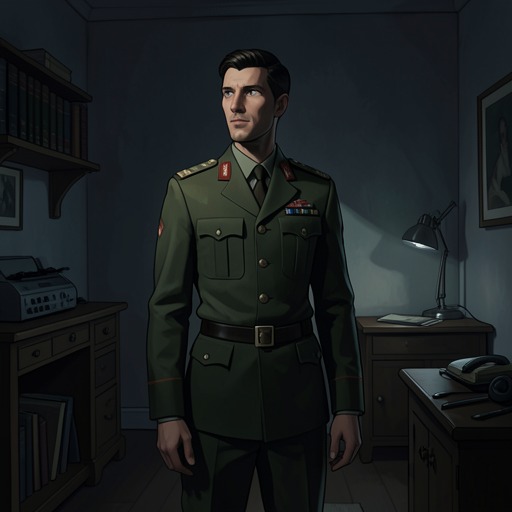
Picquart first appears as a major arriving urgently at the Ministry of War. At the Hôtel de Brienne, snow hushes the courtyard and the lights shimmer through the trees, a moment of stillness before a professional world organized around secrecy and command. The scene places him inside the institution he will later challenge: he enters its official residence in uniform, following a Republican Guard captain up the staircase, yet his eventual difficulty will be deciding when obedience no longer serves justice.
The Chief of Staff tells him that the Minister of War has been impressed by his conduct during the Dreyfus affair and that he is being considered for command of the Statistical Section. Picquart is dismayed. He considers espionage grubby work and doubts that it is what he joined the army to do. His objection is practical as well as personal: Colonel Sandherr already commands the section. He is told that Sandherr is seriously ill and unlikely to recover, and that a decade in the post has made a rest necessary. Picquart’s promotion thus begins as an assignment he does not want, made in the shadow of another officer’s decline.
The offer also exposes the private-life scrutiny attached to intelligence work. Because of the secret information he would handle, Picquart is asked whether anything in his past or private life could make him vulnerable to blackmail. The question establishes the section’s particular atmosphere: the officer is not merely expected to investigate secrets but is himself examined for possible weaknesses. His reluctance to take the post is an early contrast with the authority he will later exercise through it.
Evidence Against Esterhazy and Doubt About Dreyfus
As head of the Statistical Section, Picquart encounters the petit bleu, a torn pneumatic telegram card. Captain Lauth painstakingly reconstructs it, returning hours later with the pieces joined inside a thin manila folder. The uneven, incomplete card is at once a fragile object and a legible message. Its restoration gives Picquart a first substantial lead, and the investigation gradually identifies Esterhazy as a spy selling French secrets to a foreign power. Picquart regards that conclusion as straightforward in factual terms, but he refuses to let it settle the far more consequential question of Dreyfus’s guilt.
That distinction governs his investigative method. Once he has discussed the implications with Colonel Foucault, Picquart concludes that he has found at least one spy and that doubt about Esterhazy is gone. But he treats the case against Dreyfus as a separate, much larger problem. He orders himself to proceed one step at a time, remain dispassionate, avoid rushing to judgment, and confide in nobody until there is hard evidence. Those four principles are not a ceremonial code: they restrain the temptation to turn one discovery into a complete explanation before the documents can support it.
A photograph of the bordereau provides another decisive comparison. Picquart sits motionless with it, struck not only by the matching handwriting but by the content: its fixation on artillery, the offer to copy a manual, and the obsequious tone all point, in his view, toward Esterhazy. He considers going directly to the Minister of War with the evidence, then judges that this would be folly. Instead, he takes the material to Lauth. Even as the case against Esterhazy strengthens, Picquart keeps the evidentiary process slower than his impulse to expose it.
The evidence also forces him to look at his own standing in the affair. Armand du Paty de Clam accuses him of having been Auguste Mercier’s errand boy during Dreyfus’s court-martial, someone who advised the Minister of War on tactics and obtained his present position by telling him what he wanted to hear. Picquart leaves too angry to answer. On the walk back, however, the accusation unsettles him: he imagines seeing himself in a mirrored room from an unfamiliar angle and asks whether that is really how he appears to others. His concern is not merely the insult. The charge makes his former service in the case part of the evidence he must examine about himself.
Confronting the General Staff
At ten o’clock on Tuesday, 1 September, Picquart presents himself at Boisdeffre’s office with a briefcase. Inside are the reconstructed petit bleu, a photograph of the bordereau, Esterhazy’s letters requesting a transfer to the General Staff, surveillance photographs of Esterhazy outside the German Embassy, the secret dossier on Dreyfus, and Picquart’s four-page report. Boisdeffre’s astonishment at the collection gives way to reluctance; he would plainly rather return to the map on his table than face the matter. Picquart nevertheless tells him that there is a serious problem and that he has a duty to bring it forward immediately.
The meeting does not resolve the conflict between institutional protection and disclosure. Picquart recognizes that he has spent twenty-four years advancing through the army, but also that retaining his career at the cost of becoming one of the men who defend the cover-up would empty that career of honour and pride. By nightfall, he decides to bypass Boisdeffre and General Gonse and use his unrestricted access to the Hôtel de Brienne to present the case personally to the Minister of War. He sees the first signs of a larger disturbance, but his immediate choice is concrete: to carry the evidence past the officers who have not acted on it.
His clandestine search of the intelligence archives gives the question of Dreyfus’s innocence a documentary answer. A report from Major Henry, dated April 1894 and addressed to Colonel Sandherr, concerns the identity of the agent called D. The report identifies that agent as Jacques Dubois, a printer who could make extra copies of plans while operating a printing machine; it also says the plans he supplied were publicly available and recommends no further action. Picquart’s conclusion is blunt: D is not Dreyfus but Dubois. The finding does not erase the earlier injustice, but it removes the supposed identity on which a crucial part of the accusation rested.
Picquart later tells Louis Leblois that he has been punished for discovering that Captain Dreyfus is innocent. He gives Leblois an envelope intended for delivery to the President if Picquart dies. The gesture shows how far his sense of danger has shifted: an accusation of wrongdoing has become, in his own assessment, a threat serious enough to warrant a contingency for his death. The envelope makes his resolve legible not as a triumphant public posture but as a private preparation for consequences he cannot control.
Testimony at Rennes
At the Rennes trial, Picquart walks to the courtroom before dawn with Edmond. He wears a black frock coat and the ribbon of the Legion of Honour; a Webley is concealed in his shoulder holster. Two policemen trail the pair through the quiet streets, and at the courtroom entrance mounted gendarmes, checked papers, and infantry with fixed bayonets mark the security surrounding the proceedings. The official machinery is conspicuous, while the testimony that might challenge its earlier decisions must still make its way through the court.
Before Labori’s planned cross-examination of Mercier, Picquart visits the lawyer at his lodgings to help him prepare. He identifies three decisions by Mercier as fundamental: confining the spy-hunt to the General Staff, ordering Dreyfus held in solitary confinement for weeks in an effort to break him, and ordering the secret dossier compiled. Picquart distinguishes Mercier’s actions at the beginning from what he believes followed Dreyfus’s refusal to confess. Once the handwriting of the bordereau was all the army had against him, Picquart says, his view is that the authorities panicked and began fabricating evidence. The testimony preparation turns his knowledge of the process into an account of how procedural choices hardened into a false case.
When Picquart is called to testify, he stands on the raised platform before a panel of two colonels, three majors, and two captains. Alfred Dreyfus sits barely two metres away, close enough to shake hands with but beyond the possibility of speaking to during the proceeding. Picquart swears to tell the complete truth and concentrates on the testimony rather than the physical proximity of the man whose case has shaped his own. The scene makes their connection both intimate and constrained: Picquart can speak for the evidence in public, but the rules of the court keep the two men apart.
Restoration and Narrative Significance
The book presents the eventual victory as slow and administrative rather than spectacular. In 1903, Jean Jaurès delivers a day-and-a-half speech in the Chamber of Deputies, after which the new Minister of War, General André, agrees to examine the evidence. The André inquiry leads the Criminal Chamber to take up the case and recommend review by the Supreme Court of Appeal; political turmoil then delays the outcome. On 12 July 1906, the Court of Cassation quashes the Rennes verdict and fully exonerates Dreyfus. Facts are sifted and sifted again in speeches, inquiries, and legal chambers: justice arrives through a process Picquart’s earlier insistence on evidence had anticipated, not through a single courtroom revelation.
The following day, the Chamber of Deputies votes 432 to 32 to restore Dreyfus to the army as a major and award him the Legion of Honour. A separate motion restores Picquart at the rank he might have attained had he not been dishonourably discharged in 1898; it passes 449 to 26. He returns to the parade ground of the École Militaire for Dreyfus’s medal ceremony wearing the uniform of a brigadier general. The return reverses the public and professional exclusion imposed on him, but it does not make his recovery the story’s sole measure of justice: Dreyfus’s restoration is occurring beside his own.
On 25 October, Georges Clemenceau becomes prime minister. Picquart is in Vienna with Pauline at the opera when a telegram is passed along to him from the French Embassy: Clemenceau has appointed him Minister of War and orders him back to Paris. The appointment brings him to the office whose authority he once sought to reach with evidence that senior officers were reluctant to confront. Its significance lies in the path between those moments: he has returned to power after risking the career that power rewards.
In the final exchange, Picquart tells Dreyfus that he would never have attained the appointment without him. Dreyfus answers that Picquart attained it because he did his duty. The exchange makes their relationship reciprocal without suggesting that they experienced the affair in the same way: Picquart’s career and conscience were transformed by the case, while Dreyfus endured its central injustice. Picquart’s defining achievement is therefore not simply advancement after disgrace. It is the choice that makes advancement meaningful again: acting on the evidence when doing so threatens the institution, and the place within it, that he had spent his life serving.