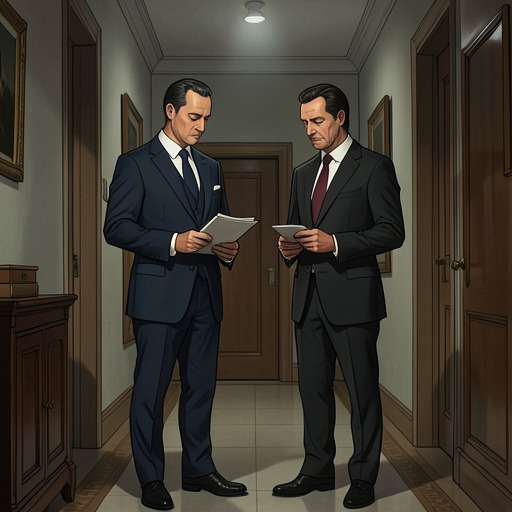
Georges Picquart—Louis Leblois
An Officer and a SpyGeorges Picquart—Louis Leblois is a friendship rooted in their school years that becomes consequential when Picquart’s investigation puts his career and freedom at risk. Louis Leblois is not merely a trusted confidant: his legal judgment, discretion, and willingness to assume professional danger help turn Picquart’s private knowledge into a carefully protected case for justice.
A friendship formed before the affair
Picquart and Leblois had known each other since school, and Picquart later describes Leblois as his oldest friend and a man whose integrity he can vouch for absolutely. Their connection belongs to a circle of people with shared roots: at a family lunch, they sit together among friends from Picquart’s past, including people who had grown up near Strasbourg. The setting presents the relationship as older than the crisis that will test it, though their closeness is not constant. Leblois eventually tells Picquart that his brilliant career has left little room for friendship and urges him to keep those ties in repair by coming home for supper. Picquart declines, showing the imbalance that has developed between his work and his personal life.
The friendship nevertheless retains the familiarity needed for candor. Leblois can speak to Picquart not only as a lawyer but as a friend concerned about his absence from their shared life. Picquart, in turn, trusts him with matters he cannot discuss openly with most people. Their bond is not represented as effortless or uninterrupted; its importance lies partly in the fact that Picquart must return to it after allowing his career to take precedence.
Trust tested by official secrecy
Their professional alliance begins with an assignment that appears remote from the Dreyfus affair. Picquart, as head of the Statistical Section, is asked to prepare the War Ministry’s opinion on proposed legislation concerning homing pigeons. Unsure how to assess the file, he turns to Leblois, whom he considers the best lawyer he knows. He sends a brief message asking his friend to call at the office to discuss business. The request gives their friendship a practical form: Picquart relies on Leblois’s expertise when official work exceeds his own knowledge.
The visit immediately raises a question of access. A colleague objects that Leblois is not a police officer and that Picquart’s office contains highly secret files. Picquart answers that Leblois is an officer of the courts, has been known to him for thirty years, and is completely trustworthy; the file in question concerns carrier pigeons and is not classified. He also notes that the other secret files are locked away. The exchange distinguishes personal trust from careless disclosure. Picquart does not deny the sensitivity of his office; he argues that this particular consultation is limited and that Leblois’s character warrants confidence.
Leblois completes the task with concise, carefully written notes identifying the points Picquart should make. Yet the encounter does more than solve an administrative problem. Leblois uses it to raise the cost of Picquart’s professional absorption: friendships, he says in effect, also require attention. Picquart refuses the invitation to supper, but the episode establishes both the friend’s concern and the limits Picquart has placed on their ordinary companionship.
From confidant to advocate
When Picquart returns from Tunisia, his reunion with Leblois marks a sharper change in their relationship. Leblois arrives at four o’clock, and the two embrace. Picquart’s account emphasizes the steadiness he finds in his friend: Leblois’s appearance, measured manner, and professional competence restore Picquart’s nerve. That response is significant because Picquart has returned carrying evidence and has reason to believe that discussing it could expose another person to danger.
Before disclosing the case, Picquart warns Leblois that their conversation could bring professional and political consequences and might become all-consuming. He clarifies that he does not expect physical danger, but cannot promise where the matter will lead. The caution is a test of informed commitment rather than a request for unqualified loyalty. Picquart wants Leblois to understand the risk before he becomes involved. Leblois listens, and Picquart identifies the central reason for his own jeopardy: he has discovered that Alfred Dreyfus is innocent.
Picquart has also brought a sealed letter intended for the President in the event of his death. Leblois reads its opening, which identifies Picquart’s former intelligence role and sets out his intention to make information known in the interests of truth and justice. The document turns the stakes of the friendship into something tangible: Picquart has prepared for the possibility that he will not be able to deliver his account himself. Leblois is given the opportunity to stop reading and withdraw, but he continues into the role of adviser and custodian.
The disclosure includes more than the letter. Picquart gives Leblois his original report to Raoul le Mouton de Boisdeffre concerning Charles Ferdinand Walsin Esterhazy, correspondence with Charles-Arthur Gonse in which Gonse urges him not to extend his inquiries from Esterhazy to Dreyfus, and a letter from Hubert-Joseph Henry revealing an inquiry into Picquart’s conduct as head of the Statistical Section. Leblois reads the papers carefully before asking what Picquart hopes to achieve. Picquart answers that justice comes first, that he still wants the army to emerge from the scandal with as little damage as possible, and that he also hopes to recover his career. Leblois’s question makes their cooperation more than the delivery of documents: it requires Picquart to state the purposes that will guide what happens next.
Strategy, protection, and the friendship’s significance
Leblois advises against simply giving the material to newspapers. He sees Henry’s letter as evidence that Picquart’s opponents have prepared for a public disclosure and that an impulsive release could harm both Picquart and Alfred Dreyfus. Rather than confront them head-on, Leblois proposes an indirect approach: Picquart should not speak to others, but should leave the handling of the information to him. He intends to take it to Auguste Scheurer-Kestner, whom he considers a public figure of unimpeachable integrity. The plan converts Leblois’s legal and political judgment into a means of advancing the case while limiting Picquart’s exposure.
The friends also make practical arrangements to protect Picquart’s account. Leblois asks whether copies have been made, takes them for safekeeping, and proposes that one remain in his safe while another goes to a safe-deposit box in Geneva. He insists that the letter be copied at least twice more, so that the evidence will not depend on a single vulnerable original. The measures answer Picquart’s fear that the people monitoring him might also reach his ally: preserving the documents in separate places makes their survival less dependent on either man alone.
Their relationship thus changes in scale without abandoning its earlier character. The school friend who once supplied notes for a file about carrier pigeons becomes the trusted lawyer who receives a death-contingent letter, weighs the evidence, and designs a route to a credible public figure. Picquart’s loyalty to Leblois is shown through disclosure and trust; Leblois’s through attention, caution, and concrete protection. Their friendship does not erase the danger surrounding the case, but gives Picquart a partner able to help him act without surrendering either the evidence or the aim of justice.