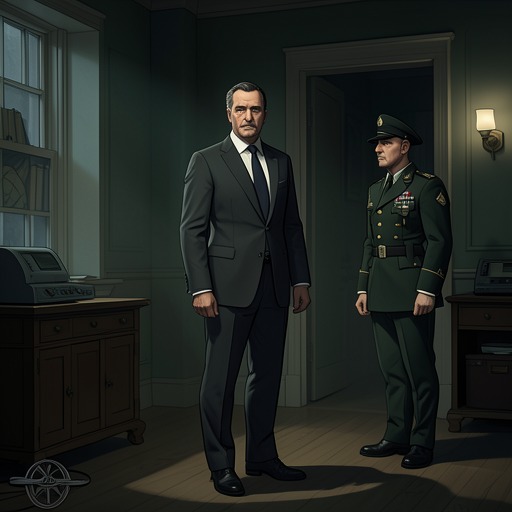
Georges Picquart—Mathieu Dreyfus
An Officer and a SpyThe relationship between Georges Picquart and Mathieu Dreyfus is shaped by a shared commitment to Alfred Dreyfus’s vindication and a painful disagreement over how to save him after the Rennes verdict. Picquart regards a pardon as a concession that could stain Alfred’s innocence; Mathieu faces the immediate prospect of losing his brother and accepts release as a necessary step toward bringing him home. Their encounter makes the difference between justice in principle and survival in the present personal: Picquart refuses to endorse Mathieu’s decision, but ultimately recognizes why the family makes it.
An Unequal Starting Point
Picquart’s connection to the Dreyfus family begins through Alfred, not Mathieu. As a professor at the École Supérieure de Guerre, he taught Alfred topography. He later recalled that he had disliked his pupil and allowed assumptions about Alfred’s wealth, family, and Jewish identity to affect how he regarded him. When Alfred challenged a low mark and asked whether his Jewishness had influenced it, Picquart denied that personal prejudice shaped his judgment. Alfred questioned the assurance itself, leaving Picquart confronted with the gap between his claim of impartiality and the suspicion his conduct had invited.
That history matters to Picquart’s eventual dealings with Mathieu. At the time of Alfred’s public degradation, Picquart watched him pass in torn uniform and understood that Alfred might wonder what role Picquart had played in his ruin. Later, in court, Hubert-Joseph Henry identified Alfred as the alleged traitor, prompting Alfred to protest the ambush. These moments establish the injustice Picquart must reckon with; they do not, by themselves, show an established personal bond between him and Mathieu. The direct relationship takes shape much later, when Mathieu visits Picquart after the Rennes judgment to explain the family’s decision.
A Case Under Pressure
By the time Mathieu comes to see him, the trial has ended in another conviction: the judges find Alfred guilty by five votes to two and reduce the sentence to ten years’ imprisonment. The verdict follows an assault on Fernand Labori, whose cross-examination of Auguste Mercier Picquart believed someone had been desperate to prevent. Picquart expected the defense would need a replacement when proceedings resumed. Instead, the adjournment lasted only forty-five minutes, leaving Edgar Demange to examine Mercier without the preparation Labori’s questioning would have provided.
This sequence places the brothers’ decision inside a legal process Picquart considers deeply compromised. Mathieu arrives at Picquart’s apartment just over a week after the verdict. He appears exhausted, turns his bowler hat nervously in his hands, and says he will soon travel to Rennes. He explains that Alfred has asked to see his children for the first time since his arrest, a request that makes the family fear that he means to say goodbye. The visit is not simply a discussion of legal strategy: Mathieu is carrying news that his brother may not survive continued imprisonment.
The Pardon Dispute
Mathieu reports that a government specialist has examined Alfred and found malnutrition and malarial fever, with possible tuberculosis of the spinal marrow. The doctor’s view, as Mathieu relays it, is that Alfred may not last long in captivity. On that basis, the family has decided to accept the government’s offer of a pardon. Mathieu also gives the political context: the Prime Minister fears that the country will remain permanently divided.
Picquart reacts with coldness and anger. To him, accepting a pardon amounts to an admission of guilt, a grave danger when Alfred has been wrongly convicted. Mathieu does not deny the technical force of this objection. Instead, he explains that Jean Jaurès has drafted a statement for Alfred to issue upon release, affirming that freedom alone does not restore his honour and that he will continue working to overturn the judicial error. Mathieu therefore distinguishes the immediate act of accepting release from the longer effort to secure full exoneration. Picquart remains unconvinced that the legal system will deliver that result.
The disagreement is also a clash over what each man can afford to risk. Picquart speaks from the standpoint of the case and the public meaning of a pardon: any appearance of conceding guilt could undermine the demand for justice. Mathieu speaks for a family confronting Alfred’s deteriorating health and the possibility of a final separation. He tells Picquart that Alfred himself is not reconciled to the decision, but that the family wants him back alive. He also suggests that Alfred would care to know whether Picquart agrees, making Picquart’s response more than a matter of abstract principle.
Refusal and Recognition
Mathieu asks what message he should take to Alfred. Picquart first asks how other supporters are divided. Mathieu reports that Émile Zola, Georges Clemenceau, and Fernand Labori oppose the pardon, while Joseph Reinach, Bernard Lazare, Victor Basch, and others support it with differing degrees of enthusiasm. Picquart says he is opposed as well. Mathieu accepts the answer without surprise and prepares to leave.
Only then does Picquart add the qualification that defines their relationship: Mathieu should tell Alfred that Picquart understands. The concession does not reverse his opposition or settle their disagreement. Instead, it separates judgment from empathy. Picquart still believes the pardon risks compromising the claim of innocence, yet he does not dismiss the human necessity that has brought Mathieu to his door. Mathieu, for his part, does not ask Picquart to pretend that their positions are identical; he asks for a message his brother may need to hear.
The Decision’s Aftermath
Alfred is released on 20 September 1899, though the news is withheld until the following day so he can travel without attracting a crowd. In disguise, he leaves the prison at dusk under the protection of Sûreté officers, joins Mathieu at the railway station in Nantes, and travels south with him. He reunites with his wife and children at a family house in Provence and later moves to Switzerland. He does not return to Paris, fearing assassination. The release gives the family the reunion it sought, but does not itself clear Alfred’s name; the statement Mathieu carried and the continuing demand for reversal preserve that distinction.
Picquart’s refusal to support the pardon remains consistent with his refusal, in December, to accept a general amnesty for those involved in the affair, even when told that he would be restored to the army and given a command. His objection is that restoration would place him in the same uniform as men he considers criminals, including Mercier, Armand du Paty de Clam, Charles-Arthur Gonse, and Jules-Maximillien Lauth. The contrast clarifies the limits and strength of his connection with Mathieu: they do not reach agreement about the means, but Picquart’s final message acknowledges the family’s choice without withdrawing his demand for Alfred’s honour.