Georges Picquart—Pauline Monnier
An Officer and a SpyGeorges Picquart and Pauline Monnier’s relationship is a long-running affair conducted inside a shared social world and under the pressure of concealment. Pauline is married to Philippe Monnier, a French Foreign Ministry official, while Picquart is an unmarried army officer whose professional position makes appearances consequential. Their attachment persists across family gatherings, public occasions, and Picquart’s forced absence from Paris; as danger gathers around him, the affair becomes not only a private bond but a vulnerability he fears the state can exploit.
Identity and Social Setting
Pauline and Picquart are not strangers brought together by the Dreyfus affair. She grew up with him and their circle near Strasbourg, and the early scenes place them among people whose friendships reach back to Alsace. At a lunch in Ville-d’Avray, Pauline sits opposite Picquart, while Philippe is described as older than the rest of their group and employed at the French Foreign Ministry. Their shared past supplies a familiar setting for the affair, but it does not erase the differences between their public lives: Pauline is a wife and mother, and Picquart is a bachelor whose military career is advancing.
The gathering also reveals how their wider circle understands loyalty and belonging. The guests, many of them exiles from Alsace, speak bitterly of Jewish Alsatians whose allegiance they believe had favored Germany after the Franco-Prussian War. Pauline and Picquart’s relationship takes shape amid this conversation, in a community where private and national loyalties are discussed in the same room. The scene does not make the affair a political alliance; rather, it establishes the social world in which Picquart’s personal life and professional identity remain closely watched by people who know one another well.
Intimacy and the Work of Concealment
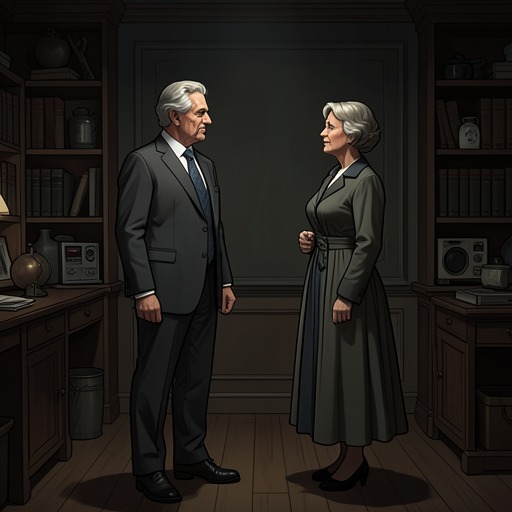
Picquart’s account presents the relationship through small acts of familiarity. Pauline wears a plain grey dress he likes, recalling one she wore when she was eighteen. Later, after Picquart has met with Charles-Arthur Gonse and learned that he is to become the army’s youngest colonel, he returns to his apartment to find her waiting. The dress connects the private meeting to the earlier family lunch, while the secrecy of their time together contrasts with the public advancement Picquart has just received. He has been instructed to keep military matters confidential, and when Pauline asks where he has been, he withholds the answer.
The same tension appears at a concert arranged by Blanche de Comminges. Pauline’s presence is presented as a surprise, and Picquart notices the military men among the audience, including officers attached to the General Staff. He is conscious that others may interpret the sight of an unmarried colonel beside a senior official’s attractive wife as evidence of an affair. Pauline notices his discomfort and asks whether he wants her to leave; he says no, but his unease makes clear that concealment is a continuing effort, not a settled condition. Afterwards, he leaves before her to preserve appearances. When she joins him on the pavement, they share a brief private moment in a cab, but she presses him to explain what his behavior has meant. The episode shows that secrecy protects them from observation while also creating friction between them: Picquart’s guardedness is legible to Pauline, even when its reasons are not.
Public Appearances and Social Scrutiny
At a later gathering at the Gasts’ home, Picquart sees Pauline with Philippe and their two daughters, Germaine and Marianne. For him, the sight of her immersed in her family life is painful. He goes outside, and Pauline joins him without drawing attention to their closeness. Their hands barely brush as they stand together looking out at the garden; to anyone approaching, they could appear to be old friends. Philippe’s voice then interrupts the private moment by calling from inside about the weather expected for the visit of the imperial couple. Pauline asks whether Picquart is involved in the arrangements, and he minimizes his part. The contrast is telling: the relationship is intense for the two people living it, yet its public form must remain ordinary and deniable.
That concealment is tested at the Bourbon Palace, where Picquart and Pauline attend a major public occasion. Every officer of the Statistical Section has arrived with a wife or, in one case, a mother. Picquart realizes how the scene must look: the unmarried head of the section accompanied by the wife of his friend Philippe Monnier. His formal introduction of Pauline as Philippe’s wife does not dispel suspicion; he thinks it makes the situation appear still more questionable. Some of the officers’ wives greet her stiffly or turn away. Pauline appears not to care, and the two have a clear view across the Seine toward the obelisk at the Place de la Concorde, amid the immense crowds gathered for the event. The public scale of the occasion magnifies the private risk: they are visible together in precisely the company most likely to understand what that appearance implies.
Separation and Conflict
When Picquart is preparing to return to Tunisia, Pauline visits him on the final day of his leave. Her arrival is discreet, and Anna makes room for them by going out for an hour. Their meeting takes place in the children’s bedroom, among the toy soldiers belonging to Picquart’s nephew. Pauline challenges his intention to return to Africa without trying to see her. The encounter makes clear that separation has not weakened the relationship, but it has sharpened the question of who gets to decide what risks they will accept.
Their disagreement becomes direct when Picquart tells her that the danger could extend beyond the two of them to her daughters. Pauline objects to his making decisions that affect them without telling her what he is thinking, and rejects his invoking the girls as an excuse. Picquart explains that he is not merely worried about gossip: he fears exposure, humiliation, and the state’s power to put them in newspapers and courts and invent claims about them. He points to the seven months he has already spent away from home, which he presents as only a small foretaste of what could follow. The relationship is thus caught between his impulse to protect Pauline by withholding information and her demand to be treated as a participant in decisions that affect her life.
Confidentiality and the Relationship’s Unresolved Future
Picquart cannot tell Pauline the matter behind his absence. He says that he has spoken of it only to Louis Leblois, his lawyer, and directs her to go to Leblois if something happens to him. He expects the crisis to break in a few weeks or perhaps a couple of months, but offers no explanation that Pauline can independently assess. She asks whether they can at least continue writing to one another, and Picquart agrees, turning intimacy into a practical problem of secure communication.
He gives her a poste restante address arranged with Leblois through a friend on avenue de la Motte-Picquet. To reduce the chance that their letters can identify them, Pauline is to omit his name from the envelope and the letter, avoid a signature, and arrange for someone else to collect the correspondence. Picquart also advises using a sealed inner envelope placed inside an outer one, so that interference would be harder to conceal. These precautions show how far public danger has entered their private life: even a letter between lovers must be designed around the possibility of government scrutiny. The available episodes leave their future unsettled. They establish continued attachment, disagreement over secrecy, and a plan to remain in contact, but do not show how the relationship ultimately resolves.