Georges Picquart’s imprisonment
An Officer and a SpyGeorges Picquart’s imprisonment is a sequence of three detentions that transforms his conflict with the military into a test of endurance and public credibility. At Mont-Valérien he is isolated but comparatively comfortable; at La Santé Prison and Cherche-Midi Prison, confinement becomes part of the government’s effort to control the consequences of his disclosures. His release coincides with the return of Alfred Dreyfus from Devil’s Island for a new trial, but freedom comes after months of imprisonment and leaves Picquart physically weakened. The author’s note frames this account as a novelistic reconstruction of a real political scandal: the principal characters are historical, while the narrative also simplifies events and invents personal details, including Picquart’s secret written account.
A sequence of detentions
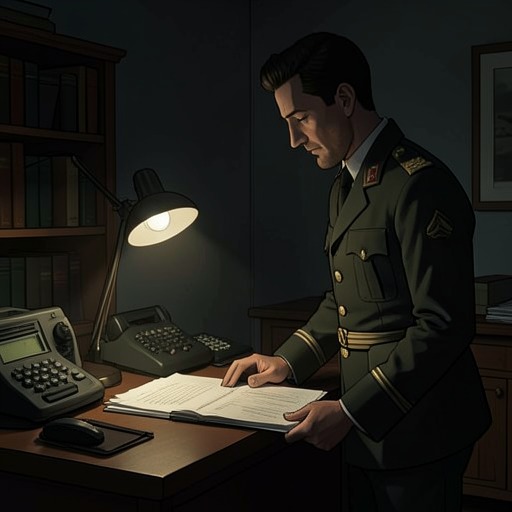
Picquart is first held at Mont-Valérien, a fortress on the western edge of Paris. Confined alone in officers’ quarters on the third floor, he has a sitting room, bedroom, lavatory, books, and a view across the Seine and the Bois de Boulogne toward the Eiffel Tower. A locked door and a sentry restrict his movement, but the material conditions are far removed from the harsher imprisonment that follows. He reads Goethe, Heine, and Ibsen; Marcel Proust sends him Les Plaisirs et les Jours, and his sister sends a French–Russian dictionary. In this first detention, the removal of the secret burden he has carried for months gives confinement a paradoxical aspect: he is deprived of liberty but relieved of keeping silent.
Two days after Picquart arrives at Mont-Valérien, the government brings a criminal-libel charge against Émile Zola. The case is to be heard publicly at the Palace of Justice rather than in a closed military chamber, and it is advanced so that the trial can begin quickly. Although the fortress commander bars visits from anyone who is not a serving officer, Picquart can still meet his lawyer, Louis Leblois. A subpoena summons him to testify on 11 February. The prospect of appearing in public thus breaks through the isolation of his detention, while also making him a witness in the confrontation that the government has chosen to pursue.
A later charge, based on the Pellieux investigation, accuses Picquart of illegally disclosing documents concerning national defence and security. After the government appoints Judge Fabre to investigate, police raid Picquart’s apartment while he is absent. The following day, Picquart and Leblois are summoned to Fabre’s chambers at the Palace of Justice and arrested. Fabre orders Picquart held at La Santé Prison during the investigation, while Leblois is released on bail. In the courtyard, as reporters watch Picquart being taken away, he remembers to hand Leblois his cane. At registration in the prison, he records that he has no religion.
Isolation and the case against him
La Santé is a sharp reversal from Mont-Valérien. Picquart is placed in a cell measuring four metres by two and a half, with a bed and a chamber pot, and is locked in for twenty-three hours each day to prevent communication with other prisoners. The account describes the cell as hot during the summer, with temperatures reaching thirty-five degrees Celsius. The restrictions make his detention not merely a change of address but a deliberately enforced isolation. He can hear the other prisoners, but cannot communicate with them; the prison’s sounds reach him across the separation imposed by his confinement.
The army then secures the right to deal with Picquart before the civil proceedings. He is transferred to Cherche-Midi Prison and held in the same cell in which Alfred Dreyfus had been confined four years earlier. Picquart is kept in solitary confinement, most visits are forbidden, and his daily exercise is limited to one hour in a yard six paces square. The accusation is that he altered the original addressee on the petit bleu and inserted Charles Ferdinand Walsin Esterhazy’s name, an offence carrying a possible five-year sentence. Questioning continues for weeks, leaving Picquart in detention while the charge against him is examined.
A record created before the disputed alteration becomes important to Picquart’s defence. He had asked Captain Lauth to photograph the petit bleu soon after it was pieced together. The photographs are eventually retrieved and show that the address had not been changed at that earlier point; the account says it was altered later as part of the conspiracy to frame Picquart. The evidence does not immediately end his imprisonment, but it gives the challenge to his credibility a concrete answer. Even while confined, he also testifies again, this time before twelve senior judges of the Criminal Chamber as they consider whether the verdict against Dreyfus can stand.
Public pressure and prolonged detention
Picquart’s imprisonment at Cherche-Midi becomes notorious because it continues without trial. Georges Clemenceau visits him and mocks the situation in L’Aurore by proposing that Picquart be appointed the state’s principal prisoner, a post supposedly vacant since the Man in the Iron Mask. Outside the prison, demonstrations form both for and against him. The authorities deploy seven hundred troops to protect the prison, and Picquart receives thousands of letters of support, including one from the former Empress Eugénie. The public attention turns his confinement into an increasingly visible political liability for the government.
Officials at the Ministry of Justice suggest that Picquart’s lawyer ask the civil courts to intervene and secure his release. Picquart refuses. He judges that remaining in custody makes him more useful as a hostage and makes the army appear more desperate and vindictive with each day that it keeps him locked up. His refusal is therefore not simple acquiescence: within the limits imposed by imprisonment, he treats the political effect of his detention as part of the continuing contest over the Dreyfus case.
Release and consequences
Picquart is released on the Friday when Alfred Dreyfus is disembarked from Devil’s Island and begins the voyage back to France aboard the warship Sfax. In light of the French Supreme Court of Appeal’s ruling, all charges against Picquart are dropped. Edmond waits outside the prison with a motor car and drives him to Ville-d’Avray. Picquart declines to speak to the journalists surrounding him, a choice that contrasts with the public attention his detention has attracted.
The return to ordinary company exposes consequences that the prison itself had concealed. Paris’s early-summer activity and the social gatherings arranged in Picquart’s honour overwhelm him. Conversation with more than one person is difficult; he is breathless, and he must pause repeatedly on the stairs and grip the handrail. His knee and ankle muscles have atrophied, his appearance has changed, and he discovers white hairs in his moustache. These details make release an ending to legal confinement, not an instant restoration of his former condition.
The author’s note cautions readers against treating every device in the novel as historical fact. It states that Picquart never wrote the secret account through which the narrative is presented and never deposited such a manuscript in a Geneva bank vault to be opened a century after his death. The imprisonment is therefore narrated within a work that openly combines historical events with novelistic construction. That distinction matters: Picquart’s confinement carries the plot’s account of institutional retaliation, while the retrospective frame itself is identified as an imaginative device rather than a document he actually left behind.