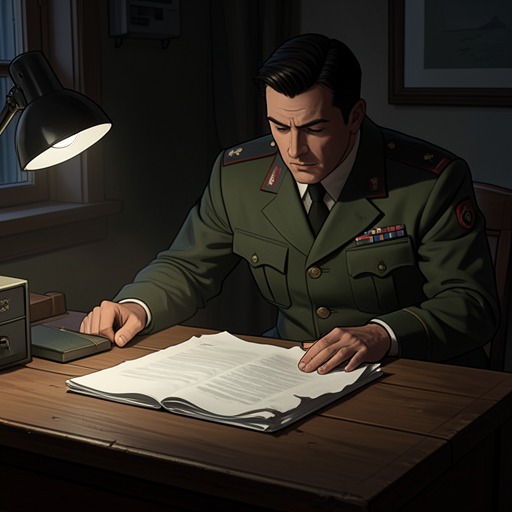
Guénée
An Officer and a SpyGuénée is a French Sûreté officer whose purported account of a warning from the Spanish military attaché became a supporting strand in the prosecution of Alfred Dreyfus. Georges Picquart’s questioning exposed how little the account could be verified: Guénée first disclaimed involvement in the secret file, then acknowledged that he must have supplied a statement, but could not say whether Val Carlos would confirm its substance. Guénée’s later death left the report’s source unavailable when its credibility mattered in open court.
Position in the Intelligence File
Guénée appears in the story as an officer with access to surveillance material and as an intermediary between an alleged foreign source and Major Henry. His position matters less through any independently established intelligence discovery than through a report attributed to Val Carlos, the Spanish military attaché. According to the deposition in the secret file, Val Carlos had said that German attachés knew of an officer on the French Army General Staff who was keeping them well informed. The report urged intensified surveillance and a search for that officer.
The account acquired particular weight because Major Henry later claimed that Val Carlos had separately warned him about a traitor in the Second Department. At Alfred Dreyfus’s court-martial, Henry used that supposed warning to identify Dreyfus as the traitor. The parallel stories made Guénée’s report appear to corroborate the accusation, but their force depended on the reliability of the source attributed to Val Carlos. The report was not simply a detail in an intelligence file: it helped connect an unnamed spy warning to the accused officer.
Picquart’s Examination of the Report
When Guénée came to Georges Picquart’s office toward the end of the morning, he brought the Dreyfus surveillance file and asked whether Major Henry was there. Picquart replied that Henry was on leave and that Guénée would have to deal with him instead. Guénée then suggested that Alfred Dreyfus’s family was almost certainly behind a pamphlet being anticipated by the intelligence service. Picquart, already concerned about the file’s growing public and institutional significance, turned the discussion to Guénée’s own contribution to it.
Asked whether he had helped compile the secret file, Guénée denied having done so. Picquart challenged that denial by recalling the statement supposedly supplied to Major Henry about Val Carlos. Guénée first resisted the reminder, then conceded that he must have provided it. The exchange did not, however, establish that Val Carlos had made the alleged warning. Picquart read the deposition aloud and asked whether the attaché had said this roughly six months before Dreyfus’s arrest. When Picquart framed the issue as one that could be put directly to Val Carlos, Guénée became uncertain: he said the conversation had been confidential and could not be sure what the attaché would say now.
That hesitation changed the significance of the document. Picquart reasoned that if Val Carlos had not told Guénée about a German spy, the attaché might not have told Henry the same story three months later. The inference struck at the supposed independent support for Henry’s courtroom accusation. It did not by itself prove what Val Carlos had or had not said, but it showed that the chain of attribution could not safely be treated as confirmation. Picquart’s questioning thus shifted attention from the report’s official presence in the file to the uncertain testimony on which it rested.
Report Challenged at the Rennes Trial
At the Rennes trial, the report returned as part of the evidence presented by Auguste Mercier. During a three-hour deposition, Mercier produced numerous documents from his black leather case, including fabricated reports attributed to Guénée about a spy in the intelligence department. Mercier omitted the name of the alleged source, Val Carlos. The omission left the court with the document’s assertion but without the attribution that would have made its origin and reliability central to examination.
In a later conversation with Fernand Labori, Georges Picquart said that the report was falsified. He explained that Guénée had claimed to receive the information from Val Carlos, while Major Henry had sworn that the attaché repeated the story to him three months later. Picquart recalled challenging Guénée soon after discovering the report and finding his response deeply suspect. He suggested that Labori call Guénée, while acknowledging that Val Carlos might claim diplomatic immunity. Labori replied that Guénée had died five weeks earlier.
Death and Narrative Significance
The medical certificate gave Guénée’s cause of death as cerebral congestion. The account supplies no further circumstances, so his death establishes his unavailability as a witness, not an explanation for the report or its disputed provenance. In the courtroom dispute, that absence had a concrete consequence: Labori could not question the officer whose statement linked Val Carlos to the alleged warning, while the report could still be produced as evidence by Mercier.
Guénée’s role therefore lies in the fragile passage between intelligence gathering and judicial proof. A claim attributed to a foreign attaché was recorded in a secret file, echoed in Major Henry’s testimony, and later presented at Rennes without the named source. Picquart’s encounter with Guénée exposed the gap between official documentation and verifiable testimony; Guénée’s death ensured that the gap could not be tested through his own evidence at trial. The episode illustrates how an allegation can acquire institutional authority through repetition even when the origin on which it depends remains uncertain.