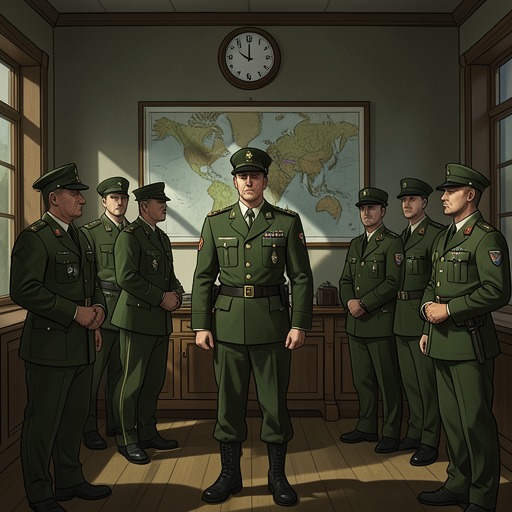
Hôtel de Brienne
An Officer and a SpyHôtel de Brienne, the official residence of the Minister of War and a working center of the French War Ministry, gives the Dreyfus affair a recurring physical setting for the exercise of military power. Georges Picquart enters it first in the urgent aftermath of Alfred Dreyfus’s degradation ceremony, and later returns through a private garden entrance to brief another minister about Esterhazy. Its reception rooms and guarded routes are not merely a backdrop: they register who can approach the government, what information reaches it, and how Picquart’s own access changes.
Setting and Government
On the winter morning of Picquart’s first visit, a sentry opens the gate on rue Saint-Dominique and Picquart hurries through a snow-filled courtyard into the warm lobby. A young captain of the Republican Guard rises to salute him. The transition from cold exterior to guarded interior establishes the residence as a place where public urgency is converted into official procedure: Picquart announces his rank and purpose, and is escorted inside.
The route leads across black-and-white marble and up a curving staircase. Suits of silver armour from the time of Louis the Sun King stand beside David’s painting of Napoleon crossing the Alps at the Col du Grand-Saint-Bernard. The military inheritance and imperial spectacle frame the journey to the offices above. Yet the building also opens unexpectedly onto a quiet garden: from a landing window, Picquart sees snow silence the grounds at the center of Paris, while electric lights shimmer through the trees. The residence thus holds two kinds of image at once, ceremonial force inside and a secluded landscape beyond its rooms.
At the end of this first ascent, Picquart is received by Minister of War Auguste Mercier. The large office is ornately panelled in duck-egg blue and has a double balcony overlooking the whitened lawn. Raoul le Mouton de Boisdeffre, Chief of the General Staff, stands there with Mercier beside an open fire. This is an intimate meeting place for senior military authorities, but its windows and garden also make the landscape part of the view from which their decisions are made.
Rooms, Keys, and Restricted Access
The residence’s geography becomes more personal when Picquart is shown the office he is to occupy. It had belonged to Jean Sandherr, and is small and dark, with drawn curtains, a large table, a locked steel filing cupboard, a desk, and a door back to the corridor. Behind the desk, a tall window looks out over the formal garden. Picquart, whose speciality is topography, takes a moment to recognize that the view is of the rear elevation of Hôtel de Brienne itself. The discovery gives him an unusual sightline across the same grounds that had seemed magical from the main residence.
Access is arranged through a ring of five keys. They open the front door, Picquart’s office, his safe, his desk, and the garden. The garden key is especially significant: Mercier had presented it to Sandherr, and Picquart is told that it provides the quicker, more private way to reach the minister. The ordinary entrance remains available, but the key makes a second route possible, one that depends on trust and restricted access rather than the formal approach through the gate and lobby.
That permission also links Picquart to Sandherr’s former place in the institution. The office, locked storage, and keys make his work tangible, while the private route gives him a direct way to approach the minister. The residence is therefore both a workplace and a system of thresholds: doors and keys determine where Picquart can go, and how discreetly he can carry information to those in authority.
Return to the Minister’s Residence
Months later, Picquart uses the garden key on a Thursday morning, at the same time that a team in Basel is expected to make its first contact with the double agent Richard Cuers. He carries the Benefactor file through the wooden garden door. The grounds have changed with the season: thick foliage screens the Ministry from view, the distant sounds of Paris seem drowsy, and an elderly gardener waters a flower bed. The turf is scorched brown. Picquart privately imagines that, if he ever became minister, he would move his desk outside in summer and run the army beneath a tree as Caesar had in Gaul.
From the lawn he crosses gravel, climbs the shallow pale-stone steps, enters through glass doors, and ascends the marble staircase he climbed on the day of Dreyfus’s degradation. The suits of armour and Napoleon painting recur along the route. This time he reaches the minister’s private office and asks an orderly, Captain Robert Calmon-Maison, whether he may speak with Jean-Baptiste Billot. Calmon-Maison does not ask what the matter concerns; Picquart is the keeper of his master’s secrets. He returns with permission for Picquart to be seen immediately.
Billot’s office brings the building’s official gravity into a more conversational encounter. Picquart sits in the same chair where he had described the degradation ceremony to Mercier and Boisdeffre. He opens the Benefactor file and tells Billot that a German spy appears to be operating in the army. He describes Esterhazy’s activities and the operation watching him, and supplies more detail than he had given Boisdeffre, including the Basel debriefing mission. He also shows Billot the petit bleu and surveillance photographs. He deliberately does not mention Dreyfus, judging that the subject would eclipse everything else he is trying to report.
Repeated Routes and Narrative Significance
The repeated passage through the residence binds separate stages of Picquart’s work. In the first visit, he comes from the degradation ceremony to report to Mercier and Boisdeffre. Later, the same staircase and ministerial setting frame a new intelligence disclosure to Billot. The route remains recognizable, but Picquart’s familiarity with it has altered: what had once left him awed in the minister’s inner sanctum has become a place of work, and the minister another soldier-bureaucrat in the revolving door of government.
The seasonal contrast reinforces that change without removing the building’s authority. In winter, the snow-covered garden offers a moment of stillness after the ceremony; in August, its heavy foliage conceals the Ministry and gives Picquart a private approach to the minister. The private key, once an inherited privilege associated with Sandherr, now serves Picquart’s own investigation. Hôtel de Brienne consequently stands at the intersection of secrecy and administration: it offers discreet access, contains the offices where intelligence is received, and makes visible the difference between entering as a subordinate summoned to report and returning as an established custodian of consequential information.