Hubert-Joseph Henry
An Officer and a SpyHubert-Joseph Henry is an experienced French Army officer who serves as deputy to Georges Picquart in the Statistical Section. Introduced as a practical operator and Picquart’s subordinate, he is also positioned at the center of an early tension over how the section handles sensitive intelligence: Henry trusts his own custody of material, while Picquart insists that its collection and use be controlled through the office.
Identity and Introduction
Henry appears when Picquart takes charge of the Statistical Section in June. He has been passed over for its chief’s position, and his appointment as deputy is described as consolation for that disappointment. The arrangement gives him substantial practical authority: he is the seasoned officer who knows how to make the section work, serving under a younger commissioned officer who is formally in charge.
Henry’s manner makes their new hierarchy less straightforward than their ranks suggest. He addresses Picquart as "Colonel Picquart!" with an emphasis that seems to mix respect, congratulations, and mockery. Picquart initially takes no offence, and imagines that the two can work together so long as neither pushes the other too far.
Working Relationship with Picquart
Their roles are cast as an old military pairing: Henry is the experienced soldier who has come up through the ranks, while Picquart is the younger superior who, in Henry’s implied view, must be prevented from doing too much damage. The description gives Henry competence and institutional seniority without making him the formal leader. Their cooperation therefore begins with an underlying question of who will actually direct the work.
The first exchange also establishes their contrasting responses to the conditions of the job. On the hot, foul-smelling day Picquart assumes command, Henry makes light of the city’s stench: "This is nothing. You should have grown up on a farm! Folk’s shit, pigs’ shit: where’s the difference?" His broad comparison and smirking manner make him appear untroubled by discomfort, while Picquart’s narration frames the encounter as the beginning of a working arrangement whose limits remain to be tested.
Control of Sensitive Material
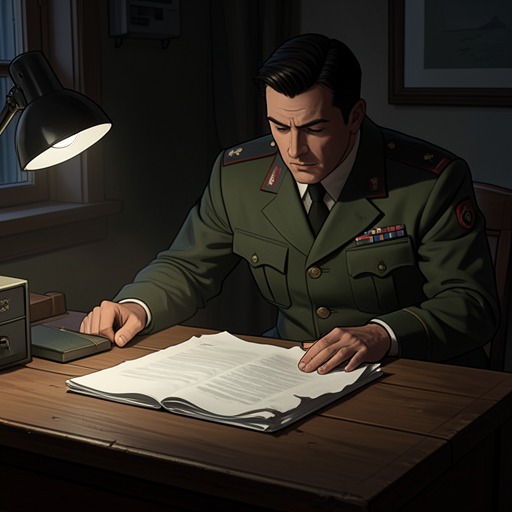
That test arrives when Picquart questions Henry about a batch of material that came in two nights earlier. Henry says that he worked on it at home and assures him that it never left his sight. Picquart’s concern is not simply whether Henry personally guarded it: he objects to the procedure and warns that material this sensitive should come directly to the office as soon as it is collected.
Picquart then asserts control over what follows. He orders that all the Auguste material be brought straight to him, kept in his safe, and handled according to his decisions about which leads to pursue and who may work on them. The exchange sharpens the difference between Henry’s confidence in his own custody and Picquart’s demand for centralized oversight. Henry is introduced as capable and experienced, but his established way of working is already being checked by the authority of his new chief.