Jules-Maximillien Lauth
An Officer and a SpyJules-Maximillien Lauth is a captain in the intelligence unit and one of its painstaking handlers of damaged documents. A German-speaking cavalryman from Alsace, he is introduced hunched over fragments of torn notepaper; later, he reconstructs a torn pneumatic telegram card so expertly that its message can be read. His work gives physical form to the case’s dependence on scraps, files, and controlled access, though the evidence does not make him an author of the accusations or a principal investigator.
Identity and Introduction
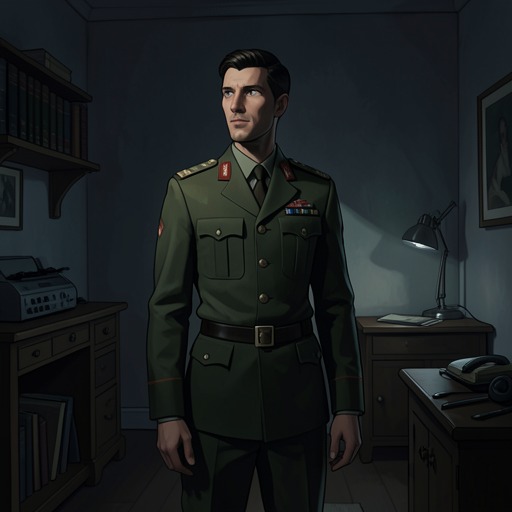
Lauth is introduced as a handsome, blond cavalryman in his thirties, originally from Alsace and able to speak German. Picquart remembers him from Alfred Dreyfus’s degradation ceremony. The contrast between Lauth’s cavalry background and his present desk work is explicit: instead of riding across the countryside, he sits under a strong electric light, bent over torn notepaper and shifting its pieces with tweezers.
When Picquart looks to Major Henry for an explanation of this delicate work, Henry says they should discuss it. The exchange marks Lauth’s task as important but initially unexplained. In the unit’s closed rooms, where officers handle intercepted correspondence and guarded files, he is presented less through formal exposition than through the careful movement of his hands among fragments.
Reconstruction and Documentary Work
Lauth’s most concrete demonstration of skill comes when Picquart gives him a torn petit bleu, a pneumatic telegram card. The pieces are smaller than usual, making the reconstruction unusually difficult. Four or five hours later, Lauth brings Picquart a thin manila folder, visibly distressed and uneasy as he offers it. Inside, he has pieced the card back together; although some fragments are missing and one edge remains jagged, the French message is clear enough to read.
The scene establishes both his technical patience and the pressure attached to the work. The recovered card is not a pristine document but a damaged object whose meaning depends on patient assembly. Lauth’s contribution is specific: he restores the text sufficiently for it to be examined. The evidence does not identify him as the person who interprets the message or determines what it proves.
Place in the Secret File Network
When Picquart makes a list of everyone who knows about the secret file, Lauth is among the first nine names, alongside senior officers and other intelligence personnel. Picquart then adds Jean-Baptiste Billot, the seven judges, President Fauré, the president’s doctor, and Mathieu Dreyfus, whose discovery of the secret file has widened the circle still further. Lauth’s inclusion establishes that he knows of the file; it does not, by itself, establish that he prepared, altered, or disclosed its contents.
The episode sets Lauth within a system in which secrecy depends on limiting knowledge but repeatedly fails as information moves among military, judicial, and public channels. Picquart reflects that modern photography, telegraphy, railways, and newspaper presses make lasting secrecy impossible. Lauth’s name in the inventory gives that reflection a concrete institutional dimension: the file is known not only to its senior custodians but also to the working officers who handle the intelligence apparatus.
Narrative Role and Significance
Lauth remains a secondary figure, defined by disciplined document work rather than by a separately developed personal history or a stated position on Dreyfus’s guilt. His reconstruction of the petit bleu and his presence on Picquart’s list of those informed about the secret file are distinct facts: one shows his practical skill, the other his place within the circle of knowledge. Neither warrants treating him as responsible for the case’s deceptions.
Together, these appearances make him a quiet but useful figure in the book’s account of intelligence work. In one scene, torn pieces become legible through his craft; in another, a supposedly secret dossier is exposed as something known by an expanding set of people. Lauth’s role lies at that junction between fragile documents and the institutions that control who may read them.