Miscarriage of justice
An Officer and a SpyA miscarriage of justice in An Officer and a Spy is the wrongful conviction of Alfred Dreyfus and the machinery that makes that conviction seem both reasonable and irreversible. The book connects the verdict to antisemitism, evidence withheld from the accused and his lawyer, and the authority of military officers whose claims are not independently tested. Its account is filtered through Georges Picquart, an officer who first accepts the case against Alfred Dreyfus and only gradually recognizes that loyalty to the institution may be sustaining an injustice.
A verdict shaped by prejudice
The degradation ceremony gives the injustice its public face. In January 1895, Alfred Dreyfus is marched before soldiers and spectators, while the crowd’s cry of “Death to the Jew!” turns an accusation of espionage into a spectacle of collective hatred. The punishment does not merely mark a military judgment: it teaches the watching crowd to read Jewish identity as evidence of treachery. As Alfred Dreyfus calls out that he is innocent, the crowd answers with taunts, and the ceremony presents humiliation as if it were confirmation.
The prejudice is also voiced by people whose rank lends their opinions weight. A Foreign Ministry observer questions how Alfred Dreyfus can endure humiliation and still maintain his innocence, then suggests that such passivity might be a Jewish trait. Jean Sandherr answers with a sweeping denunciation of Jewish patriotism and honour. The exchange exposes the reasoning beneath the judgment: conduct that might have complicated the accusation is instead reinterpreted to fit a racial stereotype. The accused is not allowed to define what his demeanour means; his persecutors supply its meaning for him.
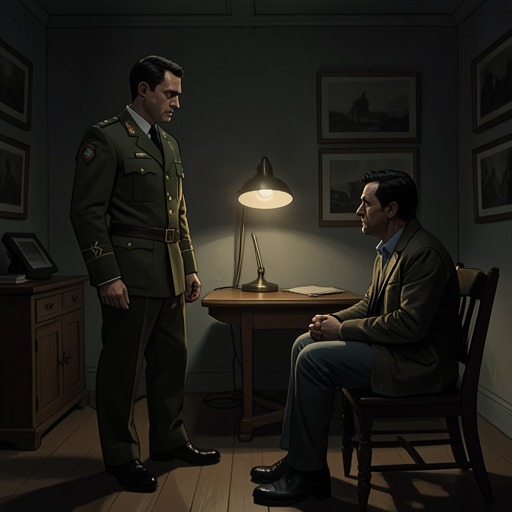
That interpretive bias has an earlier counterpart in Picquart’s recollection of Alfred Dreyfus as a student. Georges Picquart remembers him as prosperous, married, and socially distinct from poorer bachelor classmates, and admits that he had thought of him as “a regular Jew,” associating Jewishness with money, ambition, and ostentation. When Alfred Dreyfus asks, “So it’s not because I’m a Jew?”, Picquart replies that he is scrupulous about personal prejudice. The scene leaves a telling gap between Picquart’s self-description and the assumptions he has just acknowledged. The novel thus makes prejudice more than the explicit hatred of a crowd or a superior: it is also a ready-made lens through which an officer believes himself to be judging impartially.
Procedure and the withheld file
The fairness of the conviction is challenged not only by the question of guilt but by the process used to establish it. At a dinner, Louis Leblois objects in principle to secret trials and wonders whether a Christian officer would have been denied the ordinary judicial process, particularly when the public evidence reported by Le Figaro sounds thin. Picquart rejects the objection. He insists that national security required secrecy and assures the table that there was abundant evidence against Alfred Dreyfus. His confidence is decisive in the moment, but it rests on his own access to information rather than on evidence that the accused and his lawyer can examine.
When Georges Picquart learns that the family has been told of the secret material, the danger becomes clearer to him. He recognizes that Alfred Dreyfus and his lawyer never saw the evidence on which the conviction rested. Even if the information did not alter the verdict, Picquart understands that public knowledge of this procedure could lead people to argue that Alfred Dreyfus had not received a fair trial. Secrecy, defended as a safeguard of national security, has concealed a basic inequality: the authorities can use material against the accused while preventing him from answering it.
The trial scene involving Hubert-Joseph Henry sharpens that imbalance. Henry invokes an informant described as honourable, says the warning concerned a traitor on the General Staff, and then points to Alfred Dreyfus as the traitor. Alfred Dreyfus demands the informer’s name, but the accusation has already landed with the force of an authoritative disclosure. The reader sees the asymmetry in the room: an unnamed source and a senior officer’s assertion stand against the accused man’s unanswered demand. The scene does not establish the accusation as fact; it shows how forcefully an unsupported claim can operate when rank controls what counts as evidence.
Picquart’s complicity and the first cracks
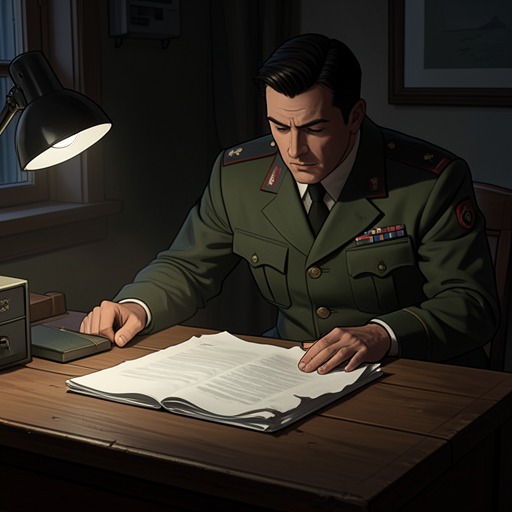
The narrative makes the injustice harder to reduce to a simple contrast between guilty officials and a clear-sighted hero. Georges Picquart witnesses the degradation and observes Alfred Dreyfus closely, even imagining that the condemned officer may wonder what role Picquart played in his ruin. Yet Picquart does not immediately accept the possibility of innocence. Later, while reading Alfred Dreyfus’s account of the ceremony, he encounters the insistence that there is a traitor but that Alfred Dreyfus is not the man. Picquart dismisses the protestations as familiar self-defence and regards the appeal as characteristic of a criminal mentality. His reaction shows how a presumption of guilt can absorb even a direct denial without being weakened by it.
The letters between Alfred Dreyfus and Lucie Dreyfus complicate that dismissal. Picquart reads Alfred Dreyfus’s anguish and Lucie’s plea that he live while they continue striving until the guilty man is found. He feels intrusive, yet keeps reading; he sympathizes with Lucie while still refusing to believe her husband. These responses do not yet amount to recognition of innocence. They reveal instead the distance between human sympathy and a judgment Picquart considers settled, and the way his official certainty can coexist with evidence that troubles him.
The appeal to investigation
Writing to Lucie Dreyfus from captivity, Alfred Dreyfus asks for justice and urges those with powerful means of investigation to search for the truth. Georges Picquart notices that the appeal is addressed on its surface to a wife but is also likely to pass through many hands. He understands it as a message to the authorities in Paris—and, unknowingly to Alfred Dreyfus, to Picquart himself, who is sitting at Jean Sandherr’s desk. The letter does not immediately change Picquart’s belief in guilt, but it gives him pause: Alfred Dreyfus is still asking for an investigation rather than a favour.
That appeal supplies the concept’s central tension. The case has been presented as closed, the punishment imposed, and secrecy justified in the name of security; nevertheless, the demand to search remains. The book identifies the miscarriage not only with an unjust outcome but with the conditions that protect the outcome from scrutiny: prejudice that converts identity into suspicion, procedure that withholds evidence, and institutional authority that treats assertion as sufficient. By showing Georges Picquart first defending those conditions and then beginning to question them, the narrative makes the injustice a failure of judgment sustained by a system—not merely a single mistaken decision.