Moral courage and heroism
An Officer and a SpyMoral courage and heroism emerge in Picquart’s story not as splendid achievement but as a costly choice: he insists on truth and justice even when doing so threatens his standing in the army he loves. The narrative tests heroism against institutional loyalty, public hostility, and the long delay between acting rightly and seeing vindication arrive.
The Question of Heroism
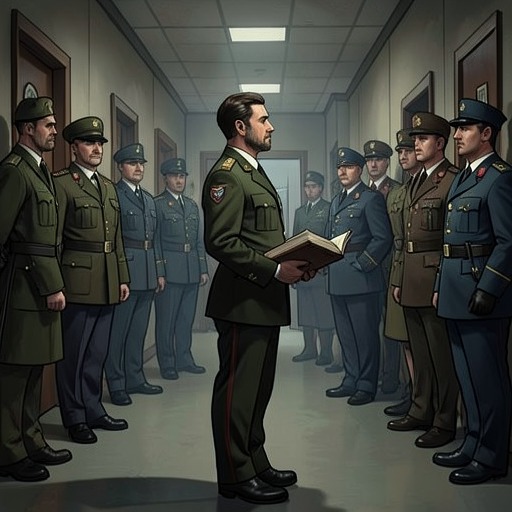
At breakfast, after black coffee and tartine, Picquart translates another page of Dostoyevsky and considers whether courage, strength, morality, or endurance in adversity makes a hero. The question is left open rather than answered with a definition. Its setting gives it weight: at nine, Armand Mercier-Milon collects him, and they descend in silence to find journalists surging toward them outside. When Mercier-Milon objects to Picquart’s dry remark about the press, the scene makes plain that the risk is not abstract. Picquart is already exposed to scrutiny and hostility, while the question of heroism remains something his conduct must answer.
Truth Against Institutional Loyalty
In conversation with Joseph Reinach and Émile Zola, Picquart explains the bind created by the army’s insistence that Alfred Dreyfus’s case remain closed. If Charles Ferdinand Walsin Esterhazy is treated as innocent to avoid reopening the case, Picquart’s campaign against him can be recast as a wicked conspiracy, making Picquart himself the person to punish. Yet Picquart does not prescribe a simple public intervention: still subject to army discipline and unable to disclose national secrets, he says he cannot write an article or publish a book. Instead, he argues that the affair must be taken out of military jurisdiction and assembled into a coherent narrative, so its proportions can be seen. His appeal to transform reality into art presents truthful narration as a way to expose what secrecy and fragmented evidence conceal.
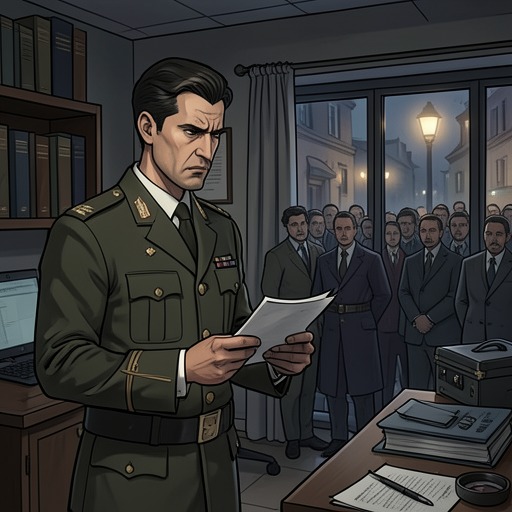
At his testimony, Picquart gives the institutional conflict its concrete shape. He identifies Hubert-Joseph Henry and Felix Gribelin, aided by Armand du Paty de Clam and acting under Charles-Arthur Gonse, as covering up mistakes made under Jean Sandherr. Picquart acknowledges uncertainty about whether the motive was misplaced loyalty or the department’s interests; what he does identify as his own offense, in their eyes, is believing that the army’s honour could be defended by something other than blind obedience. His courage is therefore not opposition to the army as such. He has given it twenty-five years of his life and still regards the pursuit of truth and justice as the better way to serve it.
Endurance and the Prospect of Vindication
Picquart speaks while his honour is under attack and his expulsion from the army seems possible. He concludes his testimony by affirming both his duty to seek truth and justice and his duty as an honest man. The response is divided: there is applause, jeering, and a lone cry of support. That night, he is smuggled through a side door to evade the mob; nearby, a crowd burns Émile Zola’s books and journals sympathetic to Alfred Dreyfus. Public hostility thus follows his principled testimony beyond the courtroom and into the streets.
Even amid these pressures, Picquart says his apparent good humour is not a mask and remains confident that the army’s defensive structure will eventually collapse under the weight of its lies. His confidence is not certainty about his own survival or Alfred Dreyfus’s: Dreyfus is entering his fourth year on Devil’s Island, and Picquart recognizes that neither may live to see vindication. The narrative’s measure of courage rests in that gap between conviction and reward. Picquart persists without knowing when, or by what means, the truth will prevail.