Picquart Exposes the “Absolute Evidence” as a Forgery at Zola’s Trial
An Officer and a SpyGeorges Picquart Exposes the “Absolute Evidence” as a Forgery at Zola’s Trial centers on a courtroom reversal: after Georges de Pellieux invoked a document as conclusive proof of Alfred Dreyfus’s guilt, Picquart identified it as a forgery. The declaration challenged not only the document but the rules by which the military case had been protected from scrutiny. A claim of absolute certainty, offered without producing its supporting evidence, became the occasion for Picquart to name the concealment publicly.
The setting: a case built on unequal credibility
The confrontation occurs during Émile Zola’s trial, where the dispute over Dreyfus had entered a public courtroom. The evidence presents a wider pattern in which assumptions about Jewish identity shaped judgments of character and loyalty. As a professor at the École Supérieure de Guerre, Picquart had taught Dreyfus and initially viewed him through those prejudices. Dreyfus once directly asked whether Picquart’s low mark reflected his being Jewish; Picquart answered that personal prejudice did not affect his judgment. The exchange showed that the possibility of bias was already present in their relationship, even when Picquart denied that it governed his decisions.
That background matters because the accusation against Dreyfus had repeatedly gained force through the authority of the accuser rather than through evidence open to challenge. During the earlier military trial, Hubert-Joseph Henry pointed to Dreyfus as the alleged traitor in the Second Department, while withholding the informer’s name. At the degradation ceremony, military officers and spectators treated Dreyfus’s Jewishness as grounds for doubting his patriotism. These episodes do not establish the forged document’s history, but they show the atmosphere in which assertions of guilt could be reinforced by institutional rank and prejudice.
Pellieux’s claim and Picquart’s recognition
The immediate exchange followed a discrepancy in the proceedings that, as Picquart describes it, weakened the government’s case under close examination. Georges de Pellieux requested a short recess. Officers of the French Army General Staff, including Charles-Arthur Gonse and Hubert-Joseph Henry, gathered around him. Picquart noticed Pellieux gesturing emphatically, but could not hear or determine what the officers discussed. Fernand Labori, the defence lawyer, also registered the unexplained huddle; Picquart could offer him no account of it.
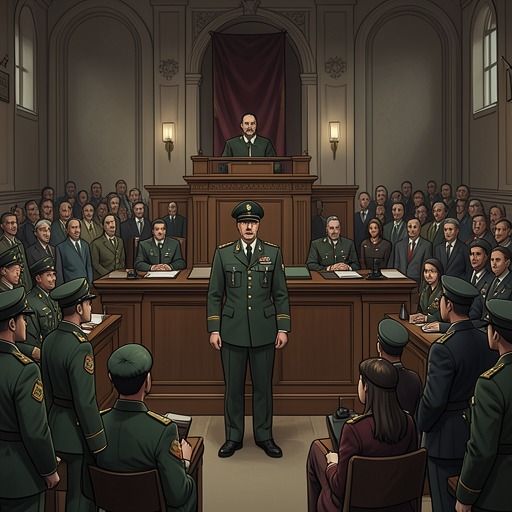
Five minutes later, Georges de Pellieux returned to address the court. He claimed that the army had kept within legal limits and said that the defence had publicly read material from an indictment meant to remain closed. He then introduced what he called absolute proof of Dreyfus’s guilt: a document said to have reached the Ministry of War in November 1896, containing a reference to relations with a Jewish man that must not be acknowledged. Pellieux vouched for the document’s origin and invoked Raoul le Mouton de Boisdeffre in support. Yet he did not produce the document for examination.
Picquart recognized the reference. He understood Pellieux to mean a letter purportedly retrieved from the German Embassy, which Jean-Baptiste Billot had read aloud but had refused to show him. It had appeared shortly before Picquart was removed from Paris. The timing and the earlier refusal made the public appeal to this supposedly indisputable evidence newly consequential: Pellieux had brought it into the trial himself, while still withholding the object on which his claim depended.
The demand for open examination
The announcement changed the courtroom’s mood. People reacted to the claim and discussed what it meant; Picquart, meanwhile, signalled to Labori that the reference was familiar and that the moment should be used. Charles-Arthur Gonse recognized the danger and rose to ask for the floor. Labori spoke first. He argued that once Georges de Pellieux had raised the matter, the debate could not be restricted, and that a document could not count as scientific proof until it had been discussed openly and produced.
Gonse confirmed Pellieux’s testimony and praised his initiative, but resisted its consequence. He maintained that the army was not afraid of truth while also asserting that prudence prevented evidence of this kind from being made public. That contradiction crystallized the dispute: the generals invoked the authority of a document while denying the defence access to the means of testing it. The issue was no longer simply what the document supposedly said, but whether a secret assertion could retain the force of proof when its source and contents were kept from examination.
Picquart names the forgery
When the judge asked Picquart what he wished to add, he addressed the document Pellieux had presented as absolute proof. Picquart stated that the document was a forgery. He explained that he would not have raised it had Pellieux not introduced it, but the claim of certainty had made silence untenable. The brief declaration shifted the argument from a disputed interpretation of secret evidence to a direct challenge to the document’s authenticity.
The courtroom erupted in shouting. Georges de Pellieux answered not by producing the document, but by attacking Picquart’s character, portraying him as an officer who still wore the French uniform while accusing three generals of forgery. The personal attack made the institutional stakes explicit: Picquart’s testimony placed his standing as an officer against the generals’ authority. The evidence supports his allegation that the document was forged; it does not, by itself, establish which individuals created it. His accusation nevertheless forced the claim of absolute proof into public dispute.
Significance and limits of the revelation
The episode’s force lies in the contrast between the language of certainty and the conditions imposed on verification. Pellieux described the document as unassailable while Gonse argued that it could not be made public; Labori insisted that evidence must be open to discussion, and Picquart supplied the decisive counterclaim. In the courtroom, a secret document could no longer operate only as an unseen authority: its status had been explicitly challenged before the people asked to judge the case.
The disclosure also belongs to Picquart’s changing relationship with Dreyfus. His earlier conduct as a teacher had included prejudice and a denial that prejudice affected his grading; now, in a separate public confrontation, he opposed the use of concealed evidence to sustain Dreyfus’s guilt. The evidence does not make the courtroom declaration a complete account of Picquart’s earlier attitudes. It does show a sharp difference between the social assumptions surrounding the accusation and his willingness at this moment to challenge the military claim on evidentiary grounds. The event’s immediate outcome is a public rupture: the asserted proof is named as false, and the generals’ response is to defend their authority while resisting open inspection.