Picquart’s clandestine search of the intelligence archives
An Officer and a SpyGeorges Picquart’s clandestine search of the intelligence archives turns the case against Alfred Dreyfus from an argument over suspicious circumstances into a traceable failure of identification. By following the designation Agent D through a torn note, correspondence, and a neglected report, Picquart discovers that the agent was Jacques Dubois, a printer with no access to classified material. The finding does more than weaken one allegation: it shows how an archival record could preserve a misleading accusation while burying the information that contradicted it.
Background: A Secret File Without Direct Proof
Before breaking into the archives, Picquart has examined the secret file used against Dreyfus. It contains five documents, but its apparent weight dissolves under scrutiny. The compilation attributes the transfer of military plans to Dreyfus through circumstance and insinuation; no document or witness directly identifies him as a traitor. Its nearest approach to an identifying mark is the initial D in a disparaging reference to an agent.
The file’s account also fails to fit the dates. It suggests that Dreyfus could have supplied plans to Germany, yet Picquart knows that Dreyfus joined the First Department only in July 1893, while the account places plans in the German attaché’s hands by June. Picquart doubts, too, that plans of such size could have been removed and returned unnoticed, and notes that no stolen documents had been reported. The gap between the file’s confident accusation and its unsupported mechanics gives him reason to look beyond the file’s own selection of evidence.
The search takes place amid a widening breach of secrecy. Picquart makes a list of those who know about the secret file: senior officers and intelligence staff, the judges, President Fauré and his doctor, and Mathieu Dreyfus, who has learned of it through someone else. The list already reaches twenty before accounting for how many people Mathieu may have told. Picquart recognizes that photography, telegraphy, railways, and the press make an inner circle difficult to maintain. A leak might vindicate his position, he fears, but could instead panic Charles-Arthur Gonse and Raoul le Mouton de Boisdeffre into restricting the investigation further.
The Break-In and the Search
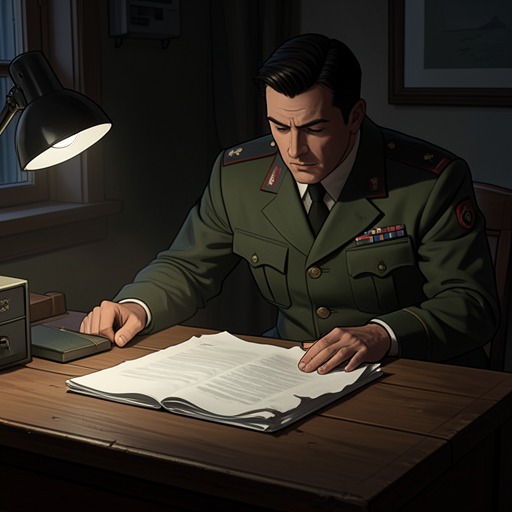
On an evening when the fireworks draw the staff away, Picquart waits in his office rather than turning on a lamp as daylight fades. At half past eight the building seems deserted. He takes a leather roll of lock-picking tools left months earlier by Desvernine and climbs to Felix Gribelin’s archive. The incongruity is central to the scene: the head of the secret intelligence section must break into his own department’s records to pursue a question those records have not answered.
Picquart picks the lock on Gribelin’s door, then opens the lower-left desk drawer where Gribelin keeps his keys. After patient trial and error, he uses them to unlock the filing cabinets. His first priority is every scrap of Agent Auguste material. The cabinet holds glued-together papers that have yellowed with age: letters and telegrams from Hauptmann Dame in Berlin, correspondence involving Maximilian von Schwartzkoppen and Alessandro Panizzardi, and messages connected to military representatives from several countries. Among them are an envelope of cinders dated November 1890 and dozens of intimate letters from Hermance de Weede and Panizzardi. Picquart records where the documents came from, treating their provenance as part of the evidence rather than as background detail.
The fireworks provide a clock for the search. At nine, while explosions shake the old windowpanes, Picquart begins trying the cabinet keys. The display is expected to last half an hour, and he estimates that the crowds at the Trocadéro gardens will need about that long to return. The time pressure sharpens the practical sequence of the search, but the files themselves resist quick interpretation: much of the material is incomplete or seemingly pointless, and Picquart admits that exhaustion and hunger after a day without food may have made him pass over the crucial document at first.
The Clue Chain: Dubois, Not Dreyfus
The decisive item is a short note written in thin black ink on squared white paper, torn into twenty pieces, some missing. Dated 27 October 1894—two weeks after Dreyfus’s arrest—it offers Schwartzkoppen the secret of smokeless powder and is signed by someone named Dubois. A second note, written two days later, offers a Lebel rifle cartridge for analysis. Picquart considers the offer unremarkable: such a cartridge could, he reasons, be obtained in a French garrison town for very little. The important clue is not the material offered but the signatory’s name.
Picquart remembers seeing Dubois in a note from Panizzardi to Schwartzkoppen in 1893. That correspondence directs him to a cross-reference, and it takes several minutes to decipher Gribelin’s filing system and locate the relevant folder. There he finds a report dated April 1894, addressed to Jean Sandherr and written by Hubert-Joseph Henry. The report concerns the possible identity of the agent designated D, who was said to have supplied the Germans and Italians with twelve master plans of Nice.
Henry’s report identifies that agent as Jacques Dubois, a printer working for a factory that handled Ministry of War contracts. Its explanation is specific: while setting a printing machine for a production run, Dubois could make extra copies. The report also says Picquart’s later discovery confirms was crucially absent from the accusation against Dreyfus: Dubois had no access to classified material, and the plans he provided were publicly available. Henry had interviewed him, judged him a fantasist of limited intelligence, and recommended that no further action be taken.
The designation that had helped implicate Dreyfus therefore points elsewhere. Picquart recognizes that Agent D is Dubois, not Dreyfus. The report does not merely introduce a competing suspect; it explains how the plans could have been copied, establishes their public availability, and records that the man associated with them lacked access to secret information. Set against the earlier file’s unanswered questions about dates, access, and the mechanics of copying, the report makes the original inference look not just weak but misdirected.
Concealment and Significance
After finding the report, Picquart notes where each document and folder originated and returns the material to its proper place. He restores the papers, locks the cabinets, wipes down the tables, replaces Gribelin’s keys in the drawer, and works the lock shut again with tired, slippery hands. By the time he turns off the lights it is just after ten. The methodical restoration matters: the discovery is made through an unauthorized search, and Picquart tries to leave no visible sign that the archive has been opened.
The scene makes the archive both the instrument of the accusation and the means by which it can be challenged. The secret file presented Dreyfus through fragments and insinuation; the broader collection contains the cross-references and report that reveal what the accusation left out. Yet the truth is not immediately legible. The papers are physically damaged, partially missing, and arranged according to a system Picquart must learn under time pressure. The answer emerges only when he connects a name across separate documents and follows the record to its source.
The discovery changes the meaning of the initial D. Instead of confirming Dreyfus’s guilt, it exposes the danger of treating a letter, a circumstantial narrative, and a secret dossier as mutually reinforcing proof without checking their provenance. Picquart’s search supplies a concrete alternative account and shows that relevant contrary information already existed inside the intelligence archives. Its force comes from the contrast between what the accusation implied and what the neglected report actually recorded.